Mama’s house

Ethel Hughes stands by the well in front of her house in Esto.
MY GRANDMOTHER LIVED in a little white Jim Walter house just behind the old brick stores on the north side of the railroad tracks in Esto. I loved her, and spent more time when I was growing up at Mama’s house than I did at home. It was a safe and loving place, and there was always something good to eat on her stove.
In 1956 — a year after I was born — Uncle John Hughes arranged for a new house to be built behind the old unpainted wood-frame house that stood in the front yard. My grandmother and grandfather had lived in the old house since 1937 and raised four children there: my mother, known in the family as Doll; Uncle Bill, whose real name was James; Uncle John, who was the most fun; and Uncle Leonard, the baby.
The new house was special for our part of the world because it had indoor plumbing. My grandfather was said to have objected to bringing that sort of business inside the house, since they had a perfectly good outhouse in the back yard.
That story I can’t prove, but I now know the dates for certain. A few days ago an unexpected priority mail box arrived. It contained a handful of photographs, some faded newspaper clippings, and a few old papers that had been saved when they cleaned out Uncle Leonard’s house in Hartford, Alabama, 10 miles north, after he died last year. Among the papers was the application for a tax deed on the property dated August 2, 1937.
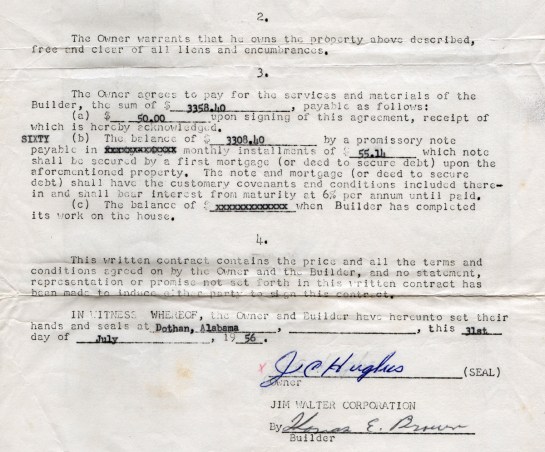
Also in the box was the original contract between my grandfather, James Cullen Hughes, and the Jim Walter Corp. dated July 31, 1956. The house cost a grand total of $3,358.40, with $50 down and monthly payments of $55.14 over the next five years.
It was a simple house with three small bedrooms, a small living room, a kitchen/dining room and the aforementioned bathroom, with tub and toilet. The contract says it was a “Capri” model measuring 24×32, or just 768 square feet, but it was big enough to hold a lot of love.
Many people in our part of the world lived in Jim Walter homes. They could be ordered from a pattern book or from the Sears Roebuck catalog. Jim Walter, a Tampa businessman, had started the company in 1946 after World War II ended and soldiers came home to pursue the American Dream, but needed housing. Thousands of Jim Walter homes were built in the following decades on lots people already owned in rural areas throughout the South. The company finally went bust after the 2008 financial crisis.
That little white house provided shelter for our family for many years — and some of my warmest childhood memories.

 The Esto Herald
Thanks for the story, photo and memories. Really brings Esto to life.