Archive

Agriculture

Red and Micki Balaban on their cattle ranch near Bonifay.

MICKI BALABAN, who helped found the Spanish Trail Playhouse in Chipley in 1962 while raising her family on a cattle ranch outside of Bonifay, died on May 4 near her longtime home in Connecticut. She was 94.

She and her husband Leonard, also known as Red, came to Bonifay in 1952 and bought an 800-acre farm northeast of town on the Poplar Springs Road. They and their children, Mike, Steve and Rachel, became a vital part of the community before moving back north in 1967.

They remained in touch with friends here long after they left. Their farm, which they called Lookout Plantation, was later divided into smaller parcels, but is still known by many as the old Balaban place.

News of her death posted online by her children brought an outpouring of happy memories and comments from around the country, and from Bonifay.

“She was a special lady,” Martha Cullifer Howell commented. “She left her mark on us here in Bonifay.”

“As a child, I would be with my mother when your mother and my mother would visit in the stores in Bonifay,” wrote Amalia Quattlebaum. “Your mother was like a breath of fresh air when she entered a room.”

Wrote retired educator Sheri Curry Brooks: “When we were growing up, I thought she was such a beautiful, exotic lady. I remember her teaching us tap dancing one summer. She was such a fun lady as well as beautiful.”

Her son Mike told more of her story:

“Micki Israel Balaban was an only child born in Providence, RI, in 1929, during the Depression. Her family life was a bit suffocating, so she couldn’t wait to become an adult and get away. Marrying my dad accomplished that.

“She was smart and talented. She wrote her high school senior play, starred in all her college theatrical productions at Pembroke College, Brown University’s women’s school, and, as a senior, was offered a Marshall scholarship to study acting at the Young Vic Theater in London. She turned it down.”

Instead, she married Lennie Balaban. They met as students at Brown, in Rhode Island, and later moved to Gainesville, where he studied animal husbandry at the University of Florida extension. He had decided to become a cattle rancher, escaping the expectations of his own family — especially his movie mogul father, Barney Balaban, president of Paramount Pictures. His ranch in Holmes County became renowned for its 300 head of purebred American Angus cattle.

Micki Balaban helped found the Spanish Trail Playhouse and directed and starred in many of its productions before she and her family returned to New England in 1967. The playhouse closed in 1968, but was resurrected in 2006 and continues today.

Micki went on to establish another theater company in Connecticut and became a skilled high school counselor.

Red became a well-known jazz musician, playing the Dixieland jazz he had taught himself on the farm in Bonifay. He led a rotating all-star group at Eddie Condon’s jazz club in Midtown Manhattan, which he owned and operated for a decade.

“She was a force,” Rachel Balaban wrote in announcing her mother’s death. “She touched people in profound ways and made them feel seen and heard.”

A celebration of life service will be held in Connecticut in August.

EARLIER: Our own ‘Green Acres’

The Balabans owned a cattle ranch outside Bonifay they called Lookout Plantation.

ESTO HAD NO Jews or Catholics when I was growing up, and nearly no Yankees or Republicans. The same was true for most of Holmes County. But there was one Jewish family, the Balabans, who owned a farm outside the county seat of Bonifay.

Steve Balaban was in our class from first through sixth grade, when his family moved north. He had an older brother, Mike, and a younger sister, Rachel.

I always wondered how they ended up in Bonifay — even more so after reading last fall about their Aunt Judy Balaban’s death in the Hollywood Reporter. During her glamorous long life she dated actors Montgomery Clift and Merv Griffin, married Tony Franciosa and was a bridesmaid at Grace Kelly’s wedding to Prince Rainier of Monaco. Her father, Barney Balaban, was president of Paramount Pictures from 1936 to 1964. Her brother Red Balaban was a noted jazz musician. The actor Bob Balaban is her first cousin.

I wanted to know more. Fortunately, Steve and I reconnected last year while we were planning our 50th high school reunion. It seemed a little strange that someone who’d left long before we graduated would be interested in the reunion. But it soon became clear that Steve had fond and formative memories from his early years in the county, and so did the rest of his family.

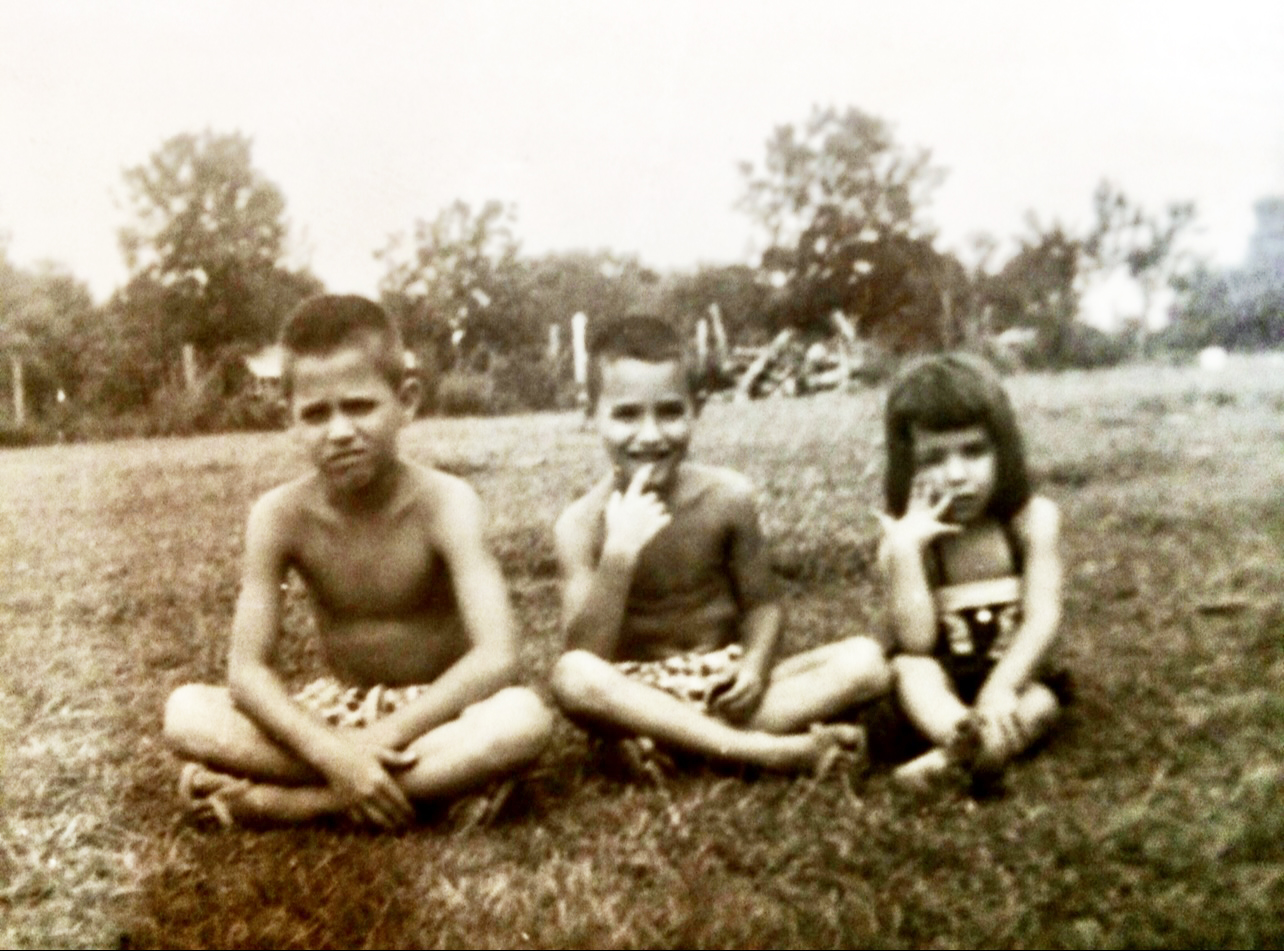
Mike, Steve and Rachel Balaban growing up on the farm.
Read More
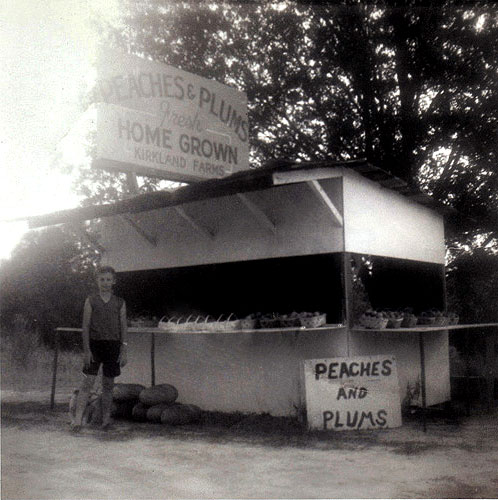
Working at the Kirkland Farms roadside stand, just south of the Florida-Alabama line, in the 1960s.

ESTO WENT PEACH CRAZY for a few years in the 1960s and early ’70s. U.T. Kirkland led the move, encouraged by his brother Carson Ray, who lived in Georgia. Several other farmers got peach fever, too, and Esto became known for its peaches.

One of T’s peach patches was in front of our house, just across a two-rut sandy lane. On the other side it faced the main highway that ran through town. Across Highway 79 he built a little wooden fruit stand with fold-down sides for selling peaches and plums from Kirkland Farms. He gave me my first job running it when I was 8. I wasn’t much of a field hand, but I could make change.

The peaches were good, but in my memory the plums were even better. There was a row of plum trees right outside our front door, along the edge of the peach patch. In early June, as school was ending for the summer, those plums came to full purple ripeness. They were the most delicious thing I’d ever tasted, and not only because they belonged to T and not to me. Years later, I asked T’s son Doyle if he remembered that row of plums and if he knew what kind they were. They were Methleys, he said. For years after I moved to California, I kept asking at farmers markets — overflowing with peaches and plums in the summer — whether they grew Methleys. There were many varieties in the bounty of fruits and nuts and flakes that California produces, but nobody grew Methleys.

My neighbor Diana Arsham heard my rhapsodic memories about Methley plums, and set out to do something about it. Here’s her story.

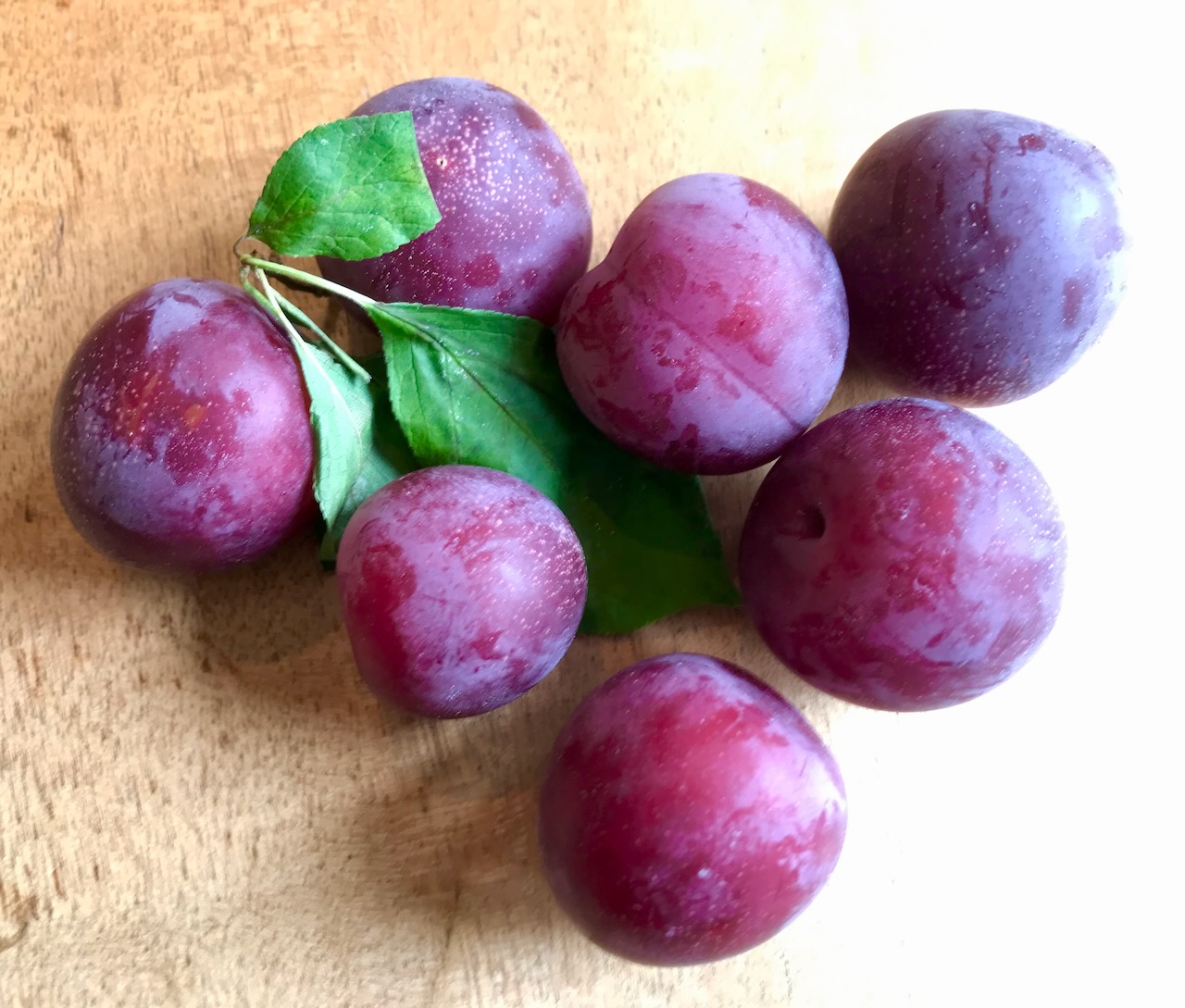
Methley plums from Diana Arsham’s California garden.

A plum like no other

By DIANA ARSHAM

IT all started in the winter of 2010 with a conversation about childhood memories. Mine: While alone in the garden of my great aunties’ midwestern farm, I walked into a vibrant pink flowering peony bush just my 5-year-old height. Likely I had been drawn to Its iridescent glow in the warmth of the mid-afternoon sun — and of course by the intoxicating scent of its fully flowering ripeness.  

My friend Thomas shared his memory of walking out his front door across a small town road lined with Methley plum trees — “a plum like no other,” or at least that’s how he had so fondly remembered the Methley. He recounted how, after moving to California, he had searched for the plum locally in the Bay Area, hoping to relive his early childhood experience. Still longing for the plum like no other, he learned that the local growers had not heard of the plum, let alone grown it. 

The conversation piqued my interest as an ardent urban farmer cutting back 10-foot camellia bushes in my backyard for new plantings of fruit trees. I knew I wanted to plant plums — a favorite of my husband Gary’s — having struck out on figs, a favorite of my own.

Plums are popular in San Francisco, particularly the Santa Rosa. I was determined also to grow the Green Gage plum, which I favored. And I had recently been told about the local prize of them all, the Beauty, a Japanese plum more red than the usual purple European variety. They all needed about 200 chill hours to bloom and bear fruit. In our mild San Francisco winters, that’s about the maximum chill time. Other fruits need 800 to 1000 chill hours, so we are talking about a special breed. 

By January 2011, Thomas, via the miracle of the Internet, had located a source for the Methley. And as luck would have it, it did have a chill hour requirement of 200 hours. Thomas delivered the Methley to our front porch. Bare root, dry and somewhat bedraggled, it had been on a long trip and needed rest and intensive care. As I prepared a soothing compost-enhanced soak for the evening, I told it we were both on the line.

I planted the Methley in the ground next to a stand of five-foot Shasta daisies (named for Mt. Shasta and hybridized by Luther Burbank), where it got the early sun in the first part of spring. The Methley bloomed its first spring and I dutifully removed all of its blossoms, encouraging it to continue strengthening its root system, branches and trunk. 

This year, although initially full of blossoms due to a very late series of rain showers, the Methley set six plums, though only five ripened and turned red.  

“Not the right color,” Thomas declared. “It’s not ripe.” Or maybe not the right species, or maybe an inadequate growing environment, I thought. Full of performance anxiety, I also wondered how I was going to keep the plums safe for the next couple of weeks to fully ripen. By now the rains had ended and I had headed off droves of insects by applying Safer soap. But could the Shasta daisies send out a strong competing scent to confuse predators in the form of birds, raccoons and rats? Just to play it safe, I squirted Critter Ridder on the Japanese boxwood at the north end of the bed. And said a prayer. 

By the first week of July, while continuing to read up on the care and feeding habits of the Methley, I decided to harvest the plums. Early one morning I sat straight up in bed, knowing it was time. Sure enough, flower pots on the fence so very close to the plum trees had been knocked over by invaders in the night. 

Yes, they were a dark purple! Gary and I tasted one. It was very different — dense, with a grape-like texture, jammy almost. It was delicious, but was it too ripe? How are they supposed to taste?

Later that day, I stopped by Thomas’s gallery to give him a tiny half of the harvest. I was ready to tell him my list of triumphs in getting the Methley to harvest, yet prepared to have him find it not as good as his childhood memory. How could it be? Before I could finish the story of my trials and successes, his 8-year-old hand dove into the basket. A second after he popped the first Methley into his mouth, he fairly yelped: “That’s it — the plum like no other!”

U.T. Kirkland in his peach orchard on Highway 79 in Esto.

By E.W. CARSWELL

ESTO has no Peachtree Street, but it came close for a few years in the 1960s and ’70s. Commercial peach orchards sprang up in the surrounding area after horticultural scientists at the Florida agricultural experiment stations developed peach varieties that appeared to be adaptable to the North Florida climate.

To be successful, however, a marketing facility was needed. That need led to the construction — with the help of a U.S. Farmers Home Administration loan — of the Esto Fruit and Vegetable Market. The facility was equipped with warehousing, refrigeration, grading, weighing and packaging equipment. Marketed and shipped from the facility, besides peaches, were watermelons, tomatoes, peas, beans, cucumbers, squash, collards, okra and a few plums.

Almost from the beginning, however, growers were unable to find adequate seasonal labor for producing and harvesting the crops, particularly peaches, which required cultivation, fertilizing, the application of insecticides and pesticides, and hand pruning, as well as harvesting.

Major growers included John W. Clark, Frank Thweatt, Doyle and U.T. Kirkland, Jesse Mills and Willis Hardy.

Fire destroyed the Esto market after a few years, and growers reduced their production level to that required to meet regional needs. Fortunately for those who continued, Northwest Florida and South Alabama communities continued to gain population, thus creating added demand for regionally produced fruit and vegetables. Esto area growers had proved that quality production could be achieved locally, if undertaken on a scale sufficient to attract needed labor.

And the Esto peach continued to find a favored place in regional produce shelves.