LOVERS OF local history will find new books of interest — including a history of Esto — at the Holmes County Public Library in Bonifay.
Recent donations from a local collection honor Joe Bob Clark, an Esto native who was the moving force behind the creation of the modern library. Its building in central Bonifay is dedicated in his honor.
Now available at the library:
• In “Esto: This Is the Place,” published in 1993, E.W. Carswell captures the people and events that shaped the town of Esto — including its most famous resident, the legendary alligator known as Two-Toed Tom.
• “Heart and History of Holmes County,” by Anna Paget Wells. The second edition is a revised and reformatted version of the book, first published in 1982, with updates and corrections by Dan W. Padgett.
• “Holmes Valley,” by Esto native E.W. Carswell, first published in 1969. This revised and updated edition from 1983 tells the story of the great influence Moss Hill United Methodist Church had on the development of this region of the Florida Panhandle.
• “I Declare!” by Malcolm B. Johnson. This collection of columns from the longtime editor of the Tallahassee Democrat opens a window onto the political scene in Florida’s capital during the middle half of the 20th century. Johnson’s closely observed commentaries were published in newspapers around the state, including the Holmes County Advertiser.
Also available at the library: “Holmesteading,” E.W. Carswell’s definitive history of Holmes County, published in 1986. Thanks to an effort spearheaded by Joe Clark, the book was republished in 2003 and the second edition is available for purchase at the library for $40. All proceeds benefit the library.
The Holmes County Public Library is located at 303 North J. Harvey Etheridge Street in Bonifay and open from Monday through Friday.
He was known as Joe Bob Clark when he was growing up in Esto.
HE WAS JERRY PELHAM when he was growing up on his family’s farm just south of Esto. But he became well known and highly respected — and made a major contribution to Florida politics and policy — as Thomas G. Pelham, the Tallahassee lawyer and land use specialist who served two different terms, under two different governors, as secretary of the state’s Department of Community Affairs.
In his recent memoir, Kids Don’t Have Backs, he tells the story of his early years on the old Blackburn place — his grandparents’ farm, later taken over and expanded by his parents, Roy and Louise Blackburn Pelham.
“The farm was located on Florida Highway 79 in a rural area known as the Holland Cross Roads farming community, just two miles south of the Alabama-Florida state line,” he writes, adding that when his grandparents moved to Holmes County from Georgia in 1918: “The county was sparsely populated and living conditions were primitive. There was no electricity, and therefore no electric lights, indoor plumbing, running water, sanitary facilities or air conditioning. Tractors and other modern farm equipment were not generally available or affordable, so farming was mostly conducted with mules and hard manual labor.”
That hadn’t changed much by the time Pelham was born in 1943, the first of four boys driven by their father, and necessity, to work the land. Eventually electricity and tractors would come, along with a new house and barn across the highway, plus a younger sister.
“The farm was a year-round, labor intensive, physically demanding enterprise,” he writes, “that over time involved the efforts of our entire family, including the children, who frequently worked like adults.”
•
Pelham paints a picture of unrelenting, backbreaking work: milking cows, feeding hogs, chopping and picking cotton, pulling corn, stacking peanuts, building and rebuilding fences. It’s a life that will be familiar to nearly everybody who grew up in Holmes County.
“Hard work never hurt anybody,” was his father’s frequent refrain.
The title comes from a memory of a hot summer day in the cotton patch when he stretched his aching back and then dropped to his knees and started crawling.
“Hey, boy, get off your knees and get to pickin’ cotton,” his daddy commanded. “But my back hurts,” he replied as he slowly got to his feet. “Kids don’t have backs,” his daddy declared.
Neither did every farmboy have a grandmother down the road who subscribed by mail to the Atlanta Journal-Constitution, which she passed along to her grandson. The Atlanta papers were especially strong in their coverage of school integration in the wake of the Brown v. Board of Education ruling in 1954, stirring Pelham’s awakening awareness of the U.S. Supreme Court and the rule of law. His learning was helped along by some memorable teachers at Holmes County High School — still segregated at the time — especially Miss Lynelle Vanlandingham, who taught ninth grade civics.
He writes: “Miss Vann’s discussions of the structure and functions of American national and state governments, the roles of the three branches of government, and our democratic values, sparked my lifelong interest in government and politics. A legendary disciplinarian, Miss Vann could silence a rowdy class simply by pointing her finger and arching an eyebrow.”
Not all of the enlightenment took place in the classroom.
The school bus — bright yellow with big black letters, just like today — picked up all of the students who lived on Highway 79 between Esto to the north of our farm and Bonifay to the south. But it also made two long loops over unpaved red clay side roads to pick up students who lived off the main highway.
Riding the school bus was an education in itself. Filled with 30 or more boys and girls ranging from first graders to high school seniors, the bus contained a combustible mix of high energy, youthful exuberance and raging hormones. Boys harassing girls and girls flirting with boys, big boys picking on little boys, profanity and sexual innuendo, spit balls and flying paper airplanes, some of them aimed at the bus driver. On a few occasions the playfulness turned ugly and fights broke out.
Pelham quickly learned to love school. “Over the years,” he writes, “it became easier and easier for me to get ready to catch the school bus every morning.”
By the time he was a senior in 1961, Pelham was president of the student council and valedictorian of his graduating class. He helped organize and raise funds for an eye-opening senior class train trip to Washington, D.C., and New York City.
“Our trip gave me a lot to think about on the train ride home,” he writes. “Seeing the exciting world that lay beyond the narrow boundaries of my life on the farm strengthened my desire to go to college. That still seemed to be an impossible dream, but I was determined to find a way to get there.”
He came home to the farm and announced his intentions. His mother, who had also been the valedictorian of her class at Holmes County High, was supportive. But not his father, at least not at first. “Who is going to help me gather these crops and take care of the farm animals and all of the work around here?” he asked.
•
By then Roy Pelham’s oldest son had a back and a backbone. He found a way to make it happen, getting degrees from Chipola Junior College, Florida State University and Duke University, and later law degrees from Florida State and Harvard Law School. When he died on February 21, 2023, after a long battle with Parkinson’s Disease — during which he wrote his memoir — he was eulogized by the state’s foremost political writer, Lucy Morgan, as a legal lion. She wrote: “No single person in our history did more to protect Florida’s fragile environment and manage growth.”
We had a late lunch at an automat. Prior to our trip, I had never heard of an automat and, in fact, our school cafeteria was as close as I had ever gotten to a restaurant or cafeteria. In an automat, I quickly learned, each food dish is placed in a compartment behind a hinged glass window. To select a food item, the diner inserts the required coins, then lifts the glass window to remove the food and place it on a tray.
While some of my classmates discussed the merits of automats, we became aware that a black man had entered the room. Tall, trim and Sidney Poitier handsome in his U.S. military uniform, with stripes and medals on his chest, the man sat down with his food tray at a table across the room. There was a sharp intake of breath by some of my classmates. We were not accustomed to seeing black people in restaurants and other public facilities, which were still segregated in the South in 1961.
“Is he allowed in here? He wouldn’t be back home,” one of our classmates whispered.
“Maybe we should leave,” someone said in a louder voice.
Then we all froze. The military officer rose from his seat and walked over to our tables.
“Welcome to New York City,” he said in a warm, friendly voice, with a big smile. “Where are you from?”
“Florida. We are on our senior class trip,” someone managed to say.
“What a great experience for you. Is this your first time in the city?”
“Yes,” several classmates responded.
“Well, you will find that New York is a great city. I hope you have a wonderful time,” he said. Then he gave a little half salute, turned and went back to his table, leaving us in stunned silence.
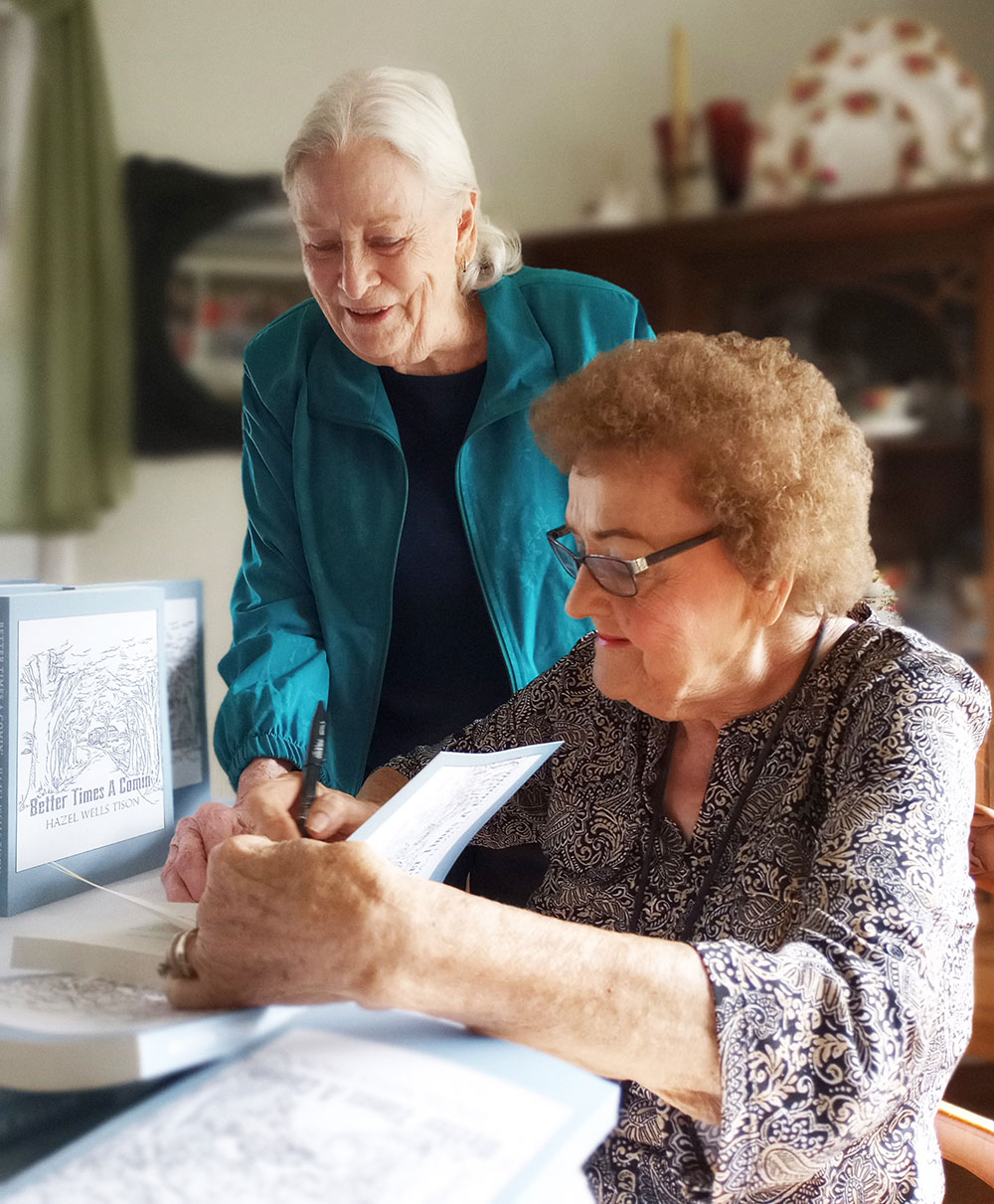
Hazel Tison (right) signs a copy of her new book as publisher Sue Cronkite looks on. Photos by Mary Ivey.
BETTER TIMES ARE ALREADY HERE, it turns out.
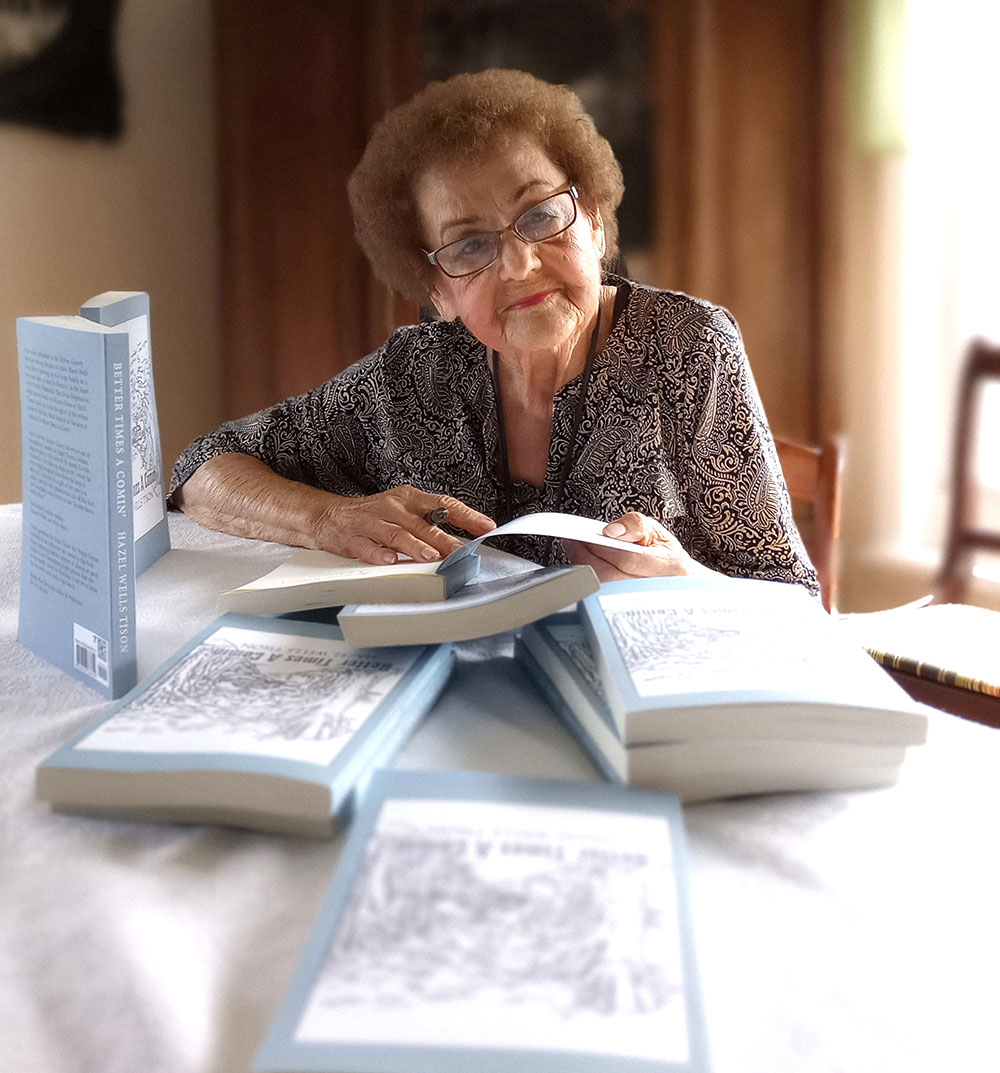
This week Hazel Wells Tison, 91, is celebrating the release of her first book, Better Times a Comin’. It’s a collection of her weekly columns in the Holmes County Advertiser about growing up during the Depression in a big family on a two-mule farm on Bonifay Route 1. She published it with the guidance of Sue Riddle Cronkite, 89, an author-publisher from the New Hope community in northwest Holmes County.
“We laugh about it,” chuckles Mrs. Tison. “Two 90-year-olds publishing a book!”
Then she adds: “Maybe it says something good about getting old.”
That ability always to look on the sunny side is the essence of Mrs. Tison’s columns, which she called the Happy Corner, after her nickname, Happy Hazel.
“Looking back on those early days and the little we had in material things, yet we did not feel deprived,” she writes in one story about going to a 50-year reunion at Bethlehem School. “We had our health, our friends and our hopes and dreams for the future.”
In another, titled “I Don’t Know How My Mama Did It,” she recalls the big midday meals her mother cooked on a wood stove “for a houseful of young’uns, field hands and wayfarers,” who were always welcome. The table was crowded with bowls of fresh field peas, corn gathered that morning, fried and boiled okra and sliced tomatoes and cucumbers, always with cornbread and sometimes a peach cobbler or a dish pan full of banana pudding.
But not at night. “At supper, we often could have used the blessing said by Annie Lou Cook: Thank the Lord for the peas and what little bread we’ve got.”
•
Mrs. Tison began writing the column in 2004 after she had retired as an English teacher at Bonifay Middle School. In addition to her many church and community activities, she’d gotten involved in a project to gather stories about Holmes County and its families, which was published in 2006 as The Heritage of Holmes County, Florida.
Word got around.
“Then the lady at the Advertiser called me up and wanted to know if I would consider writing a weekly column,” Mrs. Tison recalls. “I didn’t tell her yea nor nay, but as I began to think about it, I thought I would try a few stories.”
She took them in to the editor.
“She just jumped up and down and said ‘This is exactly what I had in mind,’ ” Mrs. Tison remembers.
She was off and running, and the Happy Corner was a regular feature in the Advertiser every week for most of the next two decades. For a few years the column was nearly the only thing local in the local paper as the Advertiser was handed off among various newspaper chains and run mostly from afar. Now that it’s more local again, Mrs. Tison has cut back and writes only when something moves her.
A recent two-parter was titled “All I Needed to Know I Learned from Uncle Josh and Others.” It included the all-purpose advice her brother Clyde — later Circuit Judge Clyde B. Wells — offered when he was teaching her to drive: “Don’t ever go backward when you can go forward.”
All in all, she’s written nearly a thousand columns telling the stories of local people and places. She steadfastly avoids politics and controversy. Recollections and homespun humor are more her style.
Columnist and now author Hazel Tison has been a favorite of readers in Esto and throughout Holmes County.
“Hardly anyone uses cloth diapers today,” she writes at the end of a column on washing clothes in cold weather. She speculates that absorbent throw-away diapers may be delaying potty training, leaving “toddlers wearing diapers well into their second and even third year, when they should be wearing big girl or big boy panties.”
She writes: “I have a personal philosophy that disposable diapers are largely responsible for disobedient children because parents allow toddlers to wear them longer and are denied the access to appropriately swat their hineys, which is too well padded to do any good.”
But here too she finds a silver lining: “There are times when going back to a simpler way of life looks attractive, but when it gets cold, I am thankful for a warm house with central heat, indoor plumbing and modern laundry equipment.”
Many of her stories feature her family. In one about her Aunt Annie — Anna Paget Wells, who wrote the earlier Heart and History of Holmes County — she acknowledges, “My husband has commented that he is sure people are tired of hearing about the Wells family.” But it’s Easter week, she notes, and she’s busy with church work, so she’s once again telling family stories that require no research.
One of the best is about “poor old Uncle George.” If somebody got angry, her family might say they’re “as mad as George Cook.” So she asked her grandmother how mad Uncle George was.
“The story goes, according to my Grandma Wells, that Uncle George was in the turpentine woods one day and he met up face to face with a bear. When he returned home he quickly took a bath and was looking for clean clothes. When Grandma Cook asked him what happened, he replied that he had encountered a bear, and that when he saw him it made him so mad that clean underwear was required.”
•
The collaboration between author and publisher that produced Better Times a Comin’ began a few years ago when Sue Cronkite stopped by Hazel Tison’s home and blueberry farm north of Bonifay to drop off a copy of a new novel she’d written that told a local story, thinking it might be something Mrs. Tison would want to write about in her column.
By the time she left, the two felt like old friends. And the idea had been planted for another book: a collection of Mrs. Tison’s columns.
“I sort of had to talk her into it,” Mrs. Cronkite says.
“It was a chore,” Mrs. Tison says of choosing which columns to include and getting them ready for publication. But now that she’s holding the book in her hands and her friends and neighbors are clamoring for a copy, she’s proud she did it, with guidance from Mrs. Cronkite and assistance from her daughter Cindy Tison Webb and helper Mary Ivey.
“Since this one is done, and I see that it’s possible, there may be another one,” she says.
Barely a year after the Holmes County native and pioneering newspaper editor published her first novel, Louette’s Wake, she’s finished and recently published her second. This one is called White Sheets, and it tells of the time a gaggle of long-haired hippies set up camp near her home in the New Hope community, in Holmes County’s northwest corner, and promptly attracted the attention of the Ku Klux Klan.
While it’s a work of fiction, Cronkite says the book is based on actual events she remembers from the late ’60s. “The setting is a real place,” she says. “The names, characters and specific incidents are products of the author’s imagination.”
But you’ll recognize these people.
Rose and Josh run the Daylight Grocery, which sounds as if it could be Hamp Berry’s or one of the other crossroads stores on Highway 2. Their kids, Pidge and Luke, ride the school bus to what sounds a lot like Bethlehem School. Neighbors come and go, stopping to fish a cold drink out of the ice box or gas up their pickup trucks. Even Two Toe Tom, Esto’s legendary alligator, puts in an appearance.
What doesn’t sound quite real is the neighborliness many of the locals show the band of hippies camping in a pasture near the Choctawhatchee River, after they take a wrong turn on their way to protest the Vietnam war. My recollection, from growing up during that era a few miles away in Esto, is that none of our neighbors had any sympathy for long-haired hippies or war protesters. And marijuana, if we’d heard of it at all, wasn’t laughed away as harmless, unlike Camels and Marlboros and Lucky Strikes.
But Sue Cronkite tells a kinder and gentler story. Some of her characters shout: “Hippies, hippies, sitting on the fence, Couldn’t tell a dollar from fifteen cents.” Her locals take in and take care of one of the barefoot hippies who’s about to have a baby, and resist their harder-hearted neighbors who side with the Klan.
It’s a fun read, intensely local, and it captures the best — and some of the worst — of our neighbors. Not many books come out of New Hope, or elsewhere in Holmes County, so that alone makes it worth the price ($14.95).
And there are more of her books to come.
“Two down and 10 to go,” Cronkite said recently. “I hope to publish at least two a year.” That will get her into her 90s, but she shows no signs of slowing down. As the new year began, she was busy clearing land to build a new home at Lake Victor, near her family’s old home place in New Hope.
But she’ll take a minute to send you a copy if you email cronkitesue@gmail.com or call (850) 653-6965. Or you can order a paperback or Kindle edition on Amazon.
Holmes County’s own Sue Riddle Cronkite and her new novel.
“There’s a sweet, sweet spirit in this place.”
SUE RIDDLE CRONKITE begins each chapter of her new novel, Louette’s Wake, with a few lines from one of the old gospel hymns popular in our part of the world. She didn’t include this one, but it’s evident nevertheless on nearly every page of her story.
Sue grew up in New Hope, another little Holmes County community just a few miles down the Hog and Hominy Highway from Esto, on the other side of the river. She’s part of the storied Riddle clan. And even though she went on to become one of the pioneering newspaperwomen of her generation — with a decade as a reporter and editor at the Birmingham News, among other stops — she’s never gotten far from home.
Sue came back to the area in the mid-1980s to become the founding editor of a new daily newspaper in Dothan, Alabama, called Wiregrass Today. That’s when I met her, introduced by our mutual friend E.W. Carswell, another notable newspaper reporter who became the historian of our stretch of the Florida Panhandle during his long career as a staff writer and columnist for the Pensacola News-Journal.
Sue turned me down for a job on her new paper. The publisher didn’t want some college boy who thought he knew it all about exactly the kind of newspaper our area needed. Sue said there was no place for me, which left me with no excuse not to take the opportunity I’d been offered to become editor and publisher of a magazine for lawyers in California.
Instead of a job on an upstart Alabama newspaper that folded after its first year, I got a lifelong friend. She and I have kept in touch across the years and miles and had an occasional visit. So it was a treat to hear a few weeks ago that she’d published the novel that had been rolling around in her mind for many years. I ordered my copy from Downtown Books and Purl in Apalachicola, where Sue now lives, and read it on a recent trip back home to the Florida Panhandle.
In short: It’s terrific. The book lives up to its billing as “an uplifting southern tale,” one that takes place in New Hope and across the state line in Geneva, Alabama. It’s a gentle story that centers on Louise Ella Kelly’s decision to throw herself a wake while she’s still alive. Even more impressive than the story is the writing, which manages in its simple words to capture the particular idioms and cadence of the way we talk — without the false dialect and ignorance and ain’ts and y’alls usually larded into books with a southern accent.
You’ll know these people, and their ruminations, and the honest country food they eat. For those who don’t — Yankees, maybe — she includes recipes at the end for chicken and dumplings, collard greens and chocolate fudge cake, among others. “Buy a big bunch of collard greens off the back of Lige’s pick-up truck, if he comes around,” that one begins.
On my recent trip home, after a couple of dozen of Apalachicola’s finest oysters, I stopped to visit Sue and collect her autograph on a few more copies of her novel I’d picked up at Downtown Books. I found her nearly finished with her next novel, this one involving Esto’s own Two Toe Tom, the legendary alligator that spawned an annual festival in my home town.
“I don’t have any aches and pains,” Sue told me, although the accumulation of years would give her every right. It’s a good thing, since she may have to live forever to finish all the stories she’s started to tell.
My advice: Call Downtown Books and Purl in Apalachicola at 850-653-1290 and ask them to send you a copy of Louette’s Wake. They have yarn, too, if you need any. You could order Sue’s book on Amazon, but it won’t be as good. I promise you’ll love it.
AN EMAIL ARRIVED offering a treasure. “If you did not get a copy of the Two Toe Tom Cookbook, prepared in the early days of that famous celebration, I will tell you that we have located one and it is a classic.”
The message was from Perry Wells, the longtime county judge in neighboring Washington County. Judge Wells, now 90, has led a long and distinguished life and has many outstanding qualities to recommend him — none more important than his wife, Hester Lee Lucas Wells, who he referred to as “my Esto girl,” since she grew up near Ten Mile Creek and went to the Esto School. I looked up to her father, Herbert Lucas — a true gentleman — when we both worked at Bunk Johnson’s gas station down at Holland Crossroads. Perhaps because of that, I have always felt a little bit kin to Perry and Hester.
Of the cookbook, he wrote that it has “many contributions of some of Esto’s finest ladies’ noted cooking skills.” It was one of many local cookbooks Hester had collected. Since her death last year, Perry has gradually been letting go of some of her treasures, including her cookbook collection. The Two Toe Tom cookbook, he said, “is yet unspoken for.”
I couldn’t get a crisp new $20 bill — the asking price — in the mail fast enough to his address on Judge Perry Wells Highway in Chipley. In due time, a package arrived. Inside was a pristine copy of the cookbook, published as part of the festivities surrounding the very first Two Toed Tom Festival back in 1987, along with a note from Perry:
“I will not deface the cookbook with an autograph, thus keeping it in its purest form,” he wrote. “I know you will find much interesting reading — and the names of so many contributors make it even more special. Hester would be proud to know the book is in your hands. She always spoke kindly of Cottontop Reynolds as the husband of your mother and the father of the son she described as “everybody’s baby in Esto.”
The cookbook was, as Perry promised, a treasure. There was Lynette Crutchfield’s recipe for Squash Relish, her daughter Brenda Sasser’s recipe for Shortnin’ Bread, and her sister Martha Sue Register’s recipe for Cabbage Soup. There was Mrs. Walter (Gladys) Dixon’s recipe for Tater Gravy, and Charlene Godwin’s recipes for Chuck Roast — “so easy,” it said — and Sweet Potato Casserole, Peach Pie and Buttermilk Pie.
It was like calling the roll of the ladies in Esto. I’d eaten at many of their tables, and had nearly everyone’s cooking at a dinner on the grounds at the Baptist church or some other community event.
I doubt Sue Worthy Champion ever actually cooked Gator Tail ‘n Taters. “Boil gator tail in large pot with black pepper, salt and red pepper until tender,” the recipe said. But it seemed appropriate in a cookbook dedicated to a legendary alligator said to live in Old Sand Hammock.
By far the biggest section was Cakes, Cookies & Desserts. Esto ladies baked great cakes. There was Louise McGowan’s recipe for Peanut Cake, her niece Dorothy Nell Miller’s recipe for Chocolate Pound Cake and Mary Nell Joiner’s recipes for Lemon Cheese Cake, Moist Coconut Cake and Lane Cake, a special holiday favorite. Mary Nell had a business baking cakes for other people for quite a few years, although Annie Laura Kidd always sniffed, “She uses cake mix,” a cardinal sin. Sure enough, her recipe for Caramel Peanut Butter Cake noted: “You may use a yellow cake mix.”
And then, on page 113, I ran into a surprise: my mother’s Chocolate Cake. Mother had died earlier that year, before the cookbook project began. But she was a great cook, and she was known for her 12-layer chocolate cake. Somebody must have decided it should be included. I’ll never make it, but I’m glad it’s in the book.
That $20 I sent Judge Perry Wells was some of the best money I’ve ever spent.




 The Esto Herald