State Road 2 — one of the key roadways into Esto — was the product of a political promise. The promise was made in 1936 by gubernatorial candidate Fred P. Cone to E.A. Williams Sr., then editor and publisher of the Holmes County Advertiser.
E.A. Williams Jr., a youthful apprentice printer then in the employ of his father, in 1990 recalled hearing Cone make the promise. “I was busy setting type nearby when Cone came to the Advertiser office to seek my father’s support,” said the junior Williams, who within a few years was to become Bonifay’s postmaster.
He said his father didn’t specifically make building a bridge over the Choctawhatchee River the price of his support, but extracted the promise in response to his request that Cone help unify the county. His father explained that the county had historically had been divided by the river. The only bridge then spanning the river was in the Caryville-Westville area. The river was crossed elsewhere on ferries.
The senior Williams told Cone that the absence of bridges forced citizens on opposite sides of the river to travel many miles over dirt roads to reach the opposite side of the county. Cone, without hesitation, promised the bridge would be built. And it was.
State Road 2, which is routed to roughly parallel the Alabama-Florida line across West Florida, was completed just before World War II through Jackson and Holmes counties. It then provided east-west access to Graceville, Campbellton and Malone in Jackson County; to Noma, Esto, Pittman and New Hope in Holmes County; and to Darlington beyond in Walton County. The road was popularly known as the “Hog and Hominy Route” because it traversed an agricultural region known for its production of corn and hogs, as well as cotton, peanuts and watermelons.
In Holmes County, State Road 2 was routed along the course of an earlier dirt-surfaced “hard road” built in about 1920 to accommodate the growing demands of automobile owners. That road had bypassed Noma by a half mile, and downtown Esto by about three-fourths of a mile, prompting predictions that the respective communities would gradually grow or move southward to meet State Road 2.
Esto, in the meantime, has grown southward along State Road 79. Several businesses have grown up near the intersection of Highways 2 and 79, known as Holland Crossroads. Town officials, foreseeing the course of growth, extended the town’s corporate limits nearly all the way down to the crossroads.
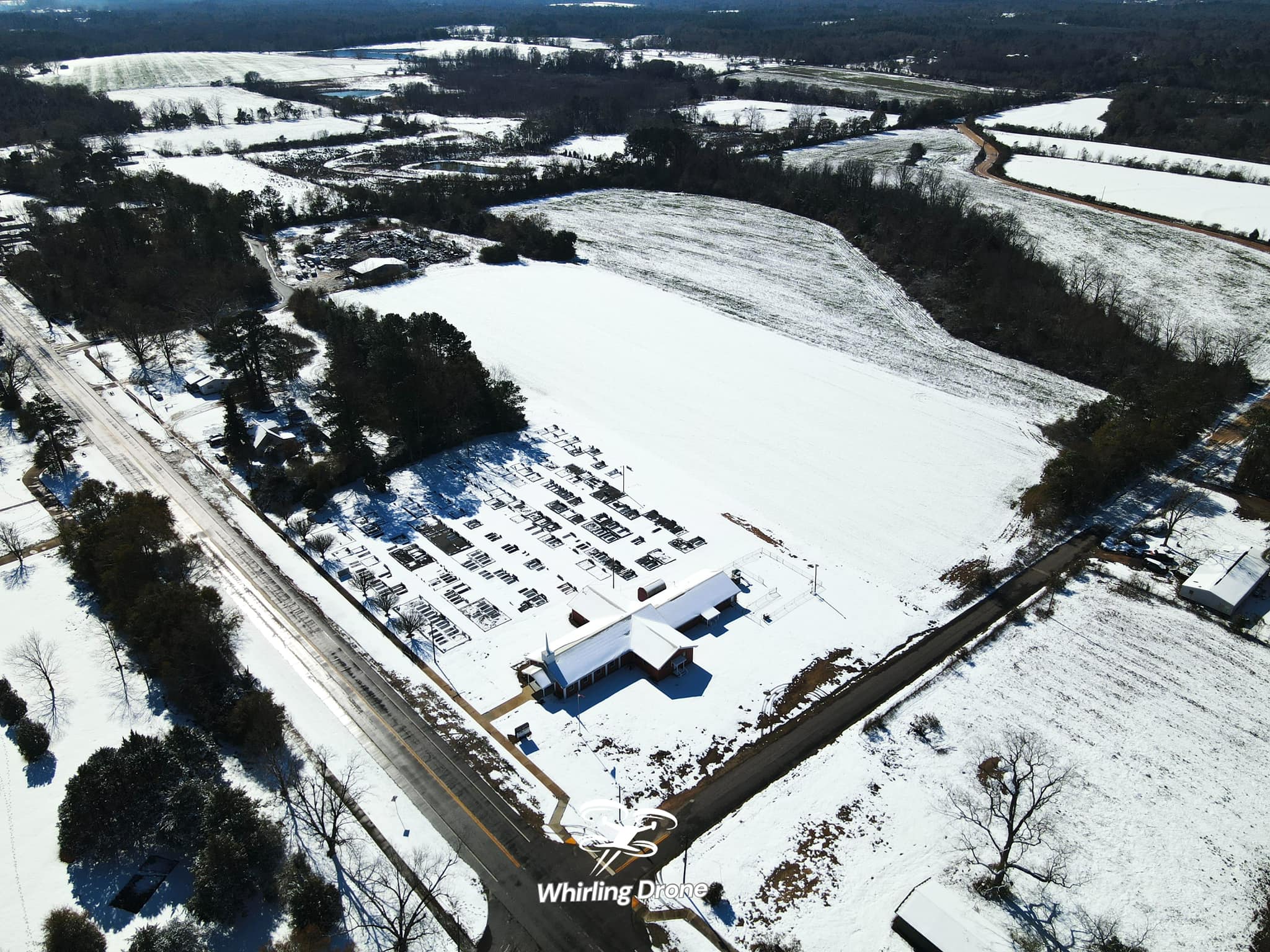
FOR DECADES to come, people will remember the time Esto got six inches of snow — the most in the recorded history of the town — during the Great Panhandle Snowstorm of January 2025.
Snow at John Clark Park.Snow covered Esto Baptist Church and the community cemetery next door.
Remembering with pleasure a time we would not go back to, even if we could.
READING HAZEL TISON’S new book over Thanksgiving weekend provided an extra helping of reasons to be grateful for growing up in Holmes County.
Put More Water in the Soup is the second collection of her columns published in the Holmes County Advertiser over the two decades since she retired as an English teacher at Bonifay Middle School. As the title suggests, most home folks were poor but hospitable.
Still, she’s not eager to relive the good old days.
“A definition of nostalgia I like,” she writes, “is remembering with pleasure a time we would not go back to, even if we could.”
This book — like her first collection, Better Times a Comin’, from two years ago — is full of familiar names and places and simple pleasures. She fondly recalls sitting on the front porch as a newlywed and learning from a group of older ladies “who was who and what was what” and “who had a baby too few months from the wedding date.”
She has lived all of her 93 years near Bonifay and taught many middle school students from Esto. As a child herself, growing up on Route 1, she writes: “We didn’t quite live on God’s Little Acre, but we weren’t too far from Tobacco Road.”
She remembers when Saturday was the big day in town.
“Stores stayed open until 9 p.m. Farmers and others came into town to shop at Evans and Joe Scheinburg’s, which were almost institutions,” she writes. “Parking along Waukesha was on a slant, no parallel parking. Many people drove downtown on Saturday just to sit in the car and watch the people.”
She captures the way the locals talked, and some of their unusual sayings and words, including “terreckly.”
“There was a fair amount of difference,” she writes, “in ‘terreckly,’ which meant ‘maybe I’ll get around to it after a while,’ and ‘directly,’ which I thought meant right away.”
Put More Water in the Soup is available locally at Pepper Town Market in Bonifay, or on Amazon.
Trains were important, the book notes, for hauling timber cut from the virgin forests in Holmes County.
LOVERS OF local history will find new books of interest — including a history of Esto — at the Holmes County Public Library in Bonifay.
Recent donations from a local collection honor Joe Bob Clark, an Esto native who was the moving force behind the creation of the modern library. Its building in central Bonifay is dedicated in his honor.
Now available at the library:
• In “Esto: This Is the Place,” published in 1993, E.W. Carswell captures the people and events that shaped the town of Esto — including its most famous resident, the legendary alligator known as Two-Toed Tom.
• “Heart and History of Holmes County,” by Anna Paget Wells. The second edition is a revised and reformatted version of the book, first published in 1982, with updates and corrections by Dan W. Padgett.
• “Holmes Valley,” by Esto native E.W. Carswell, first published in 1969. This revised and updated edition from 1983 tells the story of the great influence Moss Hill United Methodist Church had on the development of this region of the Florida Panhandle.
• “I Declare!” by Malcolm B. Johnson. This collection of columns from the longtime editor of the Tallahassee Democrat opens a window onto the political scene in Florida’s capital during the middle half of the 20th century. Johnson’s closely observed commentaries were published in newspapers around the state, including the Holmes County Advertiser.
Also available at the library: “Holmesteading,” E.W. Carswell’s definitive history of Holmes County, published in 1986. Thanks to an effort spearheaded by Joe Clark, the book was republished in 2003 and the second edition is available for purchase at the library for $40. All proceeds benefit the library.
The Holmes County Public Library is located at 303 North J. Harvey Etheridge Street in Bonifay and open from Monday through Friday.
He was known as Joe Bob Clark when he was growing up in Esto.
Esto’s old brick stores were the center of the town for decades.
DR. D.F. SMITH was Esto’s most prominent and beloved citizen during the first half of the 20th century. He served the town and surrounding area as a family physician, making house calls, delivering babies and providing the curatives then available to those who were ill.
He also operated a drug store in which he was his own pharmacist, with the help of his wife, Beckie, and daughter, Delma. Their residence and his medical office were in the back.
The drug store and clinic were part of what was always known in Esto as “the old brick stores.” The wide red brick building just north of the railroad tracks at one time also offered hardware, dry goods and clothing. Only the southern third of the building remains, now empty and forlorn, after many years as home to Wells Grocery and the post office.
•
But a piece of the old brick stores lives on a few miles north of town. A long wood and glass showcase from the stores is one of many treasures in the home of Vivian Kirkland Holman, the granddaughter of Dr. Smith. Her mother, Delma Lee Smith, and father, local farmer U.T. Kirkland, inherited the store and operated it in the 1940s and 50s, before selling to Jewel Wells. [Vivian’s parents were also the editor’s keepers during his first five years and his lifelong surrogate parents, making Vivian nearly his big sister.]
During a recent visit, Vivian shared the story of how she came to be the caretaker of a piece of the old brick stores.
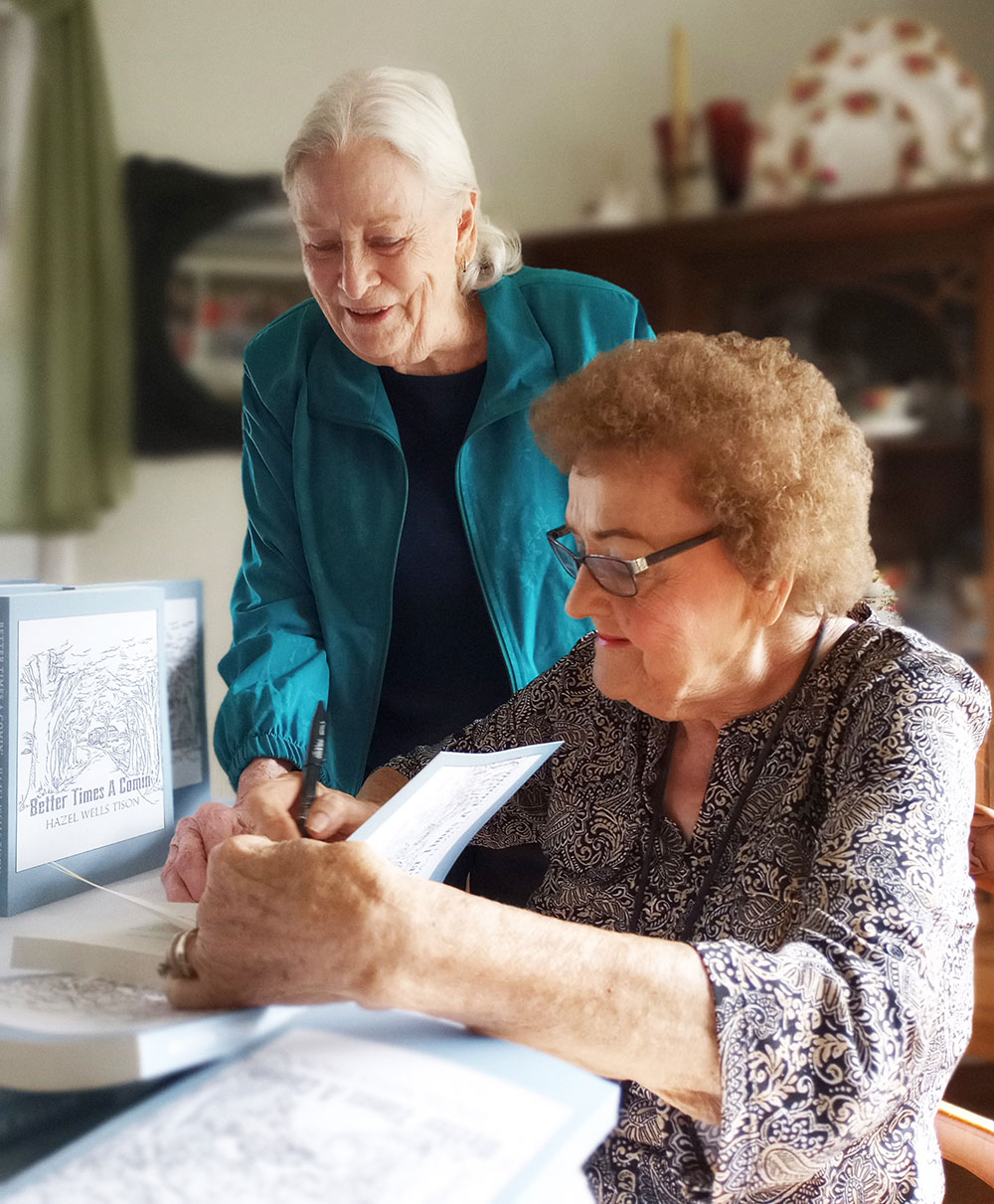
Hazel Tison (right) signs a copy of her new book as publisher Sue Cronkite looks on. Photos by Mary Ivey.
BETTER TIMES ARE ALREADY HERE, it turns out.
This week Hazel Wells Tison, 91, is celebrating the release of her first book, Better Times a Comin’. It’s a collection of her weekly columns in the Holmes County Advertiser about growing up during the Depression in a big family on a two-mule farm on Bonifay Route 1. She published it with the guidance of Sue Riddle Cronkite, 89, an author-publisher from the New Hope community in northwest Holmes County.
“We laugh about it,” chuckles Mrs. Tison. “Two 90-year-olds publishing a book!”
Then she adds: “Maybe it says something good about getting old.”
That ability always to look on the sunny side is the essence of Mrs. Tison’s columns, which she called the Happy Corner, after her nickname, Happy Hazel.
“Looking back on those early days and the little we had in material things, yet we did not feel deprived,” she writes in one story about going to a 50-year reunion at Bethlehem School. “We had our health, our friends and our hopes and dreams for the future.”
In another, titled “I Don’t Know How My Mama Did It,” she recalls the big midday meals her mother cooked on a wood stove “for a houseful of young’uns, field hands and wayfarers,” who were always welcome. The table was crowded with bowls of fresh field peas, corn gathered that morning, fried and boiled okra and sliced tomatoes and cucumbers, always with cornbread and sometimes a peach cobbler or a dish pan full of banana pudding.
But not at night. “At supper, we often could have used the blessing said by Annie Lou Cook: Thank the Lord for the peas and what little bread we’ve got.”
•
Mrs. Tison began writing the column in 2004 after she had retired as an English teacher at Bonifay Middle School. In addition to her many church and community activities, she’d gotten involved in a project to gather stories about Holmes County and its families, which was published in 2006 as The Heritage of Holmes County, Florida.
Word got around.
“Then the lady at the Advertiser called me up and wanted to know if I would consider writing a weekly column,” Mrs. Tison recalls. “I didn’t tell her yea nor nay, but as I began to think about it, I thought I would try a few stories.”
She took them in to the editor.
“She just jumped up and down and said ‘This is exactly what I had in mind,’ ” Mrs. Tison remembers.
She was off and running, and the Happy Corner was a regular feature in the Advertiser every week for most of the next two decades. For a few years the column was nearly the only thing local in the local paper as the Advertiser was handed off among various newspaper chains and run mostly from afar. Now that it’s more local again, Mrs. Tison has cut back and writes only when something moves her.
A recent two-parter was titled “All I Needed to Know I Learned from Uncle Josh and Others.” It included the all-purpose advice her brother Clyde — later Circuit Judge Clyde B. Wells — offered when he was teaching her to drive: “Don’t ever go backward when you can go forward.”
All in all, she’s written nearly a thousand columns telling the stories of local people and places. She steadfastly avoids politics and controversy. Recollections and homespun humor are more her style.
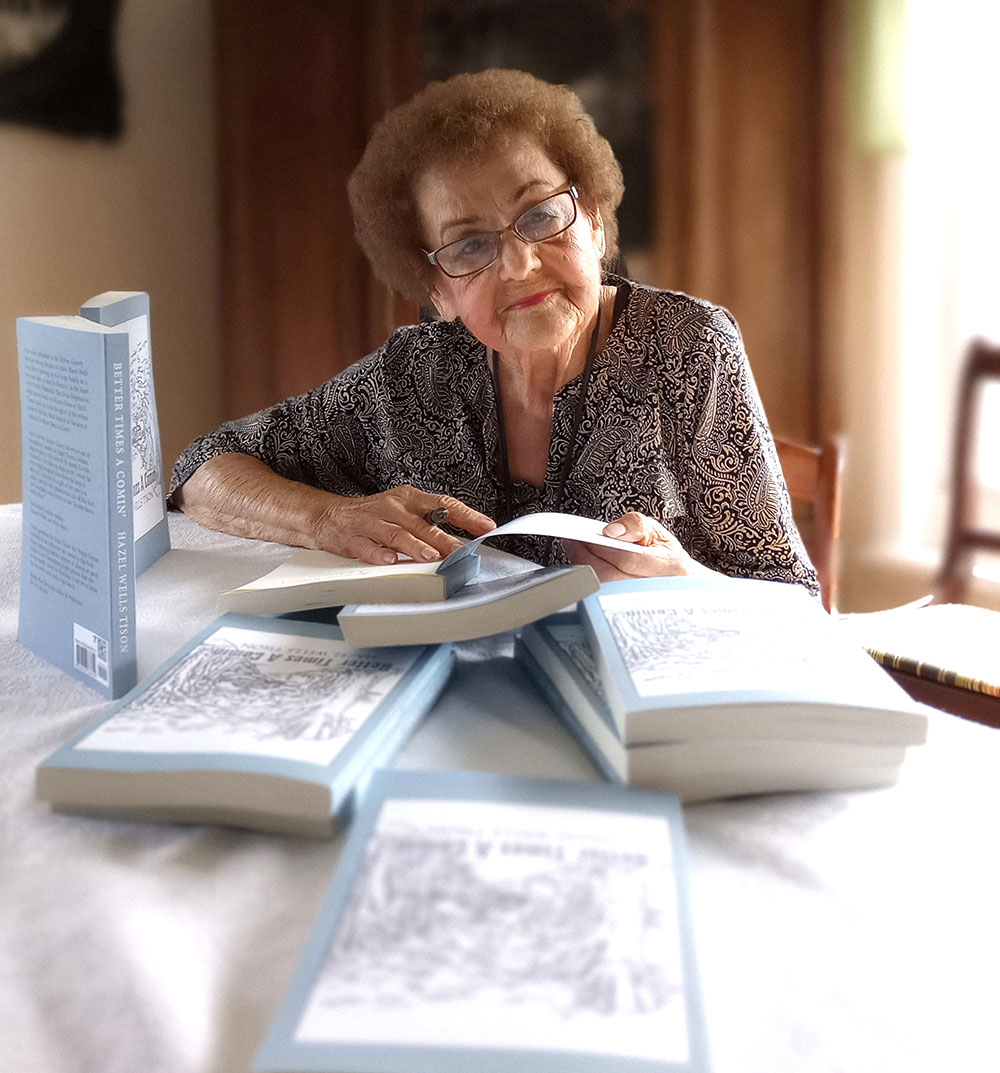
Columnist and now author Hazel Tison has been a favorite of readers in Esto and throughout Holmes County.
“Hardly anyone uses cloth diapers today,” she writes at the end of a column on washing clothes in cold weather. She speculates that absorbent throw-away diapers may be delaying potty training, leaving “toddlers wearing diapers well into their second and even third year, when they should be wearing big girl or big boy panties.”
She writes: “I have a personal philosophy that disposable diapers are largely responsible for disobedient children because parents allow toddlers to wear them longer and are denied the access to appropriately swat their hineys, which is too well padded to do any good.”
But here too she finds a silver lining: “There are times when going back to a simpler way of life looks attractive, but when it gets cold, I am thankful for a warm house with central heat, indoor plumbing and modern laundry equipment.”
Many of her stories feature her family. In one about her Aunt Annie — Anna Paget Wells, who wrote the earlier Heart and History of Holmes County — she acknowledges, “My husband has commented that he is sure people are tired of hearing about the Wells family.” But it’s Easter week, she notes, and she’s busy with church work, so she’s once again telling family stories that require no research.
One of the best is about “poor old Uncle George.” If somebody got angry, her family might say they’re “as mad as George Cook.” So she asked her grandmother how mad Uncle George was.
“The story goes, according to my Grandma Wells, that Uncle George was in the turpentine woods one day and he met up face to face with a bear. When he returned home he quickly took a bath and was looking for clean clothes. When Grandma Cook asked him what happened, he replied that he had encountered a bear, and that when he saw him it made him so mad that clean underwear was required.”
•
The collaboration between author and publisher that produced Better Times a Comin’ began a few years ago when Sue Cronkite stopped by Hazel Tison’s home and blueberry farm north of Bonifay to drop off a copy of a new novel she’d written that told a local story, thinking it might be something Mrs. Tison would want to write about in her column.
By the time she left, the two felt like old friends. And the idea had been planted for another book: a collection of Mrs. Tison’s columns.
“I sort of had to talk her into it,” Mrs. Cronkite says.
“It was a chore,” Mrs. Tison says of choosing which columns to include and getting them ready for publication. But now that she’s holding the book in her hands and her friends and neighbors are clamoring for a copy, she’s proud she did it, with guidance from Mrs. Cronkite and assistance from her daughter Cindy Tison Webb and helper Mary Ivey.
“Since this one is done, and I see that it’s possible, there may be another one,” she says.
Goodson’s beer joint on the Alabama-Florida line at the north end of Esto, overtaken by time.
I’VE GOT A bone to pick with Hazel Tison.
In her column published in last week’s Advertiser, she writes about beer joints once popular in our part of the country. She recalls the Blue Moon and the Cat’s Eye near Vernon, where she went to school. And the Green Lantern, near Chipley, which later became Chuck & Eddie’s (and is now a church!). Plus several at the state line in Esto.
But she calls them “juke joints,” a cleaned-up citified spelling of what we actually called them — jook joints — which my friend Malcolm B. Johnson spent his entire life battling.
Malcolm was the longtime editor of the Tallahassee Democrat. He wrote a daily front-page column called “I Declare.” I first read his columns republished on the editorial page of the Advertiser, back before it was consumed with national politics. Malcolm syndicated his columns to the Advertiser and other papers around the state only minimally for the money ($1 a column). Mostly he wanted to extend his influence. I came to know him first as a fearsome presence in the newsroom and later as a friend and co-conspirator when I whittled his prodigious output down to the book of his columns we published in 1983 called — what else? — “I Declare.”
Malcolm insisted we include the column he wrote in July 1977 headlined “Scholars Have Corrupted Jook.” It started: “If I were a ‘Roots’-inclined black academic, I’d work up a research project on what the white intelligentsia has done with our word ‘jook.’ They’ve gone to spelling it and pronouncing it ‘juke,’ a corruption at which I have protested off and on for two or three decades with declining influence.”
Malcolm insisted: “It was spelled ‘jook’ when anyone attempted to write it back in the 1930s, and it was pronounced to rhyme with ‘book’ and ‘look’ — and the boys at the University of Florida were given to ‘jooking’ when they took leave of booking on Saturday nights.”
Malcolm claimed personal knowledge of the matter.
“You see, I have some authority on this point” he wrote, “because I claim to have moved the word into national language and literature from the lumber camps and college campuses of Florida.”
Here’s the story, as he told it:
When I came to Tallahassee as a reporter in 1937, I picked up odd change by submitting items to Billboard magazine and various other publications. The Florida State College for Women Flambeau one week published a list of the 10 most popular records being playing on coin-operated phonographs at off-campus soda shops. Called it a “jookbox poll.” I submitted the list to Billboard, which promptly replied it didn’t care what the girls were playing, but what in heck was a “jookbox”? The magazine printed my explanation and sent me 75 cents for my work. And the word was in currency.
The college kids had brought the word out of Africa, via generations of use in the South as the name for a place where black lumber and turpentine camp workers congregated at night and whooped it up.
Malcolm even offered Florida Supreme Court citations to support his argument.
The late Supreme Court Justice Glenn Terrell referred to them in one opinion as “arch incubators of vice, immorality and low impulses.” In another he mentioned a “jook where beer and other species of fire water are dispensed.” He spelled it “jook,” drawing on his long Cracker experience. So we entered his opinions via the news wires into the growing debate over how to spell it.
His contemporary, Justice Roy Chapman, shook us one day by spelling it “juke” in one of his opinions. We called to ask if he and the court were reversing themselves on this important matter. He said no, it was a slip. He went personally to the clerk’s office and changed the spelling to “jook.”
However it’s spelled, Malcolm acknowledged: “Jooks, to be sure, were not classy joints.”
On that, he and Hazel Tison agree.
“I could only imagine what went on in those places,” she writes. “I grew up with the idea that such places were devil’s dens and women who frequented them were harlots or trollops (my mother’s terms).”
Cottontop Reynolds at the cash register of the Oasis Club. He also ran Cotton’s Place on the south side of Esto.
AN EMAIL ARRIVED offering a treasure. “If you did not get a copy of the Two Toe Tom Cookbook, prepared in the early days of that famous celebration, I will tell you that we have located one and it is a classic.”
The message was from Perry Wells, the longtime county judge in neighboring Washington County. Judge Wells, now 90, has led a long and distinguished life and has many outstanding qualities to recommend him — none more important than his wife, Hester Lee Lucas Wells, who he referred to as “my Esto girl,” since she grew up near Ten Mile Creek and went to the Esto School. I looked up to her father, Herbert Lucas — a true gentleman — when we both worked at Bunk Johnson’s gas station down at Holland Crossroads. Perhaps because of that, I have always felt a little bit kin to Perry and Hester.
Of the cookbook, he wrote that it has “many contributions of some of Esto’s finest ladies’ noted cooking skills.” It was one of many local cookbooks Hester had collected. Since her death last year, Perry has gradually been letting go of some of her treasures, including her cookbook collection. The Two Toe Tom cookbook, he said, “is yet unspoken for.”
I couldn’t get a crisp new $20 bill — the asking price — in the mail fast enough to his address on Judge Perry Wells Highway in Chipley. In due time, a package arrived. Inside was a pristine copy of the cookbook, published as part of the festivities surrounding the very first Two Toed Tom Festival back in 1987, along with a note from Perry:
“I will not deface the cookbook with an autograph, thus keeping it in its purest form,” he wrote. “I know you will find much interesting reading — and the names of so many contributors make it even more special. Hester would be proud to know the book is in your hands. She always spoke kindly of Cottontop Reynolds as the husband of your mother and the father of the son she described as “everybody’s baby in Esto.”
The cookbook was, as Perry promised, a treasure. There was Lynette Crutchfield’s recipe for Squash Relish, her daughter Brenda Sasser’s recipe for Shortnin’ Bread, and her sister Martha Sue Register’s recipe for Cabbage Soup. There was Mrs. Walter (Gladys) Dixon’s recipe for Tater Gravy, and Charlene Godwin’s recipes for Chuck Roast — “so easy,” it said — and Sweet Potato Casserole, Peach Pie and Buttermilk Pie.
It was like calling the roll of the ladies in Esto. I’d eaten at many of their tables, and had nearly everyone’s cooking at a dinner on the grounds at the Baptist church or some other community event.
I doubt Sue Worthy Champion ever actually cooked Gator Tail ‘n Taters. “Boil gator tail in large pot with black pepper, salt and red pepper until tender,” the recipe said. But it seemed appropriate in a cookbook dedicated to a legendary alligator said to live in Old Sand Hammock.
By far the biggest section was Cakes, Cookies & Desserts. Esto ladies baked great cakes. There was Louise McGowan’s recipe for Peanut Cake, her niece Dorothy Nell Miller’s recipe for Chocolate Pound Cake and Mary Nell Joiner’s recipes for Lemon Cheese Cake, Moist Coconut Cake and Lane Cake, a special holiday favorite. Mary Nell had a business baking cakes for other people for quite a few years, although Annie Laura Kidd always sniffed, “She uses cake mix,” a cardinal sin. Sure enough, her recipe for Caramel Peanut Butter Cake noted: “You may use a yellow cake mix.”
And then, on page 113, I ran into a surprise: my mother’s Chocolate Cake. Mother had died earlier that year, before the cookbook project began. But she was a great cook, and she was known for her 12-layer chocolate cake. Somebody must have decided it should be included. I’ll never make it, but I’m glad it’s in the book.
That $20 I sent Judge Perry Wells was some of the best money I’ve ever spent.
The Esto School offered instruction in grades one through nine until it was closed in 1949.
By E. W. CARSWELL
The saddest day in Esto’s history may have been September 9, 1949 — the day the community’s school was closed.
“It was the equivalent of experiencing a death in the family,” one former student observed. The community had never appeared more lifeless than it did in the weeks following the closure of Esto Junior High School, where instruction had been offered from grade one through grade nine.
Local townspeople were met with ghostly silence from a horseshoe-shaped one-story frame school building on a hillside just north of Esto Baptist Church on the western side of Highway 79. Absent were the voices of children, who for years had gathered at the school on weekday mornings to begin classes. After the school closed, they started boarding buses a little earlier instead, heading for schools in Bonifay, the Poplar Springs community or Hartford, Alabama. Lumber from the former school was used in the construction of several houses in the community.
Some Esto residents more than 40 years later seemed still unreconciled to the loss of their local school. Those sentiments promoted a feeling of uncommon closeness among those who attended the school. It was not unexpected, then, for former students to suggest that a school homecoming be added to Esto’s annual Two-Toed Tom Festival in 1991.
Betty George, who had attended the school, organized the homecoming, which became a regular part of the festival for a few years. In an interview for Florida Public Radio in 1993, she recalled fond memories the school, and marveled at how many former students showed up for the reunion.
She came from notoriety in Chicago to a farm just south of Esto, briefly.
AN EMAIL ARRIVED: “I’m writing a book about a woman named Linda Taylor, who was known as the ‘welfare queen’ in Chicago in the 1970s,” wrote Josh Levin, editorial director of the online magazine Slate. Ronald Reagan helped make her infamous in his campaign speeches when he was running for president, vilifying her as a con artist who picked up multiple welfare checks and food stamps in her Cadillac. Although Reagan exaggerated, it turns out there really was such a person.
Then Mr. Levin dropped the bomb that she once lived in Esto:
After her period of infamy, she moved to Florida and changed her identity, going by the name Linda Lynch. She lived in Esto (or just outside Esto) around 1985 — it was at the intersection of Hwy. 79 and Hwy. 2, and I’ve seen it described as the ‘old Pelham Farm.’
The property Linda Lynch bought was foreclosed on in October 1985, which means she was probably there for about six months. She was mixed race, and she had two older black people living there with her.
I’m wondering if any of this rings a bell for you or if you might know someone (or some people) who remember her.
Well. Here was a piece of unlikely Esto history I’d never heard — and wouldn’t have believed, if he hadn’t attached evidence.
Mr. Levin has now talked to at least two local residents who knew the woman during the brief time she lived near Miller’s Crossroads. We eagerly await his book.






 The Esto Herald