THE WORD FROM HOME is that our next-door neighbor, Linda Kirkland, is 86 today. That seems impossible. I remember when she came to Esto.
Linda, a Yankee from Ohio, married Doyle Kirkland, son of U.T. and Delma Kirkland, who raised me when I was little. She and Doyle met when he was in the agricultural inspection service, which was a source of employment to many young men in Esto in the 1940s and ’50s. There wasn’t much else to do. Then U.T. had a heart attack and Doyle came home to run the family farm and brought Linda with him.
Linda wasn’t like us. She talked funny and seemed to have little patience with the way we’d always done things in Esto. She stirred the pot. She encouraged us to think new things and try new ways. She thought we ought to sing our old hymns a little faster in church on Sunday mornings, and volunteered to lead the singing sometimes. Since I played the piano, she immediately sped up my life.
Doyle ran the farm, which was all around our little acre. He hired me during the long summers to pick peaches and plums and tomatoes and load watermelons. Even after the summer crops were gathered, Doyle would pay me to pull the weeds in the peanut patch — miserable work that made me know early on I didn’t have what it took to be a farmer. Doyle figured out pretty quickly that I wasn’t much of a field hand, but I could make change. So he put me in charge of the Kirkland Farms fruit stand in front of our house on Highway 79, just south the Florida-Alabama state line. He paid me $7 a day, which I saved in my new bank account.
Linda brought something new to our little town. She was a professional woman who worked with Builders Homes in Dothan to bring affordable and well-built brick homes, financed by the federal government, to our part of the world. She let me use her IBM Selectric typewriter — a true novelty in a time of manual Royal typewriters. She managed to “loan” it to me during my senior year of high school to type papers and publish The Esto Herald and the church bulletin on the mimeograph machine she’d replaced at work. Then she managed to have the Selectric declared surplus, too, and I took it with me when I went away to college.
I had a Selectric typewriter and a new red Pontiac LeMans I’d bought with the money Doyle paid me. I was on my way.
By then Doyle and Linda had built a new brick home of their own up the dirt lane from our house. I always saw them when I came home to Esto, either at home or at church, or both. I was more concerned about Doyle’s parents, who were getting older. U.T., who was a surrogate father to me, died young, when I was still in school, and it was a huge loss. Doyle’s mother, Delma — my Big Mama — lived on for nearly three more decades, and I never even considered going home to Esto without seeing her.
Now U.T. and Delma are long gone, and it never occurred to me that Doyle and Linda might get old. But here we are, all older than we once were. So before it’s too late, let me say to Doyle and Linda how grateful I am they have always been such good neighbors. They helped launch my life.
Red and Micki Balaban on their cattle ranch near Bonifay.
MICKI BALABAN, who helped found the Spanish Trail Playhouse in Chipley in 1962 while raising her family on a cattle ranch outside of Bonifay, died on May 4 near her longtime home in Connecticut. She was 94.
She and her husband Leonard, also known as Red, came to Bonifay in 1952 and bought an 800-acre farm northeast of town on the Poplar Springs Road. They and their children, Mike, Steve and Rachel, became a vital part of the community before moving back north in 1967.
They remained in touch with friends here long after they left. Their farm, which they called Lookout Plantation, was later divided into smaller parcels, but is still known by many as the old Balaban place.
News of her death posted online by her children brought an outpouring of happy memories and comments from around the country, and from Bonifay.
“She was a special lady,” Martha Cullifer Howell commented. “She left her mark on us here in Bonifay.”
“As a child, I would be with my mother when your mother and my mother would visit in the stores in Bonifay,” wrote Amalia Quattlebaum. “Your mother was like a breath of fresh air when she entered a room.”
Wrote retired educator Sheri Curry Brooks: “When we were growing up, I thought she was such a beautiful, exotic lady. I remember her teaching us tap dancing one summer. She was such a fun lady as well as beautiful.”
•
Her son Mike told more of her story:
“Micki Israel Balaban was an only child born in Providence, RI, in 1929, during the Depression. Her family life was a bit suffocating, so she couldn’t wait to become an adult and get away. Marrying my dad accomplished that.
“She was smart and talented. She wrote her high school senior play, starred in all her college theatrical productions at Pembroke College, Brown University’s women’s school, and, as a senior, was offered a Marshall scholarship to study acting at the Young Vic Theater in London. She turned it down.”
Instead, she married Lennie Balaban. They met as students at Brown, in Rhode Island, and later moved to Gainesville, where he studied animal husbandry at the University of Florida extension. He had decided to become a cattle rancher, escaping the expectations of his own family — especially his movie mogul father, Barney Balaban, president of Paramount Pictures. His ranch in Holmes County became renowned for its 300 head of purebred American Angus cattle.
Micki Balaban helped found the Spanish Trail Playhouse and directed and starred in many of its productions before she and her family returned to New England in 1967. The playhouse closed in 1968, but was resurrected in 2006 and continues today.
Micki went on to establish another theater company in Connecticut and became a skilled high school counselor.
Red became a well-known jazz musician, playing the Dixieland jazz he had taught himself on the farm in Bonifay. He led a rotating all-star group at Eddie Condon’s jazz club in Midtown Manhattan, which he owned and operated for a decade.
•
“She was a force,” Rachel Balaban wrote in announcing her mother’s death. “She touched people in profound ways and made them feel seen and heard.”
A celebration of life service will be held in Connecticut in August.
The Balabans owned a cattle ranch outside Bonifay they called Lookout Plantation.
ESTO HAD NO Jews or Catholics when I was growing up, and nearly no Yankees or Republicans. The same was true for most of Holmes County. But there was one Jewish family, the Balabans, who owned a farm outside the county seat of Bonifay.
Steve Balaban was in our class from first through sixth grade, when his family moved north. He had an older brother, Mike, and a younger sister, Rachel.
I always wondered how they ended up in Bonifay — even more so after reading last fall about their Aunt Judy Balaban’s death in the Hollywood Reporter. During her glamorous long life she dated actors Montgomery Clift and Merv Griffin, married Tony Franciosa and was a bridesmaid at Grace Kelly’s wedding to Prince Rainier of Monaco. Her father, Barney Balaban, was president of Paramount Pictures from 1936 to 1964. Her brother Red Balaban was a noted jazz musician. The actor Bob Balaban is her first cousin.
I wanted to know more. Fortunately, Steve and I reconnected last year while we were planning our 50th high school reunion. It seemed a little strange that someone who’d left long before we graduated would be interested in the reunion. But it soon became clear that Steve had fond and formative memories from his early years in the county, and so did the rest of his family.
Mike, Steve and Rachel Balaban growing up on the farm.Read More
HE WAS JERRY PELHAM when he was growing up on his family’s farm just south of Esto. But he became well known and highly respected — and made a major contribution to Florida politics and policy — as Thomas G. Pelham, the Tallahassee lawyer and land use specialist who served two different terms, under two different governors, as secretary of the state’s Department of Community Affairs.
In his recent memoir, Kids Don’t Have Backs, he tells the story of his early years on the old Blackburn place — his grandparents’ farm, later taken over and expanded by his parents, Roy and Louise Blackburn Pelham.
“The farm was located on Florida Highway 79 in a rural area known as the Holland Cross Roads farming community, just two miles south of the Alabama-Florida state line,” he writes, adding that when his grandparents moved to Holmes County from Georgia in 1918: “The county was sparsely populated and living conditions were primitive. There was no electricity, and therefore no electric lights, indoor plumbing, running water, sanitary facilities or air conditioning. Tractors and other modern farm equipment were not generally available or affordable, so farming was mostly conducted with mules and hard manual labor.”
That hadn’t changed much by the time Pelham was born in 1943, the first of four boys driven by their father, and necessity, to work the land. Eventually electricity and tractors would come, along with a new house and barn across the highway, plus a younger sister.
“The farm was a year-round, labor intensive, physically demanding enterprise,” he writes, “that over time involved the efforts of our entire family, including the children, who frequently worked like adults.”
•
Pelham paints a picture of unrelenting, backbreaking work: milking cows, feeding hogs, chopping and picking cotton, pulling corn, stacking peanuts, building and rebuilding fences. It’s a life that will be familiar to nearly everybody who grew up in Holmes County.
“Hard work never hurt anybody,” was his father’s frequent refrain.
The title comes from a memory of a hot summer day in the cotton patch when he stretched his aching back and then dropped to his knees and started crawling.
“Hey, boy, get off your knees and get to pickin’ cotton,” his daddy commanded. “But my back hurts,” he replied as he slowly got to his feet. “Kids don’t have backs,” his daddy declared.
Neither did every farmboy have a grandmother down the road who subscribed by mail to the Atlanta Journal-Constitution, which she passed along to her grandson. The Atlanta papers were especially strong in their coverage of school integration in the wake of the Brown v. Board of Education ruling in 1954, stirring Pelham’s awakening awareness of the U.S. Supreme Court and the rule of law. His learning was helped along by some memorable teachers at Holmes County High School — still segregated at the time — especially Miss Lynelle Vanlandingham, who taught ninth grade civics.
He writes: “Miss Vann’s discussions of the structure and functions of American national and state governments, the roles of the three branches of government, and our democratic values, sparked my lifelong interest in government and politics. A legendary disciplinarian, Miss Vann could silence a rowdy class simply by pointing her finger and arching an eyebrow.”
Not all of the enlightenment took place in the classroom.
The school bus — bright yellow with big black letters, just like today — picked up all of the students who lived on Highway 79 between Esto to the north of our farm and Bonifay to the south. But it also made two long loops over unpaved red clay side roads to pick up students who lived off the main highway.
Riding the school bus was an education in itself. Filled with 30 or more boys and girls ranging from first graders to high school seniors, the bus contained a combustible mix of high energy, youthful exuberance and raging hormones. Boys harassing girls and girls flirting with boys, big boys picking on little boys, profanity and sexual innuendo, spit balls and flying paper airplanes, some of them aimed at the bus driver. On a few occasions the playfulness turned ugly and fights broke out.
Pelham quickly learned to love school. “Over the years,” he writes, “it became easier and easier for me to get ready to catch the school bus every morning.”
By the time he was a senior in 1961, Pelham was president of the student council and valedictorian of his graduating class. He helped organize and raise funds for an eye-opening senior class train trip to Washington, D.C., and New York City.
“Our trip gave me a lot to think about on the train ride home,” he writes. “Seeing the exciting world that lay beyond the narrow boundaries of my life on the farm strengthened my desire to go to college. That still seemed to be an impossible dream, but I was determined to find a way to get there.”
He came home to the farm and announced his intentions. His mother, who had also been the valedictorian of her class at Holmes County High, was supportive. But not his father, at least not at first. “Who is going to help me gather these crops and take care of the farm animals and all of the work around here?” he asked.
•
By then Roy Pelham’s oldest son had a back and a backbone. He found a way to make it happen, getting degrees from Chipola Junior College, Florida State University and Duke University, and later law degrees from Florida State and Harvard Law School. When he died on February 21, 2023, after a long battle with Parkinson’s Disease — during which he wrote his memoir — he was eulogized by the state’s foremost political writer, Lucy Morgan, as a legal lion. She wrote: “No single person in our history did more to protect Florida’s fragile environment and manage growth.”
We had a late lunch at an automat. Prior to our trip, I had never heard of an automat and, in fact, our school cafeteria was as close as I had ever gotten to a restaurant or cafeteria. In an automat, I quickly learned, each food dish is placed in a compartment behind a hinged glass window. To select a food item, the diner inserts the required coins, then lifts the glass window to remove the food and place it on a tray.
While some of my classmates discussed the merits of automats, we became aware that a black man had entered the room. Tall, trim and Sidney Poitier handsome in his U.S. military uniform, with stripes and medals on his chest, the man sat down with his food tray at a table across the room. There was a sharp intake of breath by some of my classmates. We were not accustomed to seeing black people in restaurants and other public facilities, which were still segregated in the South in 1961.
“Is he allowed in here? He wouldn’t be back home,” one of our classmates whispered.
“Maybe we should leave,” someone said in a louder voice.
Then we all froze. The military officer rose from his seat and walked over to our tables.
“Welcome to New York City,” he said in a warm, friendly voice, with a big smile. “Where are you from?”
“Florida. We are on our senior class trip,” someone managed to say.
“What a great experience for you. Is this your first time in the city?”
“Yes,” several classmates responded.
“Well, you will find that New York is a great city. I hope you have a wonderful time,” he said. Then he gave a little half salute, turned and went back to his table, leaving us in stunned silence.
Sybil Taylor was a devoted member of the Church of Christ.
TODAY WAS HER 98th birthday, so I called Sybil Taylor to wish her well and talk about the old days in Esto.
She didn’t answer. A little searching revealed that she died last fall, with no announcement made locally. My Christmas card was not returned.
Sybil Miller Taylor lived almost all of her long life just south of Holland’s Crossroads, where Highway 79 meets Highway 2. She was a devout member of the Esto Church of Christ, absolutely certain of her beliefs and eager to convert others. Late in life, she gave her family farm to Faulkner University, a Church of Christ college in Montgomery, and lived on campus during her final years.
Faulkner University posted this story in its “Supporter Spotlight.”
Sybil Taylor, who passed away October 22, 2021, at the age of 97, wasn’t sure what she would do when her husband Moody Taylor died years earlier and left their farm in Florida to her.
Taylor and her husband had been having financial difficulties with the farm when she heard a sermon on giving and she made a promise to the Lord that she would give half of what she earned to the Lord and his work. She kept her promise and the Lord blessed their farm and increased their revenue.
One night after her husband passed away, Elizabeth Wright Smith, who was one of Faulkner University’s strongest supporters, visited Taylor to share the university’s missions and need for funds. After sharing her story, Smith asked Mrs. Taylor if she would like to support Faulkner University. Her response was quick. At the time, Smith was asking donors to give $1,000 each year for a period of 10 years. The next morning, Taylor gave Smith a check for $10,000.
“I knew about Faulkner University when it first opened in 1942 as Montgomery Bible College and then as Alabama Christian College,” Taylor said. “I received the Gospel Advocate newspaper, as did all my family members before me. When Elizabeth came to ask me for my support, I wanted to give. Faulkner was one of the few Christian colleges I knew about at the time and I wanted to support them.”
Since that day, Taylor was an unwavering supporter and friend of Faulkner University.
When it came time to make a decision about her farm, Taylor, who was well into her retirement years, decided to deed the farm to Faulkner for the university to sell. Funds from the sale went to the university and five charitable gift annuities were set up for Taylor to live on a stable income for the rest of her life. With a charitable gift annuity, Taylor received a return based on her age. This fixed payment was in addition to a large income tax deduction.
She lived on campus for many years before her passing.
A memorial service was held on November 2 at University Church of Christ in Montgomery.
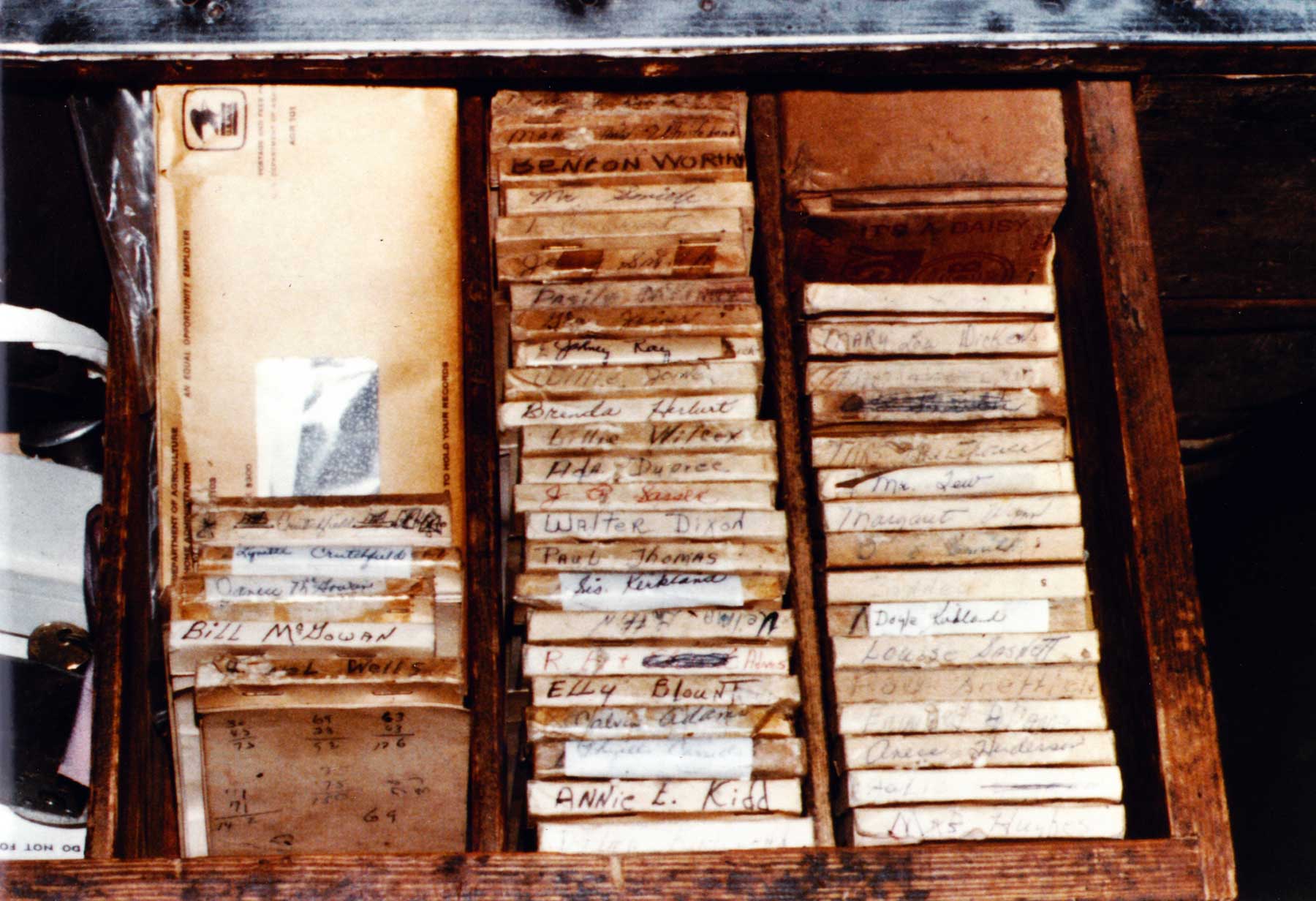
FOR MANY YEARS, “going to the store” in Esto meant going to Wells Grocery. It was the heart of our little town when I was growing up. Nearly everybody would stop by before noon to pick up the mail. No day was complete without a cold drink and a visit with proprietor Jeanette Wells.
The charge accounts in her general store called the roll of our little town. Some were never paid. But no one went hungry or without love when Jeanette was with us. She was laid to rest in the Esto cemetery this afternoon. If she didn’t get to heaven, no one will.
Most business at Wells Grocery was done on credit.
She came from notoriety in Chicago to a farm just south of Esto, briefly.
AN EMAIL ARRIVED: “I’m writing a book about a woman named Linda Taylor, who was known as the ‘welfare queen’ in Chicago in the 1970s,” wrote Josh Levin, editorial director of the online magazine Slate. Ronald Reagan helped make her infamous in his campaign speeches when he was running for president, vilifying her as a con artist who picked up multiple welfare checks and food stamps in her Cadillac. Although Reagan exaggerated, it turns out there really was such a person.
Then Mr. Levin dropped the bomb that she once lived in Esto:
After her period of infamy, she moved to Florida and changed her identity, going by the name Linda Lynch. She lived in Esto (or just outside Esto) around 1985 — it was at the intersection of Hwy. 79 and Hwy. 2, and I’ve seen it described as the ‘old Pelham Farm.’
The property Linda Lynch bought was foreclosed on in October 1985, which means she was probably there for about six months. She was mixed race, and she had two older black people living there with her.
I’m wondering if any of this rings a bell for you or if you might know someone (or some people) who remember her.
Well. Here was a piece of unlikely Esto history I’d never heard — and wouldn’t have believed, if he hadn’t attached evidence.
Mr. Levin has now talked to at least two local residents who knew the woman during the brief time she lived near Miller’s Crossroads. We eagerly await his book.
A TRIP HOME to Esto almost always includes a visit with my mother and grandmother in the Esto cemetery, along with so many other good people I have known and loved. The history of our town is told in those headstones.
This trip brought a special treat: After church on Sunday, we all adjourned to the fellowship hall for fried chicken, peas, creamed corn, fried okra and other delicious Southern delicacies. Naturally we gathered around the piano afterward to sing hymns.
Jeanette Wells Berry (right) and her sister Louise Wells McGowan with a 16-layer chocolate cake at John Clark Park in Esto.
GROWING UP IN ESTO, we always had plenty of good food. Some of the best was served up when the neighbors got together for a fish fry, or after church at an old-fashioned dinner on the grounds — lately served in the air-conditioned fellowship hall.
The ladies in Esto were always especially good at baking cakes. I remember Lane cakes and fruitcakes at Christmas, coconut cakes stacked high, red velvet cakes white on the outside and bright red on the inside, lemon cheese cakes — none of them better than a simple pound cake with a raw streak. Best of all for really special occasions was a towering chocolate cake made of many thin layers, with fudgy crystalized chocolate frosting between every layer and all over the outside. It had more frosting than cake.
So it was a happy surprise to turn to the food section of The New York Times, no less, and find a feature on Southern cakes — dateline Hartford, Alabama, just 10 miles north of Esto — celebrating what they called the “Chocolate Little Layer Cake” as a specialty of our corner of the country. That it is.
A NEW LIBRARIAN arrived with the beginning of the sixth grade. Dianne Smith took over from longtime librarian Miss Louisa Hutchinson, who had gotten married very late in life and retired.
The new librarian was brimming with ideas, including a reading contest for sixth graders. For months we had to choose books from a reading list and then be quizzed by Mrs. Smith. When it was all over, the smartest girl in our class had been bested by Danny Henderson, who would soon move with his family to Esto.
A picture of the winners appeared in the weekly Holmes County Advertiser — a high honor in itself — with a story that explained: “The purpose of the reading contest was to acquaint the students with the best books in the library in the hopes they would discover the pleasure of reading and would be encouraged to do more reading on their own.”
The contest ran almost all school year, from October 1966 to May 11, 1967. The Advertiser story explained how it worked.
Mrs. Orren Smith, librarian, prepared a reading list from which the contestants chose the books. The list included selections of fiction, biography, mythology, science, art, music and history. Most books counted one point, but selections from the classics or books of special value counted more.
After reading a book, the student would answer a few questions about it to prove that he had really read the book. The student accumulating the most points was declared the winner.
It was Dianne Smith’s first year back home in the local schools. She would soon move up to the high school to teach junior English. Later, after the formidable Mrs. Mabel Harris retired, she taught senior English and humanities for many years, touching the lives of generations of students.






 The Esto Herald