At a fish fry with stepsister Cindi and stepbrother Wayne in his barn.
I COMPLAINED that nobody has a fish fry anymore when I’m home in Esto, our traditional excuse for getting together with kinfolks and neighbors. My stepbrother Wayne said he still fished — just come on by on Saturday night. And so we did.
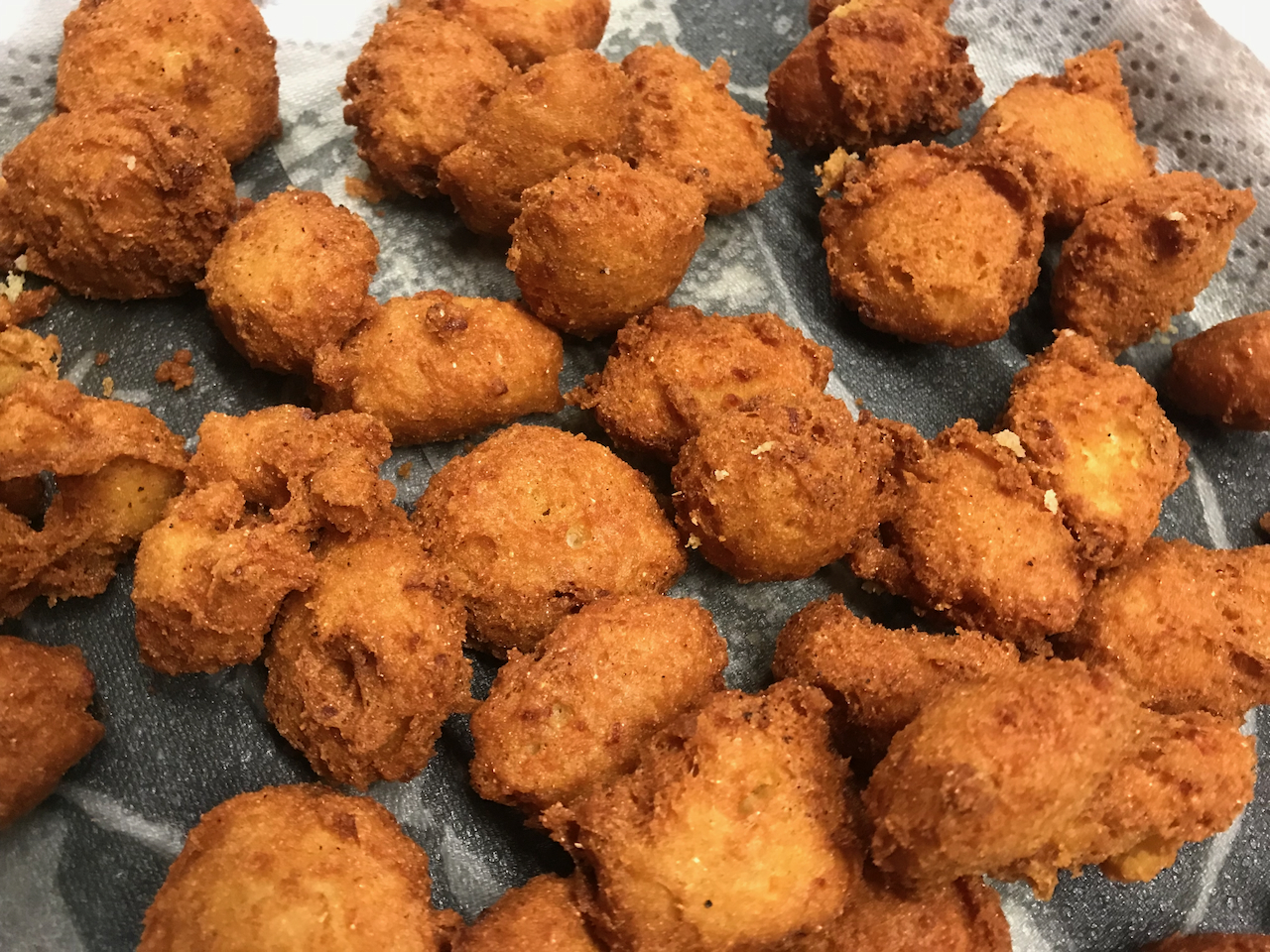
Wayne fries fish — plus French fries and hush puppies, of course — out under the barn in his back yard. It’s just up the Old Esto Road and across the state line in Black, Alabama. He invited some of his buddies from the Black Volunteer Fire Department, too, and we had a feast.
After we’d eaten, one of the firemen edged over to ask, “So you live in San Francisco?” Uh-oh, I thought, here we go with the gays again. But the bogeyman had changed. He fairly hissed: “Isn’t that where Nancy Pelosi is from?”
Wayne’s wife Lynne suggested a photo and slyly posed us in front of an Alabama banner with the stars and bars. “Show that to Nancy Pelosi,” said Wayne.
Frying fish and hush puppies under Wayne’s barn.
That was in 2018. Wayne promised there’d be more fish to fry when I made it home again. When I finally got back last fall, he had been diagnosed with lung cancer, the same fate that befell his father, Bill Henderson, my stepfather, after a lifetime of smoking. Bill insisted as he was dying that smoking had nothing to do with his medical problems and that if he had it all to do over, “I’d smoke ’em all again.” I asked Wayne if he felt the same. “I’d smoke one right now from here out to the highway,” he said as we sat on his front porch watching the sun set.
Our sister Cindi called to say that Wayne died this afternoon. I will miss him, and his hush puppies, and the way we managed to keep a connection despite the great distance between us.
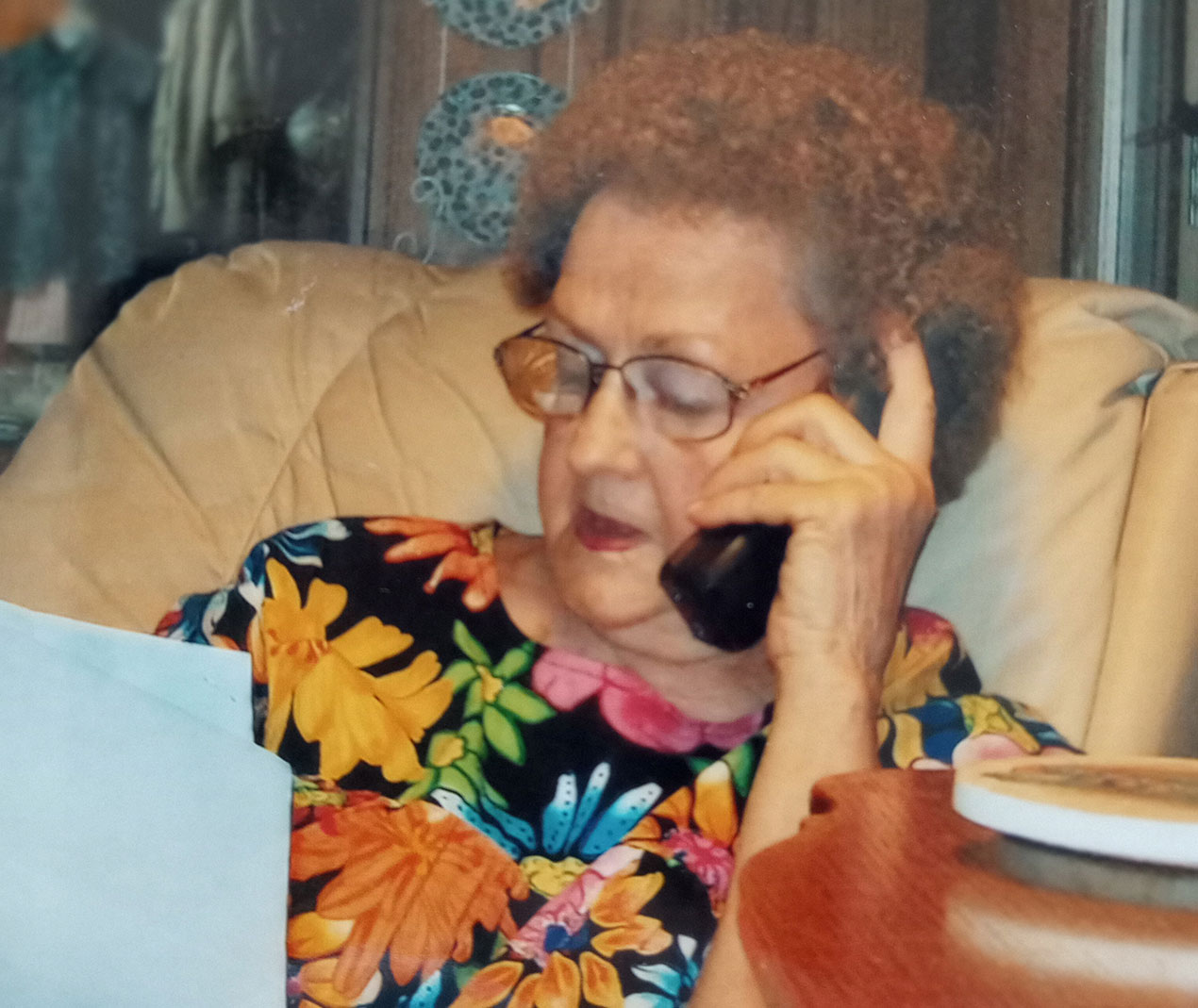
Hazel Tison, fresh from the beauty shop, works on her column for the Advertiser.
A MEMORY | HAZEL WELLS TISON
My sister Minnie Lee and I were one year apart in age, she being the older. We were about 16 and 17, both dark-haired, brown-eyed southern girls.
In the fall, when the cane had been harvested and the syrup-making finished, Daddy was taking a pickup load to sell in Pensacola. He allowed Minnie and me, along with cousin Lenora, to go with him. We spent the night there with some of his cousins — and, wonder of wonders, he took us shopping in downtown Pensacola on old Palafox Street. I don’t recall what all we were able to buy, but I know we each got a new dress. Mama had always pretty much dressed us alike. A lot of folks thought we were twins. I was younger but a bit taller and skinnier, while my sister was more shapely. She also had thick, well-managed hair, while mine was fine and wispy. It was the ’40s and glitz was being worn for casual wear, so we bought similar but not identical dresses, off-white and trimmed at the shoulders in gold sequins.
Our older brother Perry was dating Hester Lucas of Esto at the time. One Sunday evening he was attending a sing at Esto Baptist Church with her and he invited (or perhaps allowed or tolerated) his younger sisters to go with him. It was a golden opportunity to wear our new gold-trimmed dresses. We sang along with the southern gospel songs, with which we were very familiar. I don’t remember meeting any of the nice folks of Esto, though I am sure we did.
Later we got a report from Hester’s mother, Miss Pauline, that a group of the ladies were discussing the attendance of the Wells girls at the Esto sing and expressing their opinions about which one was the prettiest. Here was the conclusion of one of the Esto ladies: “Well, I thought that littlest one was the prettiest. Oh, she had that little ol’ mess of hair, but it just became her.”
That’s my Esto story. It has always been an apt description of my “little ol’ mess of hair.” That is why I resolved a long time ago that if I ever could afford it, I was going to the beauty shop every week. Don’t expect to find me at home on Thursday afternoons at 1:30.
Hazel Wells Tison, a retired teacher, is a longtime columnist for the Holmes County Advertiser and the author of Better Times a Comin’.
MY MOTHER loved these red spider lilies, which are still growing in her yard in Esto 36 years after she died — keeping her memory, and green thumb, alive.
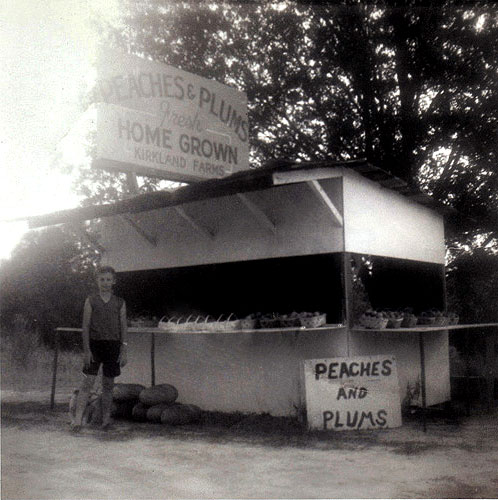
Working at the Kirkland Farms roadside stand, just south of the Florida-Alabama line, in the 1960s.
ESTO WENT PEACH CRAZY for a few years in the 1960s and early ’70s. U.T. Kirkland led the move, encouraged by his brother Carson Ray, who lived in Georgia. Several other farmers got peach fever, too, and Esto became known for its peaches.
One of T’s peach patches was in front of our house, just across a two-rut sandy lane. On the other side it faced the main highway that ran through town. Across Highway 79 he built a little wooden fruit stand with fold-down sides for selling peaches and plums from Kirkland Farms. He gave me my first job running it when I was 8. I wasn’t much of a field hand, but I could make change.
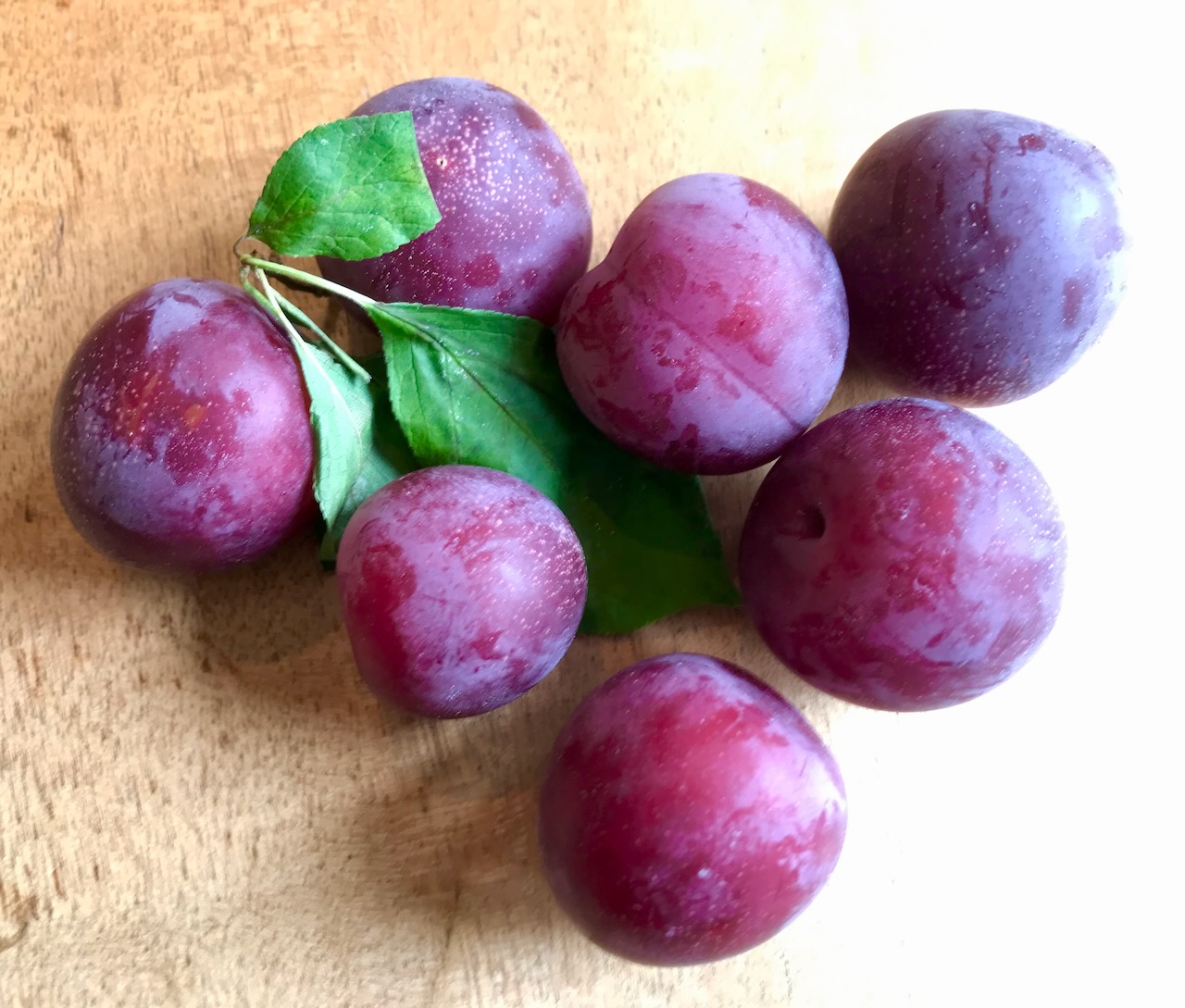
The peaches were good, but in my memory the plums were even better. There was a row of plum trees right outside our front door, along the edge of the peach patch. In early June, as school was ending for the summer, those plums came to full purple ripeness. They were the most delicious thing I’d ever tasted, and not only because they belonged to T and not to me. Years later, I asked T’s son Doyle if he remembered that row of plums and if he knew what kind they were. They were Methleys, he said. For years after I moved to California, I kept asking at farmers markets — overflowing with peaches and plums in the summer — whether they grew Methleys. There were many varieties in the bounty of fruits and nuts and flakes that California produces, but nobody grew Methleys.
My neighbor Diana Arsham heard my rhapsodic memories about Methley plums, and set out to do something about it. Here’s her story.
Methley plums from Diana Arsham’s California garden.
A plum like no other
By DIANA ARSHAM
IT all started in the winter of 2010 with a conversation about childhood memories. Mine: While alone in the garden of my great aunties’ midwestern farm, I walked into a vibrant pink flowering peony bush just my 5-year-old height. Likely I had been drawn to Its iridescent glow in the warmth of the mid-afternoon sun — and of course by the intoxicating scent of its fully flowering ripeness.
My friend Thomas shared his memory of walking out his front door across a small town road lined with Methley plum trees — “a plum like no other,” or at least that’s how he had so fondly remembered the Methley. He recounted how, after moving to California, he had searched for the plum locally in the Bay Area, hoping to relive his early childhood experience. Still longing for the plum like no other, he learned that the local growers had not heard of the plum, let alone grown it.
The conversation piqued my interest as an ardent urban farmer cutting back 10-foot camellia bushes in my backyard for new plantings of fruit trees. I knew I wanted to plant plums — a favorite of my husband Gary’s — having struck out on figs, a favorite of my own.
Plums are popular in San Francisco, particularly the Santa Rosa. I was determined also to grow the Green Gage plum, which I favored. And I had recently been told about the local prize of them all, the Beauty, a Japanese plum more red than the usual purple European variety. They all needed about 200 chill hours to bloom and bear fruit. In our mild San Francisco winters, that’s about the maximum chill time. Other fruits need 800 to 1000 chill hours, so we are talking about a special breed.
By January 2011, Thomas, via the miracle of the Internet, had located a source for the Methley. And as luck would have it, it did have a chill hour requirement of 200 hours. Thomas delivered the Methley to our front porch. Bare root, dry and somewhat bedraggled, it had been on a long trip and needed rest and intensive care. As I prepared a soothing compost-enhanced soak for the evening, I told it we were both on the line.
I planted the Methley in the ground next to a stand of five-foot Shasta daisies (named for Mt. Shasta and hybridized by Luther Burbank), where it got the early sun in the first part of spring. The Methley bloomed its first spring and I dutifully removed all of its blossoms, encouraging it to continue strengthening its root system, branches and trunk.
This year, although initially full of blossoms due to a very late series of rain showers, the Methley set six plums, though only five ripened and turned red.
“Not the right color,” Thomas declared. “It’s not ripe.” Or maybe not the right species, or maybe an inadequate growing environment, I thought. Full of performance anxiety, I also wondered how I was going to keep the plums safe for the next couple of weeks to fully ripen. By now the rains had ended and I had headed off droves of insects by applying Safer soap. But could the Shasta daisies send out a strong competing scent to confuse predators in the form of birds, raccoons and rats? Just to play it safe, I squirted Critter Ridder on the Japanese boxwood at the north end of the bed. And said a prayer.
By the first week of July, while continuing to read up on the care and feeding habits of the Methley, I decided to harvest the plums. Early one morning I sat straight up in bed, knowing it was time. Sure enough, flower pots on the fence so very close to the plum trees had been knocked over by invaders in the night.
Yes, they were a dark purple! Gary and I tasted one. It was very different — dense, with a grape-like texture, jammy almost. It was delicious, but was it too ripe? How are they supposed to taste?
Later that day, I stopped by Thomas’s gallery to give him a tiny half of the harvest. I was ready to tell him my list of triumphs in getting the Methley to harvest, yet prepared to have him find it not as good as his childhood memory. How could it be? Before I could finish the story of my trials and successes, his 8-year-old hand dove into the basket. A second after he popped the first Methley into his mouth, he fairly yelped: “That’s it — the plum like no other!”
SARAH SEGREST taught generations of students 7th grade English and Holmes County French. She was also the first touch of culture that came into the young lives of many of us country kids.
At the rear of her room she had a display space for her flower arrangements, usually featuring camellias in the winter from her garden. She was also an artist, and an ever-changing exhibition of her paintings lined the walls. Plus, she had an air conditioner in her classroom when no one else did — no small attraction in the heart and the heat of the Florida Panhandle.
Mrs. Segrest was just the right combination of nurturing and challenging for 7th graders, no longer in elementary school but not quite teenagers yet. When we got to 9th grade and had her again for French class, her elevated aesthetic sensibilities became ever more obvious. French! With a southern accent.
By the time I had an opportunity to try out my French in France, I had also moved to Chicago, far from home. As I got more interested in art, I thought of Mrs. Segrest, and wrote to her asking if I could visit on my next trip back home and possibly acquire one of her paintings.
And so I did. She and her husband, Dr. Ralph Segrest, lived just south of downtown Bonifay in a secluded woodland thick with hundreds of camellia bushes, where she’d often taken her classes for field trips. Their home was filled with her paintings. I especially liked a still life of a sliced watermelon she had just finished.
“Well, you may not want to pay what my teacher says it’s worth,” she warned me: $100.
It was my first original oil painting, and the subject matter made it a perfect way to remember her and home.
I had also been attracted to an earlier painting of persimmons — especially after she said that another favorite teacher, Mrs. Elizabeth Gavin, who taught 10th grade biology, had brought her those persimmons. As I wrote the check and claimed my prize, Mrs. Segrest took the canvasboard with the persimmon painting on it and tucked it unnoticeably inside the back of the framed watermelon painting. “Dr. Segrest doesn’t like me to give them away,” she whispered.
A few years later, as the art bug was taking hold, I went to see Mrs. Segrest again on another trip back home and asked if I might buy one of her paintings as a Christmas gift for my mother. She suggested an oval of red roses. After mother died, I reclaimed it for myself — and now it reminds me of them both.
The author’s mother with Sarah Segrest’s painting of roses.
Reynolds, who grew up in Esto, has owned an art gallery in California for 25 years (www.thomasreynolds.com). He credits Mrs. Segrest with inspiring his interest in art.
THE ADVERTISER arrived today — my weekly report from home. Holmes County’s weekly newspaper is a lot less local than when it was shepherded by four generations of the Williams family, especially now that it’s ended up as part of the Gannett empire.
Thank goodness for Hazel Tison.
Mrs. Tison was just beginning her career as an English teacher when I started writing for the Advertiser during my senior year of high school. Now, in retirement, she writes a column for the paper she calls the Happy Corner. It’s always a trip back home, usually featuring familiar people or places or things to eat.
This week her headline was “Recipe for Shrimp Bisque.” That seemed like a highfalutin offering in a rural county where we more often eat fried chicken and butterbeans. The column was a lesson in making substitutions “if you don’t have every little thing they call for” in a recipe. When checking to see if she had the makings for shrimp bisque, Mrs. Tison wrote, she found she didn’t have shrimp stock, so she used chicken stock. She didn’t have leeks, but she had a sweet white onion. She didn’t have tomato paste, but she had a can of tomato soup.
She certainly didn’t have one-fourth cup of cognac or brandy or sherry. “Don’t know what the first one is and don’t have the brandy or sherry,” she wrote. “But there is a little scuppernong wine in the refrigerator left over from the Christmas fruit cake. That’ll do.”
We didn’t know what bisque was when I was growing up in Esto. I’m sure of it. At my first important business dinner after graduating from law school, I found myself dining with a phalanx of big-city lawyers, staring down a French menu. Lobster bisque sounded fancy and surely would impress my new colleagues. So I told the waiter I’d start with the lobster beesque. “Very well, sir, the bisque then.” I turned a thousand shades of red, and I’m certain I heard a few snickers.
All these years and miles later, we still call it beesque in our household, even though it’s really pronounced bisque, as in biscuits.
Ethel Hughes stands by the well in front of her house in Esto.
MY GRANDMOTHER LIVED in a little white Jim Walter house just behind the old brick stores on the north side of the railroad tracks in Esto. I loved her, and spent more time when I was growing up at Mama’s house than I did at home. It was a safe and loving place, and there was always something good to eat on her stove.
In 1956 — a year after I was born — Uncle John Hughes arranged for a new house to be built behind the old unpainted wood-frame house that stood in the front yard. My grandmother and grandfather had lived in the old house since 1937 and raised four children there: my mother, known in the family as Doll; Uncle Bill, whose real name was James; Uncle John, who was the most fun; and Uncle Leonard, the baby.
The new house was special for our part of the world because it had indoor plumbing. My grandfather was said to have objected to bringing that sort of business inside the house, since they had a perfectly good outhouse in the back yard.
That story I can’t prove, but I now know the dates for certain. A few days ago an unexpected priority mail box arrived. It contained a handful of photographs, some faded newspaper clippings, and a few old papers that had been saved when they cleaned out Uncle Leonard’s house in Hartford, Alabama, 10 miles north, after he died last year. Among the papers was the application for a tax deed on the property dated August 2, 1937.
Also in the box was the original contract between my grandfather, James Cullen Hughes, and the Jim Walter Corp. dated July 31, 1956. The house cost a grand total of $3,358.40, with $50 down and monthly payments of $55.14 over the next five years.
It was a simple house with three small bedrooms, a small living room, a kitchen/dining room and the aforementioned bathroom, with tub and toilet. The contract says it was a “Capri” model measuring 24×32, or just 768 square feet, but it was big enough to hold a lot of love.
Many people in our part of the world lived in Jim Walter homes. They could be ordered from a pattern book or from the Sears Roebuck catalog. Jim Walter, a Tampa businessman, had started the company in 1946 after World War II ended and soldiers came home to pursue the American Dream, but needed housing. Thousands of Jim Walter homes were built in the following decades on lots people already owned in rural areas throughout the South. The company finally went bust after the 2008 financial crisis.
That little white house provided shelter for our family for many years — and some of my warmest childhood memories.
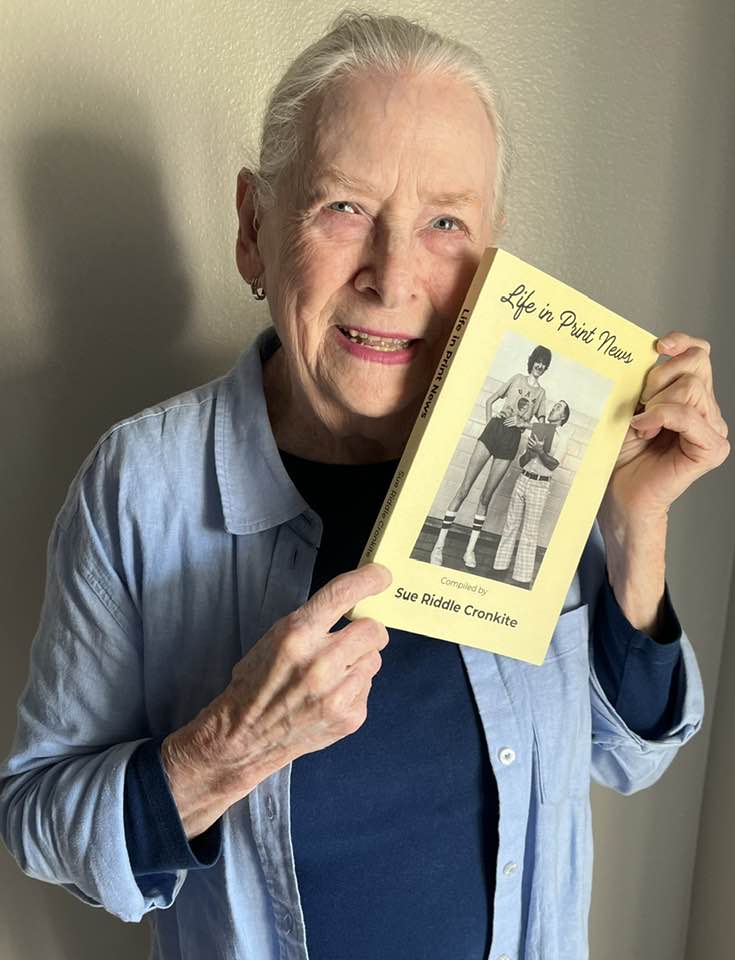
Holmes County’s own Sue Riddle Cronkite and her new novel.
“There’s a sweet, sweet spirit in this place.”
SUE RIDDLE CRONKITE begins each chapter of her new novel, Louette’s Wake, with a few lines from one of the old gospel hymns popular in our part of the world. She didn’t include this one, but it’s evident nevertheless on nearly every page of her story.
Sue grew up in New Hope, another little Holmes County community just a few miles down the Hog and Hominy Highway from Esto, on the other side of the river. She’s part of the storied Riddle clan. And even though she went on to become one of the pioneering newspaperwomen of her generation — with a decade as a reporter and editor at the Birmingham News, among other stops — she’s never gotten far from home.
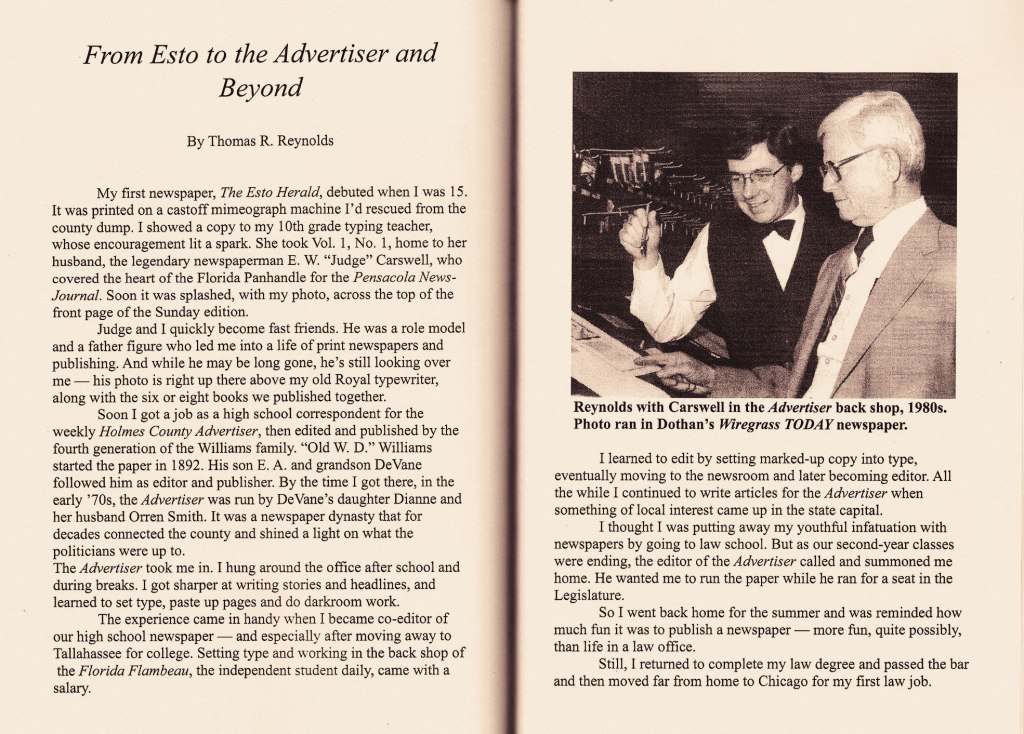
Sue came back to the area in the mid-1980s to become the founding editor of a new daily newspaper in Dothan, Alabama, called Wiregrass Today. That’s when I met her, introduced by our mutual friend E.W. Carswell, another notable newspaper reporter who became the historian of our stretch of the Florida Panhandle during his long career as a staff writer and columnist for the Pensacola News-Journal.
Sue turned me down for a job on her new paper. The publisher didn’t want some college boy who thought he knew it all about exactly the kind of newspaper our area needed. Sue said there was no place for me, which left me with no excuse not to take the opportunity I’d been offered to become editor and publisher of a magazine for lawyers in California.
Instead of a job on an upstart Alabama newspaper that folded after its first year, I got a lifelong friend. She and I have kept in touch across the years and miles and had an occasional visit. So it was a treat to hear a few weeks ago that she’d published the novel that had been rolling around in her mind for many years. I ordered my copy from Downtown Books and Purl in Apalachicola, where Sue now lives, and read it on a recent trip back home to the Florida Panhandle.
In short: It’s terrific. The book lives up to its billing as “an uplifting southern tale,” one that takes place in New Hope and across the state line in Geneva, Alabama. It’s a gentle story that centers on Louise Ella Kelly’s decision to throw herself a wake while she’s still alive. Even more impressive than the story is the writing, which manages in its simple words to capture the particular idioms and cadence of the way we talk — without the false dialect and ignorance and ain’ts and y’alls usually larded into books with a southern accent.
You’ll know these people, and their ruminations, and the honest country food they eat. For those who don’t — Yankees, maybe — she includes recipes at the end for chicken and dumplings, collard greens and chocolate fudge cake, among others. “Buy a big bunch of collard greens off the back of Lige’s pick-up truck, if he comes around,” that one begins.
On my recent trip home, after a couple of dozen of Apalachicola’s finest oysters, I stopped to visit Sue and collect her autograph on a few more copies of her novel I’d picked up at Downtown Books. I found her nearly finished with her next novel, this one involving Esto’s own Two Toe Tom, the legendary alligator that spawned an annual festival in my home town.
“I don’t have any aches and pains,” Sue told me, although the accumulation of years would give her every right. It’s a good thing, since she may have to live forever to finish all the stories she’s started to tell.
My advice: Call Downtown Books and Purl in Apalachicola at 850-653-1290 and ask them to send you a copy of Louette’s Wake. They have yarn, too, if you need any. You could order Sue’s book on Amazon, but it won’t be as good. I promise you’ll love it.
With first cousin Paul Hughes in our backyard in Esto on my 8th birthday. He was 6.
DR. J. PAUL HUGHES had a head start on life by being born to parents who lived in Esto, an idyllic little town on the Alabama-Florida line. They lived on the south side of the railroad tracks, near the Wellses and some of the Kirklands. Motor and Humpy Pitts also lived nearby, a little farther back into the woods.
Paul’s grandparents, Ethel and Cullen Hughes, lived a couple of blocks away, if we’d had blocks back then in Esto. So did his father’s sister, known in the family as Doll, who was my mother. Paul and I were close in age — I’m two years older — and we were playmates as far back as I can remember.
What I recall most fondly about Paul’s early years is when Uncle Leonard and Aunt Sarah bought him a swimming pool — just a little above-ground tin-sided round pool that held about two feet of water, but it seemed rich in a time and place where swimming was done in Ten Mile Creek. Paul and I spent hours in that pool, which sat out in their yard beside a big stinky gardenia bush. Our favorite game was to hold our noses and dive underwater, looking to be the first to find the bottle cap one of us had thrown backwards over our shoulder.
As we got a little older, our hobbies grew more sophisticated. We began collecting and identifying rocks we found on nearby dirt roads. We used our crayons to draw flags from countries around the world. Eventually we took up stamp collecting. We claimed a corner of Mama and Papa’s junk house and set up the H&R Hobby Shop. Why his name came first I can’t imagine, although it’s true he always was a little smarter.
Wells Grocery Store sat just beside Mama’s house. One day Mr. Wells decided to put in a coin laundry. The washers and dryers came in huge cardboard boxes, and we had weeks of fun playing in those big boxes.
Perhaps inevitably, Esto became too small for Paul. He and his parents moved across the state line to Hartford, Alabama, about 10 miles north. We thought they were puttin’ on airs by moving to town, but off they went, and into a new brick house, no less. Our play days were over.
But we remained friends. Years later, after he’d finished college and medical school, he came to live with me in Chicago for a few months while he interned at Cook County Hospital. By then our hobbies and interests were considerably more refined. I especially remember dollar pitchers of beer at Streeter’s Tavern on Thursday nights.
He became a brilliant physician, an astute investor and a talented musician who played many instruments and recorded quite a few albums. But he never lost his taste for beer. It did him in, at only 61, three days before Christmas. He will be buried this morning near home in the Hartford cemetery.
A PHONE CALL tonight from Esto reminds me to wish a Happy Father’s Day to U.T. Kirkland, who was a father figure to many of us Esto boys. That’s T, as we knew him, in the middle with (from left) Wesley Brockway, Stevie and David Godwin, Charles Crutchfield, Dean Newman and Ray Reynolds.