Archive

Personal History

MissVann

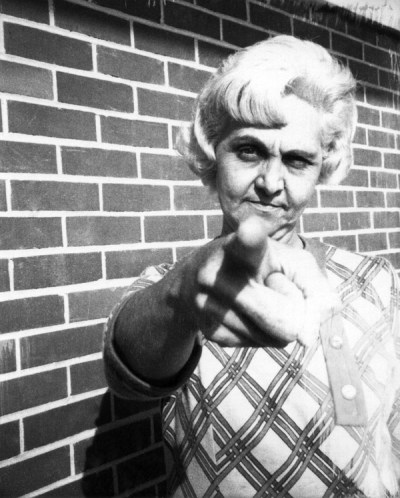
Lynelle Vanlandingham’s pointed finger and raised eyebrow were legendary.

MANY STUDENTS from Esto and other Holmes County communities who went to school in Bonifay had Lynelle Vanlandingham as their civics teacher in ninth grade. She was from the old school, and misbehaving in her classroom was never an option. She’d point her finger and raise her eyebrow and everyone would fall in line.

That technique worked until the very end. Her fellow teacher Mrs. Dianne Smith — who first taught ninth grade English and later became the senior English teacher at Holmes County High School — recalled a visit with Miss Vann at the nursing home in Bonifay shortly before her death in 2016.

“Nelle remained as feisty as ever,” Mrs. Smith said. “I visited her in the nursing home just a few days before she died. I asked her then if she could still raise that eyebrow like she did to control students. She showed me that she could — and said she used it on some of the nurses when they did something she didn’t like.”

Read More: “One tough teacher

mother-icecream

Homemade ice cream under the pecan trees.

IT WAS 30 years ago today — exactly — that my mother died.

She had tried again to quit smoking, and had succeeded for almost a month. But when she’d come home from the shirt factory a few days earlier, driving the 10 miles south across the Alabama-Florida line, as she’d done nearly every working day since she was 16, she sat down on the back steps and smoked a cigarette. The aneurysm in her brain followed.

All the way to the hospital, she kept saying, “I knew I shouldn’t have that cigarette.” My brother Bobby called that night to say, “We have a problem.” Somehow I knew I should take a suit and tie. By the time I got across the country the next night, the doctors said it was unlikely she would recover. We never talked again. She was gone by the end of the week.

A death in Esto requires food. Fried chicken, potato salad and a 12-layer chocolate cake soon began to arrive from the neighbors. Two days later, at her funeral, flowers crowded the front of our church. Afterward we went outside to her waiting grave in the cemetery. We are neck-hugging people. When Mr. Bass, the ancient patriarch of our church, came slowly walking up, I hugged him close and cried. It wasn’t supposed to be this way, not so soon, or so fast, or so unexpectedly. “Well, son, it’s hard to lose your mama,” our neighbor Clyde Griffin said in his big loud voice as he wrapped his arm around my shoulder. And then he lightened the mood, unintentionally. “If she’d a lived,” he said, “after that aneurysm, she’d a never been nothing but a vegetarian.”
mother

MOTHER HAD BEEN in intensive care for a week. Her eyes were closed, but she seemed to move at times. The doctors said her ruptured brain was dying, that the movement was involuntary.

Still they kept her alive. They said there was no hope of recovery, but still they kept her breathing. It didn’t seem right. “They should let her go,” I told my friend Susan, who phoned in every day. “She’ll go when she’s ready,” Susan replied.

I had to leave the hospital. I drove home to Esto. It was late on Sunday afternoon. As I pulled mother’s car into the driveway, the weak winter sunlight was slanting through the pines. I walked around our acre, through the trees, past the barren garden, by the modest tin barn, as the sun went down. As I walked into the house, the phone was ringing.

“Better come back,” my brother said.

Mother died that night as we stood holding her hands.

img_8581

THE DOORBELL RANG. It was a mailman delivering a priority mail box. Inside was a treasure: old family books and papers from Elijah Curtis Young, the only relative of my father I ever knew, who died 40 years ago, in 1976.

I was never sure exactly how we were related, or even if we really were. Throughout my childhood, Curtis would stop and visit every fall when he came through Esto on his annual trip home to see friends and relatives in Georgia and Alabama. Usually he brought along oranges or grapefruit as a treat from South Florida.

As it turns out, we truly were related. Curtis’s mother was a Reynolds, according to the family Bible. Lennie Jane Reynolds, born December 3, 1882, married Stephen F. Young, born May 17, 1866. Elijah Curtis was one of four brothers and sisters. He married Elizabeth Hayes on December 27, 1934. I would know them as Curtis and Lizzie, and they were important beyond measure in my young life.

Read More

AFTER THE Esto Herald appeared in 1970, the editor was invited to begin contributing to the Holmes County Advertiser, the weekly newspaper of record published in the county seat of Bonifay. It launched a lifelong friendship between an aspiring young editor from Esto and Orren Smith, longtime editor and publisher of the Advertiser, that lasted until Smith’s death on September 16, 2015.

Read More:Remembering Orren Smith”

Orren-Dianne-Smith-1978

Dianne and Orren Smith at the Holmes County Advertiser in 1978.

WHEN WE WENT BACK to school for sixth grade in 1966, there was a new librarian at Bonifay Elementary School. Dianne Williams Smith was returning Holmes County royalty — the daughter, granddaughter and great-granddaughter of editor-publishers of the Holmes County Advertiser, whose family founded the newspaper in 1892.

By ninth grade she was teaching us the glories of “To Kill a Mockingbird” and beginning a distinguished career as a tough but respected English teacher.

Her husband, Orren Smith, a native of nearby Greenwood in Jackson County, had come home with her from Atlanta, where they married, to help run the family business. Orren wasn’t a newspaperman, but he was a quick study, and the Advertiser benefited from his business acumen. A few years later, after Dianne’s father was sidelined by a stroke, Orren took over as editor and publisher.

Read More

blueberries

Dear Mary,

WHEN I WAS A LITTLE BOY growing up in Esto, there was a blueberry patch down the hill and across the highway that ran in front of our house. It was on land owned by U.T. Kirkland. Those initials were all the name he had, but he was a kind-hearted, hard-working farmer whose wife Delma — I called her Big Mama — kept me in the years before I started school. (She also taught me some of my most important early lessons. When I turned 5 and got one of those sit-down blackboards, I sat right down and wrote my first word: S-H-I-T. She wouldn’t say it, but she frequently spelled it, and apparently I had been paying attention.)

T and Big Mama were all-important to me. My mother left early every morning to drive across the Alabama line to work in the Van Heusen shirt factory in Hartford, and my father died young just as I turned 4. I loved T and Big Mama. And blueberries always bring them back to me.

Thank you for that perfect blueberry flip you shared last night — and for the memories that came with it.

lakeworth

STILL I REMEMBER the images: the grass alongside the road blurring by outside the car window; waking alone in the motel room; the whiskey bottle silhouetted against the night.

I was 2. My father had picked me up at Big Mama’s after lunch, as usual, to take me for ice cream. But he didn’t stop. I was immediately excited because I knew something unusual was happening. We always stopped at Bunk Johnson’s gas station at the crossroads to get ice cream. But this time we kept going south on Highway 79, past Moody and Sybil Taylor’s farm

Read More