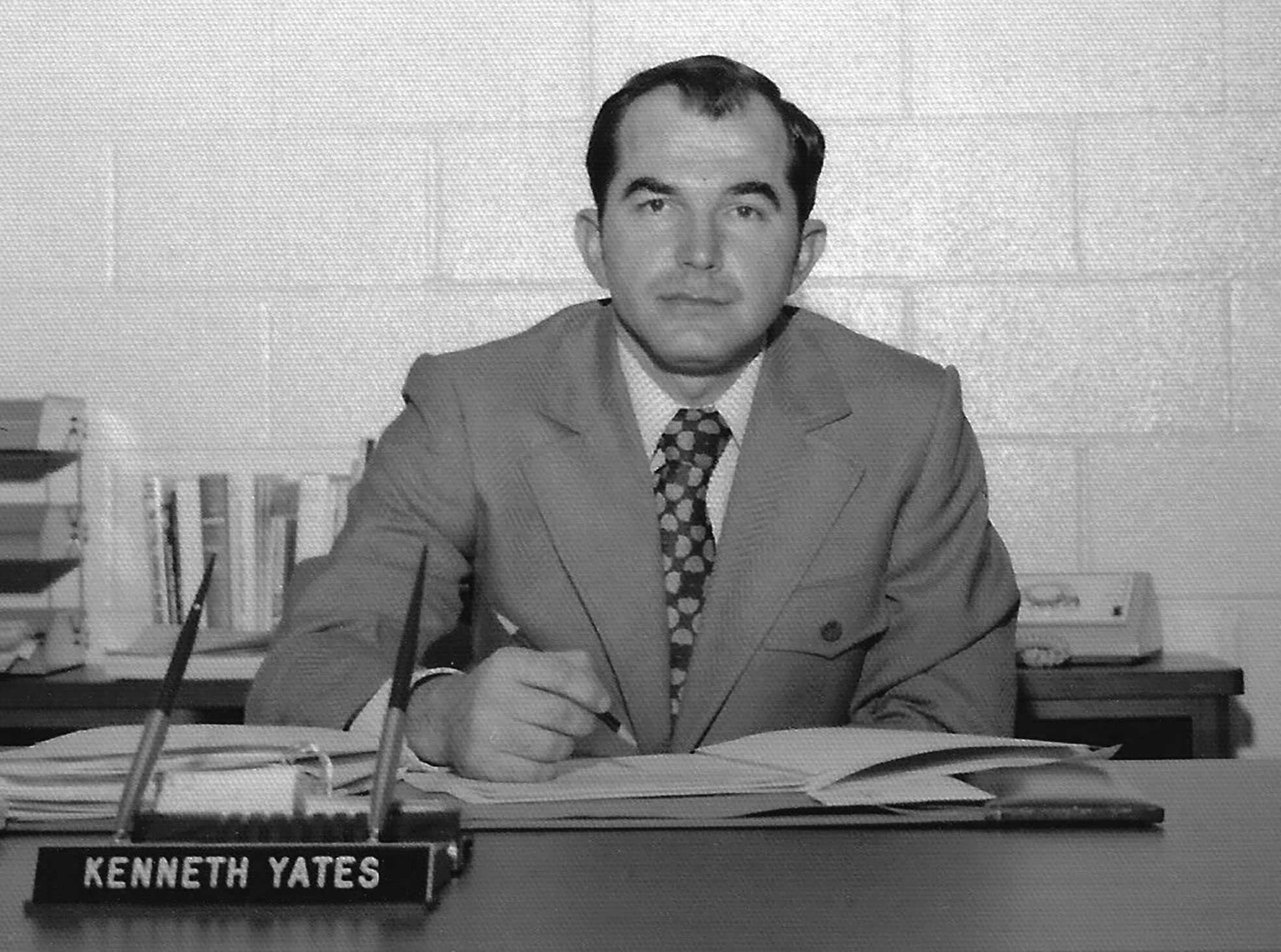
For decades, Kenneth Yates was principal at Poplar Springs and Bonifay Elementary School.
FEW HAVE TOUCHED more young lives in Holmes County than Ken Yates. Or possibly more adult lives, either.
He was honored last Sunday for playing the organ at First Baptist Church in Bonifay for 70 years. One might guess the ever-youthful Mr. Yates must have started before he was born.
In fact, he started at 14. He and young Dianne Williams — later as Dianne Smith a revered high school English teacher — played for Sunday night services.
Along the way he set out to find the church a respectable pipe organ. He heard the old First Presbyterian Church building in Pensacola was being torn down. So he arranged, for $400, to have its organ brought to Bonifay — where, as it happened, mighty First Baptist was just about to build and occupy a grand new sanctuary. The organ, and Mr. Yates himself, have been installed there ever since.
“I’ve had a wonderful time, and it started innocently,” he said when he finally rose from the bench and leaned on the organ to speak on Sunday morning. There wasn’t a lot to do in Bonifay on Sunday afternoons when he was growing up two blocks from the church. One Sunday he wandered in while Dianne Williams was practicing for that night’s service.
“Don’t you play the piano?” she asked.
He had taken a few lessons, and he did play the bass drum in the high school band, but was not a trained musician — and in fact has never had a formal organ lesson. But the Bonifay Baptists acquired a modest organ in the 1950s “because the Methodist church bought an organ,” Yates cracked. “They had money.” He asked Miss Mary Coleman, the church’s retired organist and a longtime 4th grade teacher, to meet him after school to show him the basics.
“That’s how it all started,” he said, recalling his first offertory song: “Nobody Knows the Trouble I’ve Seen.”
In addition to being a natural musician, he was a good student. He went on to Chipola and then to Florida State, where he got his bachelor’s degree. After teaching for a year in Marianna, he went back to FSU for a masters in educational administration and supervision. During his internship at a Pensacola high school, he was lured home to become the principal at Poplar Springs. He was almost as young as his students.
“Sitting in this room are people from way back,” he told the congregation. “Some of you have gotten older than I am — I don’t know how you did it.”
Yates went on to serve for two decades as principal of the modern new Bonifay Elementary School and implemented all sorts of innovative programs. Students and teachers loved him, and parents did, too. Eventually he got kicked upstairs to the county office and kept stirring the pot until his retirement. Then he started volunteering at the hospital and nursing home and as a teacher at the new state prison built just south of town.
“I taught school and I taught prison,” he said. “There wasn’t a lot of difference.”
Through it all, he’s kept playing the organ at First Baptist Church.
“This was on the side,” he said. “But I felt just as committed to what I did here.”
I GOT A special bonus when the Holmes County Advertiser arrived this week. Tucked inside was a copy of The Graceville News, including a special section congratulating this year’s graduating classes at the local schools.
The paper was intended for Roy Price, who lives just down the coast. Before I sent it on, I took a look. After all, people in Esto often went to Graceville when we “went to town.” It had the closest Piggly Wiggly.
I especially enjoyed a column headlined “The Graceville I Knew,” which described pretty much the same Graceville I knew — the soda fountains at Service Drug Store and Cash Drug Store, the Jones Theater, the American Legion pool. Added columnist Bill Clark: “Once in a while we got to travel up to Dothan for special outings” like bowling or a big-screen movie at the Martin Theater.
That was “going to Dothan,” 30 miles over the Alabama state line, rather than “going to town,” which to those of us in Esto usually meant Graceville or Hartford, Alabama, both about 10 miles away.
A lot of the advertisers in the special graduation section were familiar: the Pig, Circle Grill, Rex Lumber, Woodham Peanut Plant, West Florida Electric, the churches, the politicians and the funeral home. Some mainstays were missing, including Henry Arnold Ford and Jones Motor Co., which sold Chevrolets and Cadillacs. Graceville had its prosperous side and was said to be the smallest town in the country with a Cadillac dealership. I used to walk into the showroom and dream. One time a salesman told me I had good posture, which made me stand up even straighter, then and now.
This year’s graduates look full of promise in their senior pictures, formal in black dresses or tuxes with black bow ties. I was surprised to see an identical number of students graduating from both Graceville School and from Poplar Springs High School, which has doubled in size since our growing-up years. Graceville’s graduates are now mostly black, Poplar Springs’s still almost all white.
I mailed his paper on to Roy Price in Ventura with a note confessing I’d taken a look. I told him: “Perhaps like you, I’m happy to live in California, but still consider the Panhandle home.”
HE WAS JERRY PELHAM when he was growing up on his family’s farm just south of Esto. But he became well known and highly respected — and made a major contribution to Florida politics and policy — as Thomas G. Pelham, the Tallahassee lawyer and land use specialist who served two different terms, under two different governors, as secretary of the state’s Department of Community Affairs.
In his recent memoir, Kids Don’t Have Backs, he tells the story of his early years on the old Blackburn place — his grandparents’ farm, later taken over and expanded by his parents, Roy and Louise Blackburn Pelham.
“The farm was located on Florida Highway 79 in a rural area known as the Holland Cross Roads farming community, just two miles south of the Alabama-Florida state line,” he writes, adding that when his grandparents moved to Holmes County from Georgia in 1918: “The county was sparsely populated and living conditions were primitive. There was no electricity, and therefore no electric lights, indoor plumbing, running water, sanitary facilities or air conditioning. Tractors and other modern farm equipment were not generally available or affordable, so farming was mostly conducted with mules and hard manual labor.”
That hadn’t changed much by the time Pelham was born in 1943, the first of four boys driven by their father, and necessity, to work the land. Eventually electricity and tractors would come, along with a new house and barn across the highway, plus a younger sister.
“The farm was a year-round, labor intensive, physically demanding enterprise,” he writes, “that over time involved the efforts of our entire family, including the children, who frequently worked like adults.”
•
Pelham paints a picture of unrelenting, backbreaking work: milking cows, feeding hogs, chopping and picking cotton, pulling corn, stacking peanuts, building and rebuilding fences. It’s a life that will be familiar to nearly everybody who grew up in Holmes County.
“Hard work never hurt anybody,” was his father’s frequent refrain.
The title comes from a memory of a hot summer day in the cotton patch when he stretched his aching back and then dropped to his knees and started crawling.
“Hey, boy, get off your knees and get to pickin’ cotton,” his daddy commanded. “But my back hurts,” he replied as he slowly got to his feet. “Kids don’t have backs,” his daddy declared.
Neither did every farmboy have a grandmother down the road who subscribed by mail to the Atlanta Journal-Constitution, which she passed along to her grandson. The Atlanta papers were especially strong in their coverage of school integration in the wake of the Brown v. Board of Education ruling in 1954, stirring Pelham’s awakening awareness of the U.S. Supreme Court and the rule of law. His learning was helped along by some memorable teachers at Holmes County High School — still segregated at the time — especially Miss Lynelle Vanlandingham, who taught ninth grade civics.
He writes: “Miss Vann’s discussions of the structure and functions of American national and state governments, the roles of the three branches of government, and our democratic values, sparked my lifelong interest in government and politics. A legendary disciplinarian, Miss Vann could silence a rowdy class simply by pointing her finger and arching an eyebrow.”
Not all of the enlightenment took place in the classroom.
The school bus — bright yellow with big black letters, just like today — picked up all of the students who lived on Highway 79 between Esto to the north of our farm and Bonifay to the south. But it also made two long loops over unpaved red clay side roads to pick up students who lived off the main highway.
Riding the school bus was an education in itself. Filled with 30 or more boys and girls ranging from first graders to high school seniors, the bus contained a combustible mix of high energy, youthful exuberance and raging hormones. Boys harassing girls and girls flirting with boys, big boys picking on little boys, profanity and sexual innuendo, spit balls and flying paper airplanes, some of them aimed at the bus driver. On a few occasions the playfulness turned ugly and fights broke out.
Pelham quickly learned to love school. “Over the years,” he writes, “it became easier and easier for me to get ready to catch the school bus every morning.”
By the time he was a senior in 1961, Pelham was president of the student council and valedictorian of his graduating class. He helped organize and raise funds for an eye-opening senior class train trip to Washington, D.C., and New York City.
“Our trip gave me a lot to think about on the train ride home,” he writes. “Seeing the exciting world that lay beyond the narrow boundaries of my life on the farm strengthened my desire to go to college. That still seemed to be an impossible dream, but I was determined to find a way to get there.”
He came home to the farm and announced his intentions. His mother, who had also been the valedictorian of her class at Holmes County High, was supportive. But not his father, at least not at first. “Who is going to help me gather these crops and take care of the farm animals and all of the work around here?” he asked.
•
By then Roy Pelham’s oldest son had a back and a backbone. He found a way to make it happen, getting degrees from Chipola Junior College, Florida State University and Duke University, and later law degrees from Florida State and Harvard Law School. When he died on February 21, 2023, after a long battle with Parkinson’s Disease — during which he wrote his memoir — he was eulogized by the state’s foremost political writer, Lucy Morgan, as a legal lion. She wrote: “No single person in our history did more to protect Florida’s fragile environment and manage growth.”
We had a late lunch at an automat. Prior to our trip, I had never heard of an automat and, in fact, our school cafeteria was as close as I had ever gotten to a restaurant or cafeteria. In an automat, I quickly learned, each food dish is placed in a compartment behind a hinged glass window. To select a food item, the diner inserts the required coins, then lifts the glass window to remove the food and place it on a tray.
While some of my classmates discussed the merits of automats, we became aware that a black man had entered the room. Tall, trim and Sidney Poitier handsome in his U.S. military uniform, with stripes and medals on his chest, the man sat down with his food tray at a table across the room. There was a sharp intake of breath by some of my classmates. We were not accustomed to seeing black people in restaurants and other public facilities, which were still segregated in the South in 1961.
“Is he allowed in here? He wouldn’t be back home,” one of our classmates whispered.
“Maybe we should leave,” someone said in a louder voice.
Then we all froze. The military officer rose from his seat and walked over to our tables.
“Welcome to New York City,” he said in a warm, friendly voice, with a big smile. “Where are you from?”
“Florida. We are on our senior class trip,” someone managed to say.
“What a great experience for you. Is this your first time in the city?”
“Yes,” several classmates responded.
“Well, you will find that New York is a great city. I hope you have a wonderful time,” he said. Then he gave a little half salute, turned and went back to his table, leaving us in stunned silence.
Elizabeth Gavin opened the minds of many students at Holmes County High School.
FIFTY YEARS AGO, I was a student in Beth Gavin’s senior biology class. But she wasn’t there. Olive Berry had come out of retirement to substitute during the fall semester while Mrs. Gavin was having her third child, her son, Tom.
We noted the birth in Devil’s Chatter, the student newspaper, adding cheekily: “How’s that for knowing your subject matter?” Soon came the directive to destroy all copies of the issue and reprint it without that offending line.
Mrs. Gavin thought the handwringing was ridiculous. That was, by far, not the raciest thing she’d heard in years of teaching teenagers about reproduction and evolution.
“They all thought I was an atheist,” she recalled of first teaching country kids Darwin’s theory of evolution. (In fact, she was a Methodist.) Of her frank approach to teaching about sex, she said: “This is real life. This is what happens. And it’s not to be ignored or hidden. It just is.”
Mrs. Gavin brought that same matter-of-fact approach to all of the topics she taught over the decades at Holmes County High School — primarily 10th grade biology, where I first experienced her firm control of both her subject matter and her classroom.
She’d already helped write the textbook we used, plus several others. She instructed us in the rigor of the scientific method through science projects we created and presented at regional, state and international science fairs. Her approval did not come easily. She drilled into us that we were just as able as students who came from bigger schools and fancier families in tonier towns.
•
She expected us to grow up. She even took a lucky few of us on school trips out into the world beyond Holmes County, insisting we learn to behave properly, and adventurously.
“I was what other people might call ‘loose,’ but I thought that was all right,” she told me toward the end of her life as we recalled a memorable trip to the International Science and Engineering Fair in New Orleans when I was 16. “I do know that I have done some things wrong. But, then again, I wouldn’t undo them.”
She sponsored me for scholarships to summer science programs, where I lived and learned with other, smarter high school students from around the country. She led me toward college at Florida State, 100 miles away in Tallahassee, rather than staying home for junior college with everybody else.
“There’s a bigger world,” she would tell me.
And the encouragement didn’t stop when I graduated from high school. I had a friend and supporter for life. There were regular notes and birthday cards. And I’d better not be spotted back home in Esto without stopping for a visit with her.
She had a long retirement with her husband, Bill Tom, at their farm just across the dirt road from his family home, and not far from the house her mother built at Highway 2 and Gavin Road. As she aged, she kept her faith in medicine. When surgery was required, she was ready. “I believe in science,” she said.
•
A few days into the new year, at age 84, Elizabeth Gavin died. She will be much missed and long remembered by her family and friends and the hundreds of students whose minds she shaped.
She had three biological children: Gayla, Jennifer and Tom. But I always felt that Martha Cullifer Howell and I were a close fourth and fifth. Of Martha, she said, “I love her — I feel like she’s my oldest daughter,” while showing off a mug Martha brought proclaiming her Big Bad Bitchy Beth.
“Write, call, come see me before I die!” she wrote in a birthday card for my 64th birthday. “I love my oldest son very much and miss you.” During one of our last visits she told me: “What matters to me are my children and certain students. Whatever they do, I love them.”
We loved you, too, Beth. You were a great teacher, in the broadest possible sense of the word. One more time: Thank you. Rest in peace.
SARAH SEGREST taught generations of students 7th grade English and Holmes County French. She was also the first touch of culture that came into the young lives of many of us country kids.
At the rear of her room she had a display space for her flower arrangements, usually featuring camellias in the winter from her garden. She was also an artist, and an ever-changing exhibition of her paintings lined the walls. Plus, she had an air conditioner in her classroom when no one else did — no small attraction in the heart and the heat of the Florida Panhandle.
Mrs. Segrest was just the right combination of nurturing and challenging for 7th graders, no longer in elementary school but not quite teenagers yet. When we got to 9th grade and had her again for French class, her elevated aesthetic sensibilities became ever more obvious. French! With a southern accent.
By the time I had an opportunity to try out my French in France, I had also moved to Chicago, far from home. As I got more interested in art, I thought of Mrs. Segrest, and wrote to her asking if I could visit on my next trip back home and possibly acquire one of her paintings.
And so I did. She and her husband, Dr. Ralph Segrest, lived just south of downtown Bonifay in a secluded woodland thick with hundreds of camellia bushes, where she’d often taken her classes for field trips. Their home was filled with her paintings. I especially liked a still life of a sliced watermelon she had just finished.
“Well, you may not want to pay what my teacher says it’s worth,” she warned me: $100.
It was my first original oil painting, and the subject matter made it a perfect way to remember her and home.
I had also been attracted to an earlier painting of persimmons — especially after she said that another favorite teacher, Mrs. Elizabeth Gavin, who taught 10th grade biology, had brought her those persimmons. As I wrote the check and claimed my prize, Mrs. Segrest took the canvasboard with the persimmon painting on it and tucked it unnoticeably inside the back of the framed watermelon painting. “Dr. Segrest doesn’t like me to give them away,” she whispered.
A few years later, as the art bug was taking hold, I went to see Mrs. Segrest again on another trip back home and asked if I might buy one of her paintings as a Christmas gift for my mother. She suggested an oval of red roses. After mother died, I reclaimed it for myself — and now it reminds me of them both.
The author’s mother with Sarah Segrest’s painting of roses.
Reynolds, who grew up in Esto, has owned an art gallery in California for 25 years (www.thomasreynolds.com). He credits Mrs. Segrest with inspiring his interest in art.
The Esto School offered instruction in grades one through nine until it was closed in 1949.
By E. W. CARSWELL
The saddest day in Esto’s history may have been September 9, 1949 — the day the community’s school was closed.
“It was the equivalent of experiencing a death in the family,” one former student observed. The community had never appeared more lifeless than it did in the weeks following the closure of Esto Junior High School, where instruction had been offered from grade one through grade nine.
Local townspeople were met with ghostly silence from a horseshoe-shaped one-story frame school building on a hillside just north of Esto Baptist Church on the western side of Highway 79. Absent were the voices of children, who for years had gathered at the school on weekday mornings to begin classes. After the school closed, they started boarding buses a little earlier instead, heading for schools in Bonifay, the Poplar Springs community or Hartford, Alabama. Lumber from the former school was used in the construction of several houses in the community.
Some Esto residents more than 40 years later seemed still unreconciled to the loss of their local school. Those sentiments promoted a feeling of uncommon closeness among those who attended the school. It was not unexpected, then, for former students to suggest that a school homecoming be added to Esto’s annual Two-Toed Tom Festival in 1991.
Betty George, who had attended the school, organized the homecoming, which became a regular part of the festival for a few years. In an interview for Florida Public Radio in 1993, she recalled fond memories the school, and marveled at how many former students showed up for the reunion.
A NEW LIBRARIAN arrived with the beginning of the sixth grade. Dianne Smith took over from longtime librarian Miss Louisa Hutchinson, who had gotten married very late in life and retired.
The new librarian was brimming with ideas, including a reading contest for sixth graders. For months we had to choose books from a reading list and then be quizzed by Mrs. Smith. When it was all over, the smartest girl in our class had been bested by Danny Henderson, who would soon move with his family to Esto.
A picture of the winners appeared in the weekly Holmes County Advertiser — a high honor in itself — with a story that explained: “The purpose of the reading contest was to acquaint the students with the best books in the library in the hopes they would discover the pleasure of reading and would be encouraged to do more reading on their own.”
The contest ran almost all school year, from October 1966 to May 11, 1967. The Advertiser story explained how it worked.
Mrs. Orren Smith, librarian, prepared a reading list from which the contestants chose the books. The list included selections of fiction, biography, mythology, science, art, music and history. Most books counted one point, but selections from the classics or books of special value counted more.
After reading a book, the student would answer a few questions about it to prove that he had really read the book. The student accumulating the most points was declared the winner.
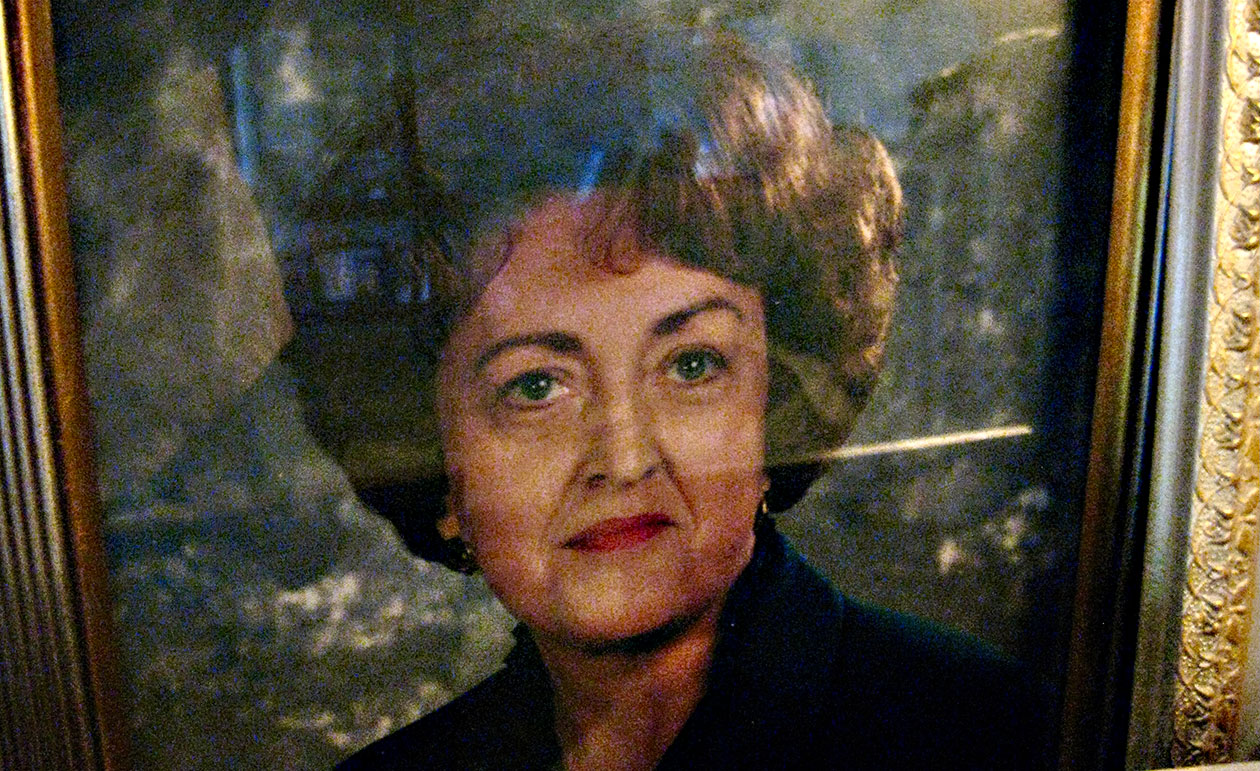
It was Dianne Smith’s first year back home in the local schools. She would soon move up to the high school to teach junior English. Later, after the formidable Mrs. Mabel Harris retired, she taught senior English and humanities for many years, touching the lives of generations of students.
Lynelle Vanlandingham’s pointed finger and raised eyebrow were legendary.
MANY STUDENTS from Esto and other Holmes County communities who went to school in Bonifay had Lynelle Vanlandingham as their civics teacher in ninth grade. She was from the old school, and misbehaving in her classroom was never an option. She’d point her finger and raise her eyebrow and everyone would fall in line.
That technique worked until the very end. Her fellow teacher Mrs. Dianne Smith — who first taught ninth grade English and later became the senior English teacher at Holmes County High School — recalled a visit with Miss Vann at the nursing home in Bonifay shortly before her death in 2016.
“Nelle remained as feisty as ever,” Mrs. Smith said. “I visited her in the nursing home just a few days before she died. I asked her then if she could still raise that eyebrow like she did to control students. She showed me that she could — and said she used it on some of the nurses when they did something she didn’t like.”
Dianne and Orren Smith at the Holmes County Advertiser in 1978.
WHEN WE WENT BACK to school for sixth grade in 1966, there was a new librarian at Bonifay Elementary School. Dianne Williams Smith was returning Holmes County royalty — the daughter, granddaughter and great-granddaughter of editor-publishers of the Holmes County Advertiser, whose family founded the newspaper in 1892.
By ninth grade she was teaching us the glories of “To Kill a Mockingbird” and beginning a distinguished career as a tough but respected English teacher.
Her husband, Orren Smith, a native of nearby Greenwood in Jackson County, had come home with her from Atlanta, where they married, to help run the family business. Orren wasn’t a newspaperman, but he was a quick study, and the Advertiser benefited from his business acumen. A few years later, after Dianne’s father was sidelined by a stroke, Orren took over as editor and publisher.
Miss Vann was aware of the power of her raised eyebrow and pointed finger.
FROM A CARING Mrs. Ruby Coleman in first grade to a nurturing Mrs. Sarah Segrest in seventh, and on through the demanding Mrs. Mable Harris for senior English, we were fortunate to have some wonderful teachers.
Last weekend we lost one of the very best: Miss Lynelle Vanlandingham, who taught ninth grade civics for decades at Holmes County High School.
Miss Vann had a richly deserved reputation as a tough taskmaster. A pointed finger and an arched eyebrow were usually all it took. A firm thump on the ear when necessary. You did not want to be directed to step outside.
We had no choice but to learn something in Miss Vann’s classroom. There were no distractions. She was thoroughly prepared. And the subject was interesting: current events, and how a democracy works, and a citizen’s responsibility to help make it work.
Miss Vann taught generations of Holmes County students, including some she prepared also to become great teachers.
“Nelle taught me ninth grade civics,” remembered Mrs. Dianne Smith, who taught us ninth grade English the same year we had Miss Vann, and later would succeed Mrs. Harris as an equally demanding senior English teacher.
“Even at my relatively young age at the time, I caught on that a stern teacher controlled the classroom better than the teachers who wanted to be ‘best friends’ with their students,” Mrs. Smith said. “As stern as she was, though, she could still say some funny things at times. In the summertime, she frequently chaperoned house parties at the beach, so we got to see another side of her. She was a lot of fun and knew how to keep a bunch of silly teenage girls in line. We loved her.”
Mrs. Smith said she picked up some of Miss Vann’s approach to teaching.
“Not only did I absorb some things about the importance of classroom management and discipline, but also I learned about the importance of organizational skills for students. She made us keep a notebook just for her class, and she graded it at the end of each six weeks.”
After a long career in the classroom, Miss Vann had a long retirement. She was 93 when she died.
“I went to visit her last Sunday at the nursing home,” Mrs. Smith said. “She told me some funny stories, and seemed to be in good spirits. Like all nursing home patients, she told me several times how much she wanted to go home. When I heard that she’d died, my first thought was that God had taken her home.”




 The Esto Herald