Archive

Video

GOSPEL WAS OUR MUSIC when I was growing up in Esto. In addition to church, we often had community sings, and the Biggest All Night Gospel Singing in the World was a major event every Fourth of July weekend, from sundown to sunup, at the football field in Bonifay, the county seat.

When I was a senior in high school, we went to a revival service at First Baptist Church in Bonifay — the big time in Holmes County. It featured traveling evangelists Ed and Bette Stalnecker and their entourage of musicians. I especially loved Bette’s soaring rendition of “His Eye Is on the Sparrow,” a beautiful song not in our hymnal. I found the sheet music and must have played that song hundreds of times on the piano at Esto Baptist Church as the prelude or offertory or benediction hymn.

After I moved all the way to Tallahassee for college, I saw the Stalneckers again at Thomasville Road Baptist Church. The music was still joyous and uplifting, especially “His Eye Is on the Sparrow.” (But you had to wonder about Rev. Ed Stalnecker’s demand at the end of his sermon that 100 people come forward to make a public profession of faith before the doors would be opened.)

I saw and heard the Stalneckers only those two times, but the memory of their music stayed with me. Once when I was back home, I asked retired school principal Kenneth Yates, then and now the organist at First Baptist Bonifay, if he remembered the Stalneckers. Not only did he remember; he had recorded some of their music, and promised to make a copy. I rarely saw Mr. Yates on my trips home that I didn’t ask about the Stalnecker recording. He always assured me he’d find it someday and make a copy. But it never happened. Decades passed.

And now, all of a sudden, it’s here. I went to the post office on Monday and found a yellow notice in our box that we had a package. The desk clerk came back with a small square padded envelope. Return address: K. Yates, Bonifay, FL. Inside was a CD with the inscription: “A Week of Gospel Music: The Stalneckers. FBC Bonifay. February 1973.” Only 49 1/2 years later!

“This is my story, this is my song.”

That’s the full-throated opening chorus of the first hymn, an old favorite. Then “Love Lifted Me” and “Heaven Came Down and Glory Filled My Soul” and “Oh, the Wonder of It All.” And then, on track 10: “His Eye Is on the Sparrow,” every bit as wonderful as I remembered.

That voice! Bette Stalnecker was a contralto, it turns out, with a big deep husky singing voice that sounds almost like a man. Her soft-spoken sweetness and gentle humor come through between songs. At one point she says, “We get a complaint every now and then that we don’t do enough foot-stomping gospel music,” followed by a rollicking version of “Jesus Is Coming Soon.” And then, near the end, everybody’s favorite: “How Great Thou Art.”

I’ve played the CD dozens of times during the past week. A little searching revealed that Ed divorced Bette a few years after I saw them. He found another Betty and another ministry involving donated cars and boats. Allegations of forgery and other wrongdoing preceded his death in 2007. 

Bette kept singing in Baptist churches throughout the South, successfully battling the throat cancer that took her voice for almost a year. She remarried, to a longtime family friend, after his wife died. Now, at 93, Bette Stalnecker Gibson is still singing — and on Facebook. A few days ago she posted a video of herself before a senior group in Tennessee. She was singing “His Eye Is on the Sparrow.”

"HIS EYE IS ON THE SPARROW" (2022)

FOR TRUE FANS of gospel music, here is a selection of songs performed by the Stalneckers at First Baptist Church, Bonifay, in February 1973.

cookbook

AN EMAIL ARRIVED offering a treasure. “If you did not get a copy of the Two Toe Tom Cookbook, prepared in the early days of that famous celebration, I will tell you that we have located one and it is a classic.”

The message was from Perry Wells, the longtime county judge in neighboring Washington County. Judge Wells, now 90, has led a long and distinguished life and has many outstanding qualities to recommend him — none more important than his wife, Hester Lee Lucas Wells, who he referred to as “my Esto girl,” since she grew up near Ten Mile Creek and went to the Esto School. I looked up to her father, Herbert Lucas — a true gentleman — when we both worked at Bunk Johnson’s gas station down at Holland Crossroads. Perhaps because of that, I have always felt a little bit kin to Perry and Hester.

Of the cookbook, he wrote that it has “many contributions of some of Esto’s finest ladies’ noted cooking skills.” It was one of many local cookbooks Hester had collected. Since her death last year, Perry has gradually been letting go of some of her treasures, including her cookbook collection. The Two Toe Tom cookbook, he said, “is yet unspoken for.”

I couldn’t get a crisp new $20 bill — the asking price — in the mail fast enough to his address on Judge Perry Wells Highway in Chipley. In due time, a package arrived. Inside was a pristine copy of the cookbook, published as part of the festivities surrounding the very first Two Toed Tom Festival back in 1987, along with a note from Perry:

“I will not deface the cookbook with an autograph, thus keeping it in its purest form,” he wrote. “I know you will find much interesting reading — and the names of so many contributors make it even more special. Hester would be proud to know the book is in your hands. She always spoke kindly of Cottontop Reynolds as the husband of your mother and the father of the son she described as “everybody’s baby in Esto.”

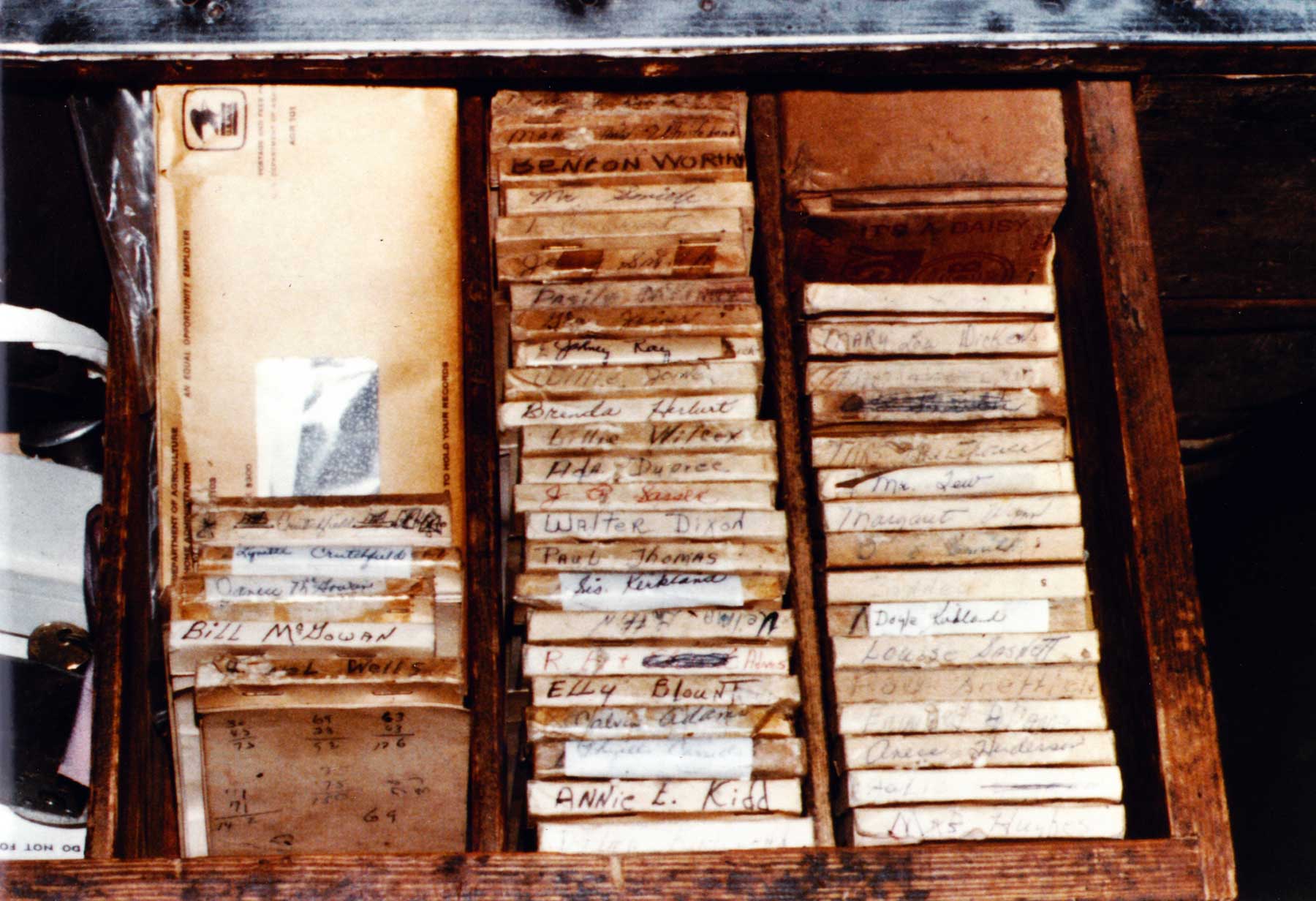
The cookbook was, as Perry promised, a treasure. There was Lynette Crutchfield’s recipe for Squash Relish, her daughter Brenda Sasser’s recipe for Shortnin’ Bread, and her sister Martha Sue Register’s recipe for Cabbage Soup. There was Mrs. Walter (Gladys) Dixon’s recipe for Tater Gravy, and Charlene Godwin’s recipes for Chuck Roast — “so easy,” it said — and Sweet Potato Casserole, Peach Pie and Buttermilk Pie.

It was like calling the roll of the ladies in Esto. I’d eaten at many of their tables, and had nearly everyone’s cooking at a dinner on the grounds at the Baptist church or some other community event.

I doubt Sue Worthy Champion ever actually cooked Gator Tail ‘n Taters. “Boil gator tail in large pot with black pepper, salt and red pepper until tender,” the recipe said. But it seemed appropriate in a cookbook dedicated to a legendary alligator said to live in Old Sand Hammock.

By far the biggest section was Cakes, Cookies & Desserts. Esto ladies baked great cakes. There was Louise McGowan’s recipe for Peanut Cake, her niece Dorothy Nell Miller’s recipe for Chocolate Pound Cake and Mary Nell Joiner’s recipes for Lemon Cheese Cake, Moist Coconut Cake and Lane Cake, a special holiday favorite. Mary Nell had a business baking cakes for other people for quite a few years, although Annie Laura Kidd always sniffed, “She uses cake mix,” a cardinal sin. Sure enough, her recipe for Caramel Peanut Butter Cake noted: “You may use a yellow cake mix.”

And then, on page 113, I ran into a surprise: my mother’s Chocolate Cake. Mother had died earlier that year, before the cookbook project began. But she was a great cook, and she was known for her 12-layer chocolate cake. Somebody must have decided it should be included. I’ll never make it, but I’m glad it’s in the book.

That $20 I sent Judge Perry Wells was some of the best money I’ve ever spent.


FOR MANY YEARS, “going to the store” in Esto meant going to Wells Grocery. It was the heart of our little town when I was growing up. Nearly everybody would stop by before noon to pick up the mail. No day was complete without a cold drink and a visit with proprietor Jeanette Wells.

The charge accounts in her general store called the roll of our little town. Some were never paid. But no one went hungry or without love when Jeanette was with us. She was laid to rest in the Esto cemetery this afternoon. If she didn’t get to heaven, no one will.

store-chargebooks

Most business at Wells Grocery was done on credit.

school

The Esto School offered instruction in grades one through nine until it was closed in 1949.

By E. W. CARSWELL

The saddest day in Esto’s history may have been September 9, 1949 — the day the community’s school was closed.

“It was the equivalent of experiencing a death in the family,” one former student observed. The community had never appeared more lifeless than it did in the weeks following the closure of Esto Junior High School, where instruction had been offered from grade one through grade nine.

Local townspeople were met with ghostly silence from a horseshoe-shaped one-story frame school building on a hillside just north of Esto Baptist Church on the western side of Highway 79. Absent were the voices of children, who for years had gathered at the school on weekday mornings to begin classes. After the school closed, they started boarding buses a little earlier instead, heading for schools in Bonifay, the Poplar Springs community or Hartford, Alabama. Lumber from the former school was used in the construction of several houses in the community.

Some Esto residents more than 40 years later seemed still unreconciled to the loss of their local school. Those sentiments promoted a feeling of uncommon closeness among those who attended the school. It was not unexpected, then, for former students to suggest that a school homecoming be added to Esto’s annual Two-Toed Tom Festival in 1991.

Betty George, who had attended the school, organized the homecoming, which became a regular part of the festival for a few years. In an interview for Florida Public Radio in 1993, she recalled fond memories the school, and marveled at how many former students showed up for the reunion.

A TRIP HOME to Esto almost always includes a visit with my mother and grandmother in the Esto cemetery, along with so many other good people I have known and loved. The history of our town is told in those headstones.

This trip brought a special treat: After church on Sunday, we all adjourned to the fellowship hall for fried chicken, peas, creamed corn, fried okra and other delicious Southern delicacies. Naturally we gathered around the piano afterward to sing hymns.

Inez

Inez Wells Hampton had a ready smile.

INEZ WAS ONE of Esto’s Wells sisters. “She always wanted to give,” remembers her sister Jeanette. “She had a big heart.”

I remember her big heart and big hug, which usually came with a big smile and a raucous laugh. But not the day she came to see my mother lying in the intensive care ward. Only family members were allowed to visit, which didn’t concern Nez. “I’m family,” she said, and walked right in with me.

Mother had been there a few days by then. She’d had an aneurysm in her brain and was showing no signs of recovery. The doctors acknowledged she sometimes moved her arms and legs, but said it was involuntary. As Nez and I stood by her bedside, Mother seemed to grab at the arm of my sweater.

Nez assured me: “She knows who you are.”

Mother died before the end of the week. But I never saw or thought of Nez again without remembering that kind moment in the intensive care ward. I always hoped to see her when I came home to Esto. One visit she’d heard I was in town and stopped by early in the morning to say hello. My sister-in-law told her I was still asleep.

“Well, wake him up,” said Nez.

I’m glad she did.

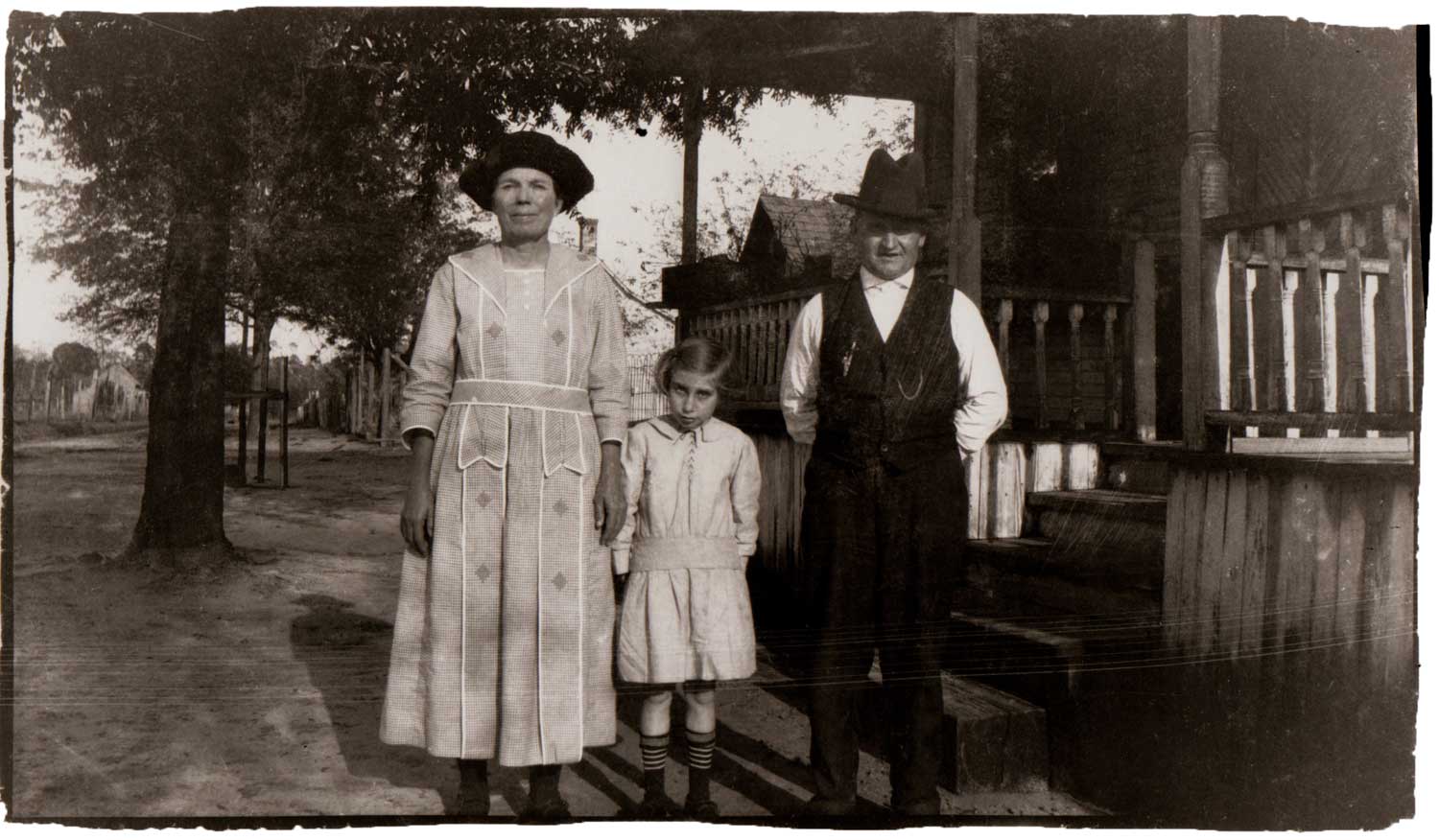
Delma Lee Smith Kirkland (center) with her parents in Esto in the 1920s.

ESTO’S MOST SENIOR CITIZEN — and one of its most beloved — died early Sunday morning, May 17, 2010. Delma Lee Kirkland was 94 and a lifelong resident of Esto.

She had been at home, in bed, for nearly a dozen years, since she had begun to drift away. She spoke only rarely at first, and then not at all. By the end she had stopped even opening her eyes. But someone was always near her side, usually one of her children or grandchildren.

News of her impending death came first on Saturday afternoon to a caretaker as she sat on the screened front porch of the family’s old white wooden house. She said it seemed as if God Himself spoke to say He was going to bring Mrs. Kirkland a blessing. So she went inside to be sure everything was alright. As she repeated what she had heard, Mrs. Kirkland, for the first time in weeks, opened her eyes and looked back, seemingly into her caretaker’s very soul. By morning, her long, lingering journey was over.

Her funeral on Wednesday morning, May 20, brought a full house of friends and flowers to Esto Baptist Church, where Mrs. Kirkland had worshipped all her life. A former son-in-law, Tommy Holman, captured her spirit in his eulogy.

“We got our phone calls early Sunday morning, one week after Mother’s Day, that Nanny had passed away,” he began. “Nanny was the wife of a farmer,” U.T. Kirkland, he said. “She knew her job and she did it well. She raised two children during wartime and she supported the endeavors of her husband until he passed away. She kept a good house and filled the table each meal with good and healthy food.”

Delma Kirkland (center) with daughter Vivian Holman and husband U.T. Kirkland in 1975.

He spoke directly to those who had doubted the family’s decision to keep her at home, in bed, for so many years.

“There are many who would question why it was that Nanny was required to live so many years confined to a bed and fed through a tube,” he said. “There were many who voiced their opinion that Nanny would not want to be there in that condition. There were just as many who questioned why her family did not resign her to a nursing home.”

He had an answer. “Those who questioned did not see what Nanny was giving to her family,” he said. “Even in her nonverbal state Nanny was giving her family a reason to remain a family in these times when so many families have drifted apart.”

Some might also have questioned why it was a former son-in-law delivering the eulogy, one whose divorce had been extremely painful for the family. He had an answer for that question, too, remembering that Mrs. Kirkland had once told him, “I can’t say what’s right or wrong for other people and it’s not my place to judge.”

“That was the way Nanny lived her long life,” he said. “She worked hard, she loved devotedly, she accepted unconditionally, she cried some, but she laughed much.”

Her capacity for love was brought home powerfully just as the funeral was beginning when a group from the Association for Retarded Citizens in Chipley, where Mrs. Kirkland had worked later in her life, entered the church.

“She helped and encouraged challenged individuals toward a better life,” her ex-son-in-law said. “She was a natural at this job because it was ever her way to help and to encourage others. This job came as natural to her as her smile and her jovial laughter.”

Despite the loss of a neighbor they had known all their lives, many in the crowd that filled the church had smiles on their faces and a humorous story to share as they moved outside for the graveside farewell.

Afterward, a bounteous old-fashioned dinner on the grounds awaited inside the church’s air-conditioned fellowship hall.

“I think she would have loved her funeral,” said Annie Laura Kidd, Mrs. Kirkland’s 85-year-old first cousin and “sister of the heart,” as the obituary noted, who clutched a rose from her lifelong friend’s casket. “She always said she wanted a lot of pretty flowers.”

VIMEO | Delma Kirkland and Annie Laura Kidd remember picking violets when they were little girls.