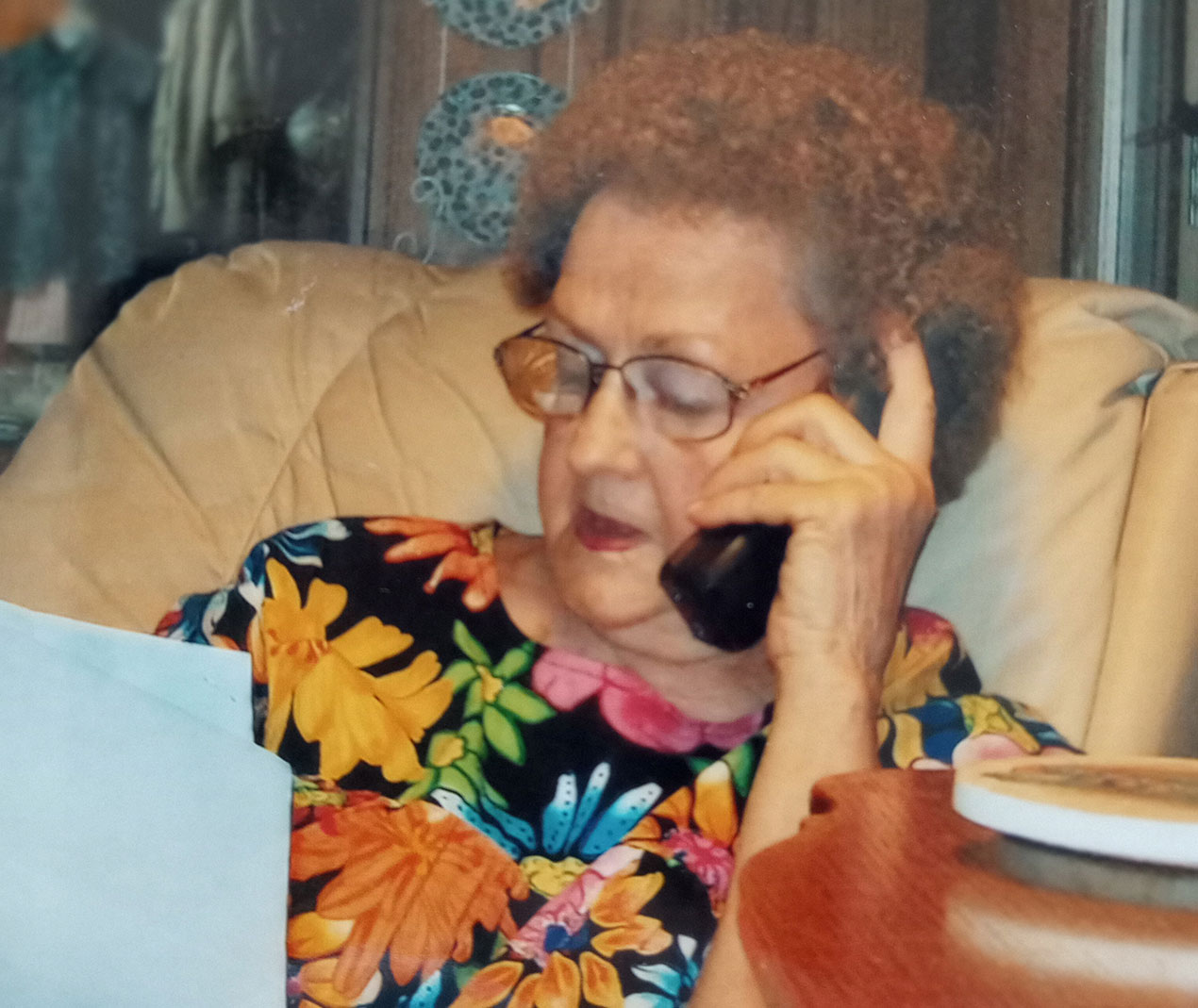
Hazel Tison, fresh from the beauty shop, works on her column for the Advertiser.
A MEMORY | HAZEL WELLS TISON
My sister Minnie Lee and I were one year apart in age, she being the older. We were about 16 and 17, both dark-haired, brown-eyed southern girls.
In the fall, when the cane had been harvested and the syrup-making finished, Daddy was taking a pickup load to sell in Pensacola. He allowed Minnie and me, along with cousin Lenora, to go with him. We spent the night there with some of his cousins — and, wonder of wonders, he took us shopping in downtown Pensacola on old Palafox Street. I don’t recall what all we were able to buy, but I know we each got a new dress. Mama had always pretty much dressed us alike. A lot of folks thought we were twins. I was younger but a bit taller and skinnier, while my sister was more shapely. She also had thick, well-managed hair, while mine was fine and wispy. It was the ’40s and glitz was being worn for casual wear, so we bought similar but not identical dresses, off-white and trimmed at the shoulders in gold sequins.
Our older brother Perry was dating Hester Lucas of Esto at the time. One Sunday evening he was attending a sing at Esto Baptist Church with her and he invited (or perhaps allowed or tolerated) his younger sisters to go with him. It was a golden opportunity to wear our new gold-trimmed dresses. We sang along with the southern gospel songs, with which we were very familiar. I don’t remember meeting any of the nice folks of Esto, though I am sure we did.
Later we got a report from Hester’s mother, Miss Pauline, that a group of the ladies were discussing the attendance of the Wells girls at the Esto sing and expressing their opinions about which one was the prettiest. Here was the conclusion of one of the Esto ladies: “Well, I thought that littlest one was the prettiest. Oh, she had that little ol’ mess of hair, but it just became her.”
That’s my Esto story. It has always been an apt description of my “little ol’ mess of hair.” That is why I resolved a long time ago that if I ever could afford it, I was going to the beauty shop every week. Don’t expect to find me at home on Thursday afternoons at 1:30.
Hazel Wells Tison, a retired teacher, is a longtime columnist for the Holmes County Advertiser and the author of Better Times a Comin’.
LOVERS OF local history will find new books of interest — including a history of Esto — at the Holmes County Public Library in Bonifay.
Recent donations from a local collection honor Joe Bob Clark, an Esto native who was the moving force behind the creation of the modern library. Its building in central Bonifay is dedicated in his honor.
Now available at the library:
• In “Esto: This Is the Place,” published in 1993, E.W. Carswell captures the people and events that shaped the town of Esto — including its most famous resident, the legendary alligator known as Two-Toed Tom.
• “Heart and History of Holmes County,” by Anna Paget Wells. The second edition is a revised and reformatted version of the book, first published in 1982, with updates and corrections by Dan W. Padgett.
• “Holmes Valley,” by Esto native E.W. Carswell, first published in 1969. This revised and updated edition from 1983 tells the story of the great influence Moss Hill United Methodist Church had on the development of this region of the Florida Panhandle.
• “I Declare!” by Malcolm B. Johnson. This collection of columns from the longtime editor of the Tallahassee Democrat opens a window onto the political scene in Florida’s capital during the middle half of the 20th century. Johnson’s closely observed commentaries were published in newspapers around the state, including the Holmes County Advertiser.
Also available at the library: “Holmesteading,” E.W. Carswell’s definitive history of Holmes County, published in 1986. Thanks to an effort spearheaded by Joe Clark, the book was republished in 2003 and the second edition is available for purchase at the library for $40. All proceeds benefit the library.
The Holmes County Public Library is located at 303 North J. Harvey Etheridge Street in Bonifay and open from Monday through Friday.
He was known as Joe Bob Clark when he was growing up in Esto.
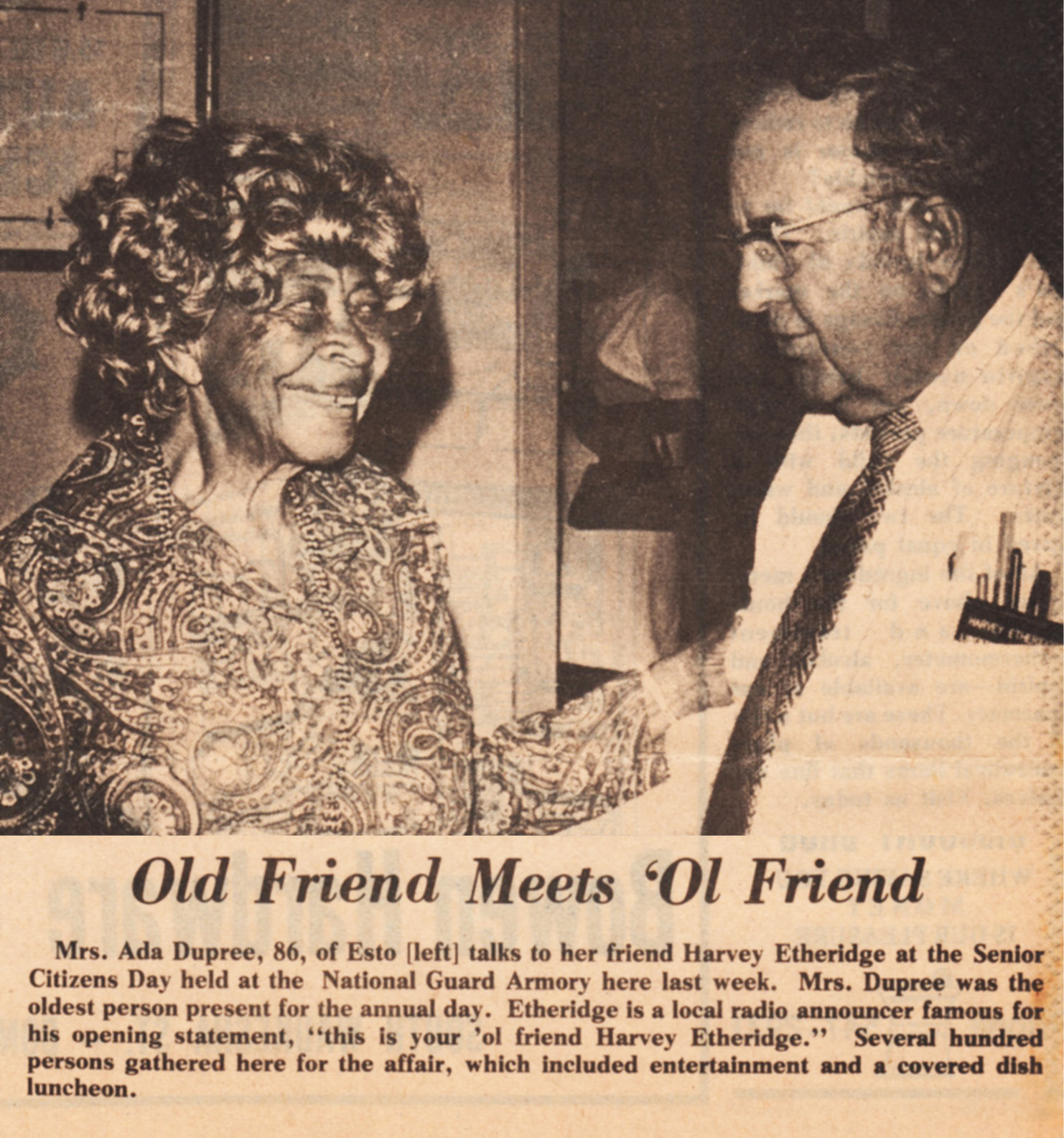
From the front page of the Holmes County Advertiser, circa 1974.
“GIVE A Holmes Countian half a chance, and they’ll do well,” local broadcaster J. Harvey Etheridge often said on his morning radio program while bragging about a neighbor’s accomplishments.
For decades his distinctive warm voice came booming into homes in the tri-county area six mornings a week on WBGC 1240 from Chipley. (The station’s call letters stood for Bonifay, Graceville and Chipley.)
“Hello everybody everywhere, this is your old friend Harvey Etheridge, bringing you the news of Bonifay and Holmes County,” he always began.
He presented a mix of newsy items he’d heard or read or gathered on the tape recorder he always took with him on his travels around the area selling Liberty Mutual life insurance. Etheridge was the county’s chief spokesman and booster, sharing notice of birthdays, family get-togethers and local events small and large — especially Bonifay’s annual rodeo and all-night gospel sing.
J. Harvey Etheridge Street in downtown Bonifay — the address of city hall, the public library and his longtime office — is named in his honor.
Even before Etheridge moved to Holmes County in the 1950s and became a leader of the “World’s Biggest All-Night Gospel Sing” every Fourth of July weekend at Memorial Field in Bonifay, he was involved as a young man in promoting gospel music in Dothan, Alabama. For a time he was a member of a gospel group called the Alabama Four.
He had a powerful singing voice. For decades, he was a member of the choir at Bonifay’s First United Methodist Church. He led the singing during Sunday night services and often sang solos just before the sermon.
“He loved gospel music,” says his daughter, Lygia Etheridge Tisdale. “He had a beautiful bass voice. I always told my Mama she fell in love with Daddy’s voice first.”
For a week in the spring of 1972, Etheridge was lured across town from the Methodist church to First Baptist Church to lead the singing at a spring revival. Recently, retired educator and longtime First Baptist organist Kenneth Yates unearthed and digitized recordings that capture portions of the week’s services.
Etheridge’s distinctive voice and gentle sense of humor are on full display. He prays and sings and even hums favorite old gospel hymns.
Etheridge says in the recording that he was kidded all week about being a Methodist in a Baptist church, but found they weren’t that different.
“I thought I’d sing out of the Methodist hymnal tonight,” he says during one service. “And, lo and behold, the same song is in the Baptist hymnal.”
Harvey Etheridge leads the singing at First Baptist Church in Bonifay during a revival in 1972.
Esto’s old brick stores were the center of the town for decades.
DR. D.F. SMITH was Esto’s most prominent and beloved citizen during the first half of the 20th century. He served the town and surrounding area as a family physician, making house calls, delivering babies and providing the curatives then available to those who were ill.
He also operated a drug store in which he was his own pharmacist, with the help of his wife, Beckie, and daughter, Delma. Their residence and his medical office were in the back.
The drug store and clinic were part of what was always known in Esto as “the old brick stores.” The wide red brick building just north of the railroad tracks at one time also offered hardware, dry goods and clothing. Only the southern third of the building remains, now empty and forlorn, after many years as home to Wells Grocery and the post office.
•
But a piece of the old brick stores lives on a few miles north of town. A long wood and glass showcase from the stores is one of many treasures in the home of Vivian Kirkland Holman, the granddaughter of Dr. Smith. Her mother, Delma Lee Smith, and father, local farmer U.T. Kirkland, inherited the store and operated it in the 1940s and 50s, before selling to Jewel Wells. [Vivian’s parents were also the editor’s keepers during his first five years and his lifelong surrogate parents, making Vivian nearly his big sister.]
During a recent visit, Vivian shared the story of how she came to be the caretaker of a piece of the old brick stores.
MY MOTHER loved these red spider lilies, which are still growing in her yard in Esto 36 years after she died — keeping her memory, and green thumb, alive.
HE WAS JERRY PELHAM when he was growing up on his family’s farm just south of Esto. But he became well known and highly respected — and made a major contribution to Florida politics and policy — as Thomas G. Pelham, the Tallahassee lawyer and land use specialist who served two different terms, under two different governors, as secretary of the state’s Department of Community Affairs.
In his recent memoir, Kids Don’t Have Backs, he tells the story of his early years on the old Blackburn place — his grandparents’ farm, later taken over and expanded by his parents, Roy and Louise Blackburn Pelham.
“The farm was located on Florida Highway 79 in a rural area known as the Holland Cross Roads farming community, just two miles south of the Alabama-Florida state line,” he writes, adding that when his grandparents moved to Holmes County from Georgia in 1918: “The county was sparsely populated and living conditions were primitive. There was no electricity, and therefore no electric lights, indoor plumbing, running water, sanitary facilities or air conditioning. Tractors and other modern farm equipment were not generally available or affordable, so farming was mostly conducted with mules and hard manual labor.”
That hadn’t changed much by the time Pelham was born in 1943, the first of four boys driven by their father, and necessity, to work the land. Eventually electricity and tractors would come, along with a new house and barn across the highway, plus a younger sister.
“The farm was a year-round, labor intensive, physically demanding enterprise,” he writes, “that over time involved the efforts of our entire family, including the children, who frequently worked like adults.”
•
Pelham paints a picture of unrelenting, backbreaking work: milking cows, feeding hogs, chopping and picking cotton, pulling corn, stacking peanuts, building and rebuilding fences. It’s a life that will be familiar to nearly everybody who grew up in Holmes County.
“Hard work never hurt anybody,” was his father’s frequent refrain.
The title comes from a memory of a hot summer day in the cotton patch when he stretched his aching back and then dropped to his knees and started crawling.
“Hey, boy, get off your knees and get to pickin’ cotton,” his daddy commanded. “But my back hurts,” he replied as he slowly got to his feet. “Kids don’t have backs,” his daddy declared.
Neither did every farmboy have a grandmother down the road who subscribed by mail to the Atlanta Journal-Constitution, which she passed along to her grandson. The Atlanta papers were especially strong in their coverage of school integration in the wake of the Brown v. Board of Education ruling in 1954, stirring Pelham’s awakening awareness of the U.S. Supreme Court and the rule of law. His learning was helped along by some memorable teachers at Holmes County High School — still segregated at the time — especially Miss Lynelle Vanlandingham, who taught ninth grade civics.
He writes: “Miss Vann’s discussions of the structure and functions of American national and state governments, the roles of the three branches of government, and our democratic values, sparked my lifelong interest in government and politics. A legendary disciplinarian, Miss Vann could silence a rowdy class simply by pointing her finger and arching an eyebrow.”
Not all of the enlightenment took place in the classroom.
The school bus — bright yellow with big black letters, just like today — picked up all of the students who lived on Highway 79 between Esto to the north of our farm and Bonifay to the south. But it also made two long loops over unpaved red clay side roads to pick up students who lived off the main highway.
Riding the school bus was an education in itself. Filled with 30 or more boys and girls ranging from first graders to high school seniors, the bus contained a combustible mix of high energy, youthful exuberance and raging hormones. Boys harassing girls and girls flirting with boys, big boys picking on little boys, profanity and sexual innuendo, spit balls and flying paper airplanes, some of them aimed at the bus driver. On a few occasions the playfulness turned ugly and fights broke out.
Pelham quickly learned to love school. “Over the years,” he writes, “it became easier and easier for me to get ready to catch the school bus every morning.”
By the time he was a senior in 1961, Pelham was president of the student council and valedictorian of his graduating class. He helped organize and raise funds for an eye-opening senior class train trip to Washington, D.C., and New York City.
“Our trip gave me a lot to think about on the train ride home,” he writes. “Seeing the exciting world that lay beyond the narrow boundaries of my life on the farm strengthened my desire to go to college. That still seemed to be an impossible dream, but I was determined to find a way to get there.”
He came home to the farm and announced his intentions. His mother, who had also been the valedictorian of her class at Holmes County High, was supportive. But not his father, at least not at first. “Who is going to help me gather these crops and take care of the farm animals and all of the work around here?” he asked.
•
By then Roy Pelham’s oldest son had a back and a backbone. He found a way to make it happen, getting degrees from Chipola Junior College, Florida State University and Duke University, and later law degrees from Florida State and Harvard Law School. When he died on February 21, 2023, after a long battle with Parkinson’s Disease — during which he wrote his memoir — he was eulogized by the state’s foremost political writer, Lucy Morgan, as a legal lion. She wrote: “No single person in our history did more to protect Florida’s fragile environment and manage growth.”
We had a late lunch at an automat. Prior to our trip, I had never heard of an automat and, in fact, our school cafeteria was as close as I had ever gotten to a restaurant or cafeteria. In an automat, I quickly learned, each food dish is placed in a compartment behind a hinged glass window. To select a food item, the diner inserts the required coins, then lifts the glass window to remove the food and place it on a tray.
While some of my classmates discussed the merits of automats, we became aware that a black man had entered the room. Tall, trim and Sidney Poitier handsome in his U.S. military uniform, with stripes and medals on his chest, the man sat down with his food tray at a table across the room. There was a sharp intake of breath by some of my classmates. We were not accustomed to seeing black people in restaurants and other public facilities, which were still segregated in the South in 1961.
“Is he allowed in here? He wouldn’t be back home,” one of our classmates whispered.
“Maybe we should leave,” someone said in a louder voice.
Then we all froze. The military officer rose from his seat and walked over to our tables.
“Welcome to New York City,” he said in a warm, friendly voice, with a big smile. “Where are you from?”
“Florida. We are on our senior class trip,” someone managed to say.
“What a great experience for you. Is this your first time in the city?”
“Yes,” several classmates responded.
“Well, you will find that New York is a great city. I hope you have a wonderful time,” he said. Then he gave a little half salute, turned and went back to his table, leaving us in stunned silence.
Elizabeth Gavin opened the minds of many students at Holmes County High School.
FIFTY YEARS AGO, I was a student in Beth Gavin’s senior biology class. But she wasn’t there. Olive Berry had come out of retirement to substitute during the fall semester while Mrs. Gavin was having her third child, her son, Tom.
We noted the birth in Devil’s Chatter, the student newspaper, adding cheekily: “How’s that for knowing your subject matter?” Soon came the directive to destroy all copies of the issue and reprint it without that offending line.
Mrs. Gavin thought the handwringing was ridiculous. That was, by far, not the raciest thing she’d heard in years of teaching teenagers about reproduction and evolution.
“They all thought I was an atheist,” she recalled of first teaching country kids Darwin’s theory of evolution. (In fact, she was a Methodist.) Of her frank approach to teaching about sex, she said: “This is real life. This is what happens. And it’s not to be ignored or hidden. It just is.”
Mrs. Gavin brought that same matter-of-fact approach to all of the topics she taught over the decades at Holmes County High School — primarily 10th grade biology, where I first experienced her firm control of both her subject matter and her classroom.
She’d already helped write the textbook we used, plus several others. She instructed us in the rigor of the scientific method through science projects we created and presented at regional, state and international science fairs. Her approval did not come easily. She drilled into us that we were just as able as students who came from bigger schools and fancier families in tonier towns.
•
She expected us to grow up. She even took a lucky few of us on school trips out into the world beyond Holmes County, insisting we learn to behave properly, and adventurously.
“I was what other people might call ‘loose,’ but I thought that was all right,” she told me toward the end of her life as we recalled a memorable trip to the International Science and Engineering Fair in New Orleans when I was 16. “I do know that I have done some things wrong. But, then again, I wouldn’t undo them.”
She sponsored me for scholarships to summer science programs, where I lived and learned with other, smarter high school students from around the country. She led me toward college at Florida State, 100 miles away in Tallahassee, rather than staying home for junior college with everybody else.
“There’s a bigger world,” she would tell me.
And the encouragement didn’t stop when I graduated from high school. I had a friend and supporter for life. There were regular notes and birthday cards. And I’d better not be spotted back home in Esto without stopping for a visit with her.
She had a long retirement with her husband, Bill Tom, at their farm just across the dirt road from his family home, and not far from the house her mother built at Highway 2 and Gavin Road. As she aged, she kept her faith in medicine. When surgery was required, she was ready. “I believe in science,” she said.
•
A few days into the new year, at age 84, Elizabeth Gavin died. She will be much missed and long remembered by her family and friends and the hundreds of students whose minds she shaped.
She had three biological children: Gayla, Jennifer and Tom. But I always felt that Martha Cullifer Howell and I were a close fourth and fifth. Of Martha, she said, “I love her — I feel like she’s my oldest daughter,” while showing off a mug Martha brought proclaiming her Big Bad Bitchy Beth.
“Write, call, come see me before I die!” she wrote in a birthday card for my 64th birthday. “I love my oldest son very much and miss you.” During one of our last visits she told me: “What matters to me are my children and certain students. Whatever they do, I love them.”
We loved you, too, Beth. You were a great teacher, in the broadest possible sense of the word. One more time: Thank you. Rest in peace.
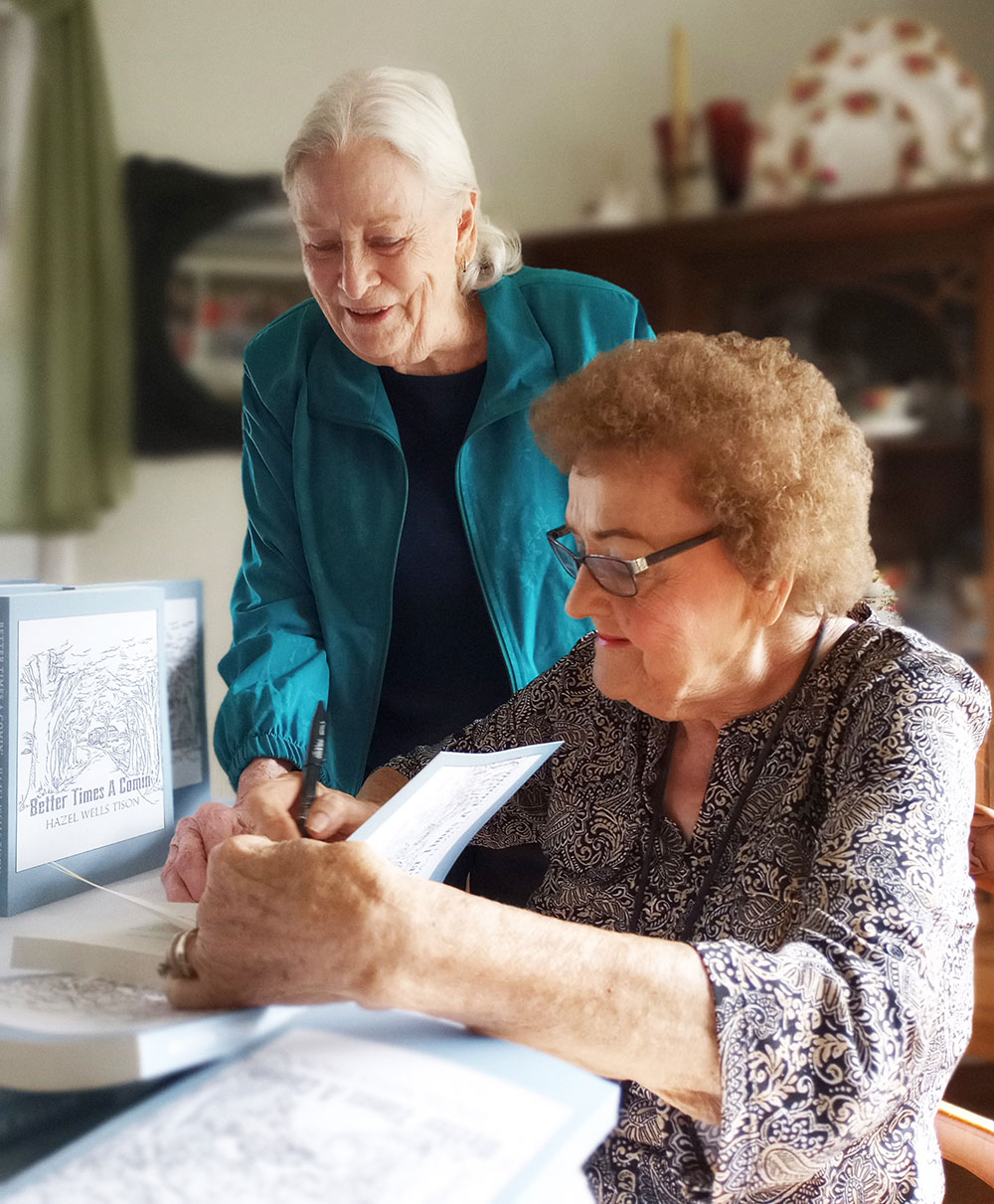
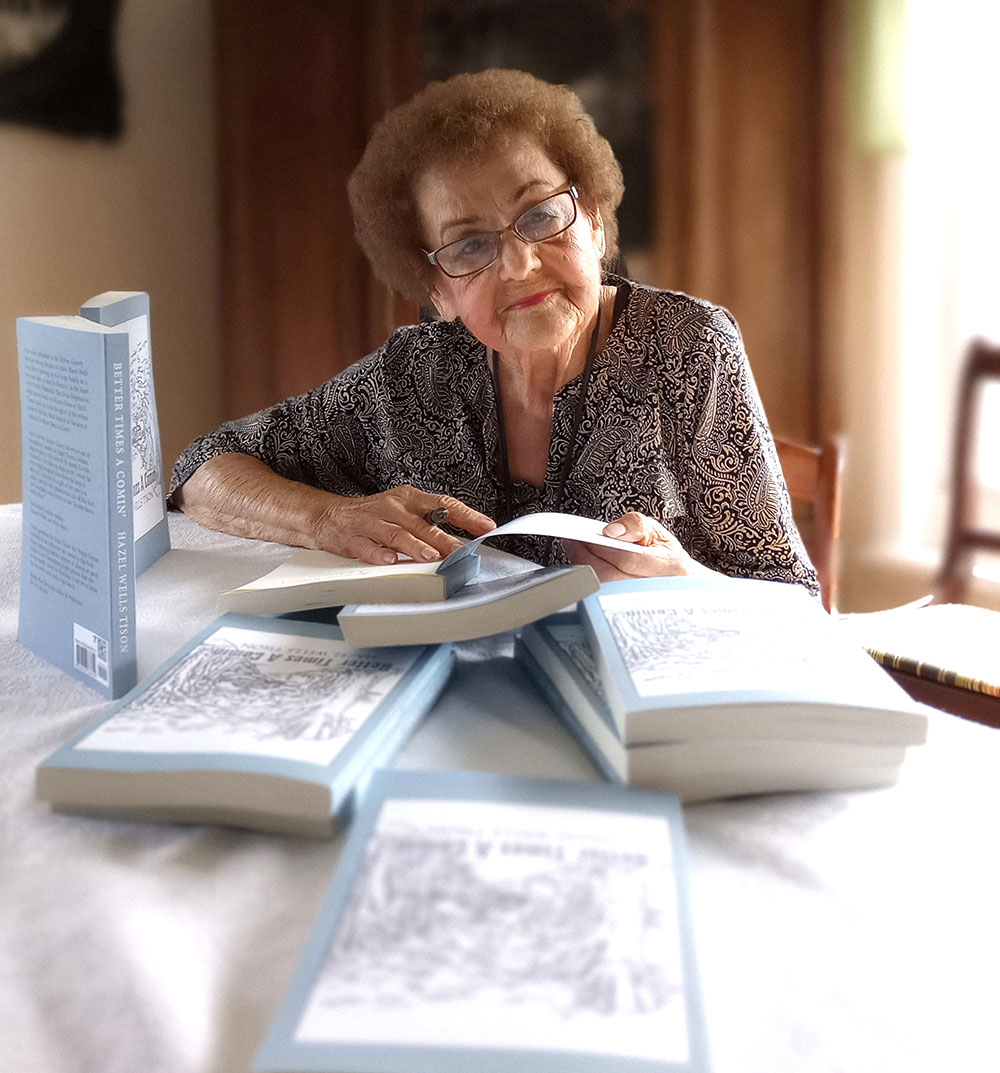
Hazel Tison (right) signs a copy of her new book as publisher Sue Cronkite looks on. Photos by Mary Ivey.
BETTER TIMES ARE ALREADY HERE, it turns out.
This week Hazel Wells Tison, 91, is celebrating the release of her first book, Better Times a Comin’. It’s a collection of her weekly columns in the Holmes County Advertiser about growing up during the Depression in a big family on a two-mule farm on Bonifay Route 1. She published it with the guidance of Sue Riddle Cronkite, 89, an author-publisher from the New Hope community in northwest Holmes County.
“We laugh about it,” chuckles Mrs. Tison. “Two 90-year-olds publishing a book!”
Then she adds: “Maybe it says something good about getting old.”
That ability always to look on the sunny side is the essence of Mrs. Tison’s columns, which she called the Happy Corner, after her nickname, Happy Hazel.
“Looking back on those early days and the little we had in material things, yet we did not feel deprived,” she writes in one story about going to a 50-year reunion at Bethlehem School. “We had our health, our friends and our hopes and dreams for the future.”
In another, titled “I Don’t Know How My Mama Did It,” she recalls the big midday meals her mother cooked on a wood stove “for a houseful of young’uns, field hands and wayfarers,” who were always welcome. The table was crowded with bowls of fresh field peas, corn gathered that morning, fried and boiled okra and sliced tomatoes and cucumbers, always with cornbread and sometimes a peach cobbler or a dish pan full of banana pudding.
But not at night. “At supper, we often could have used the blessing said by Annie Lou Cook: Thank the Lord for the peas and what little bread we’ve got.”
•
Mrs. Tison began writing the column in 2004 after she had retired as an English teacher at Bonifay Middle School. In addition to her many church and community activities, she’d gotten involved in a project to gather stories about Holmes County and its families, which was published in 2006 as The Heritage of Holmes County, Florida.
Word got around.
“Then the lady at the Advertiser called me up and wanted to know if I would consider writing a weekly column,” Mrs. Tison recalls. “I didn’t tell her yea nor nay, but as I began to think about it, I thought I would try a few stories.”
She took them in to the editor.
“She just jumped up and down and said ‘This is exactly what I had in mind,’ ” Mrs. Tison remembers.
She was off and running, and the Happy Corner was a regular feature in the Advertiser every week for most of the next two decades. For a few years the column was nearly the only thing local in the local paper as the Advertiser was handed off among various newspaper chains and run mostly from afar. Now that it’s more local again, Mrs. Tison has cut back and writes only when something moves her.
A recent two-parter was titled “All I Needed to Know I Learned from Uncle Josh and Others.” It included the all-purpose advice her brother Clyde — later Circuit Judge Clyde B. Wells — offered when he was teaching her to drive: “Don’t ever go backward when you can go forward.”
All in all, she’s written nearly a thousand columns telling the stories of local people and places. She steadfastly avoids politics and controversy. Recollections and homespun humor are more her style.
Columnist and now author Hazel Tison has been a favorite of readers in Esto and throughout Holmes County.
“Hardly anyone uses cloth diapers today,” she writes at the end of a column on washing clothes in cold weather. She speculates that absorbent throw-away diapers may be delaying potty training, leaving “toddlers wearing diapers well into their second and even third year, when they should be wearing big girl or big boy panties.”
She writes: “I have a personal philosophy that disposable diapers are largely responsible for disobedient children because parents allow toddlers to wear them longer and are denied the access to appropriately swat their hineys, which is too well padded to do any good.”
But here too she finds a silver lining: “There are times when going back to a simpler way of life looks attractive, but when it gets cold, I am thankful for a warm house with central heat, indoor plumbing and modern laundry equipment.”
Many of her stories feature her family. In one about her Aunt Annie — Anna Paget Wells, who wrote the earlier Heart and History of Holmes County — she acknowledges, “My husband has commented that he is sure people are tired of hearing about the Wells family.” But it’s Easter week, she notes, and she’s busy with church work, so she’s once again telling family stories that require no research.
One of the best is about “poor old Uncle George.” If somebody got angry, her family might say they’re “as mad as George Cook.” So she asked her grandmother how mad Uncle George was.
“The story goes, according to my Grandma Wells, that Uncle George was in the turpentine woods one day and he met up face to face with a bear. When he returned home he quickly took a bath and was looking for clean clothes. When Grandma Cook asked him what happened, he replied that he had encountered a bear, and that when he saw him it made him so mad that clean underwear was required.”
•
The collaboration between author and publisher that produced Better Times a Comin’ began a few years ago when Sue Cronkite stopped by Hazel Tison’s home and blueberry farm north of Bonifay to drop off a copy of a new novel she’d written that told a local story, thinking it might be something Mrs. Tison would want to write about in her column.
By the time she left, the two felt like old friends. And the idea had been planted for another book: a collection of Mrs. Tison’s columns.
“I sort of had to talk her into it,” Mrs. Cronkite says.
“It was a chore,” Mrs. Tison says of choosing which columns to include and getting them ready for publication. But now that she’s holding the book in her hands and her friends and neighbors are clamoring for a copy, she’s proud she did it, with guidance from Mrs. Cronkite and assistance from her daughter Cindy Tison Webb and helper Mary Ivey.
“Since this one is done, and I see that it’s possible, there may be another one,” she says.
Goodson’s beer joint on the Alabama-Florida line at the north end of Esto, overtaken by time.
I’VE GOT A bone to pick with Hazel Tison.
In her column published in last week’s Advertiser, she writes about beer joints once popular in our part of the country. She recalls the Blue Moon and the Cat’s Eye near Vernon, where she went to school. And the Green Lantern, near Chipley, which later became Chuck & Eddie’s (and is now a church!). Plus several at the state line in Esto.
But she calls them “juke joints,” a cleaned-up citified spelling of what we actually called them — jook joints — which my friend Malcolm B. Johnson spent his entire life battling.
Malcolm was the longtime editor of the Tallahassee Democrat. He wrote a daily front-page column called “I Declare.” I first read his columns republished on the editorial page of the Advertiser, back before it was consumed with national politics. Malcolm syndicated his columns to the Advertiser and other papers around the state only minimally for the money ($1 a column). Mostly he wanted to extend his influence. I came to know him first as a fearsome presence in the newsroom and later as a friend and co-conspirator when I whittled his prodigious output down to the book of his columns we published in 1983 called — what else? — “I Declare.”
Malcolm insisted we include the column he wrote in July 1977 headlined “Scholars Have Corrupted Jook.” It started: “If I were a ‘Roots’-inclined black academic, I’d work up a research project on what the white intelligentsia has done with our word ‘jook.’ They’ve gone to spelling it and pronouncing it ‘juke,’ a corruption at which I have protested off and on for two or three decades with declining influence.”
Malcolm insisted: “It was spelled ‘jook’ when anyone attempted to write it back in the 1930s, and it was pronounced to rhyme with ‘book’ and ‘look’ — and the boys at the University of Florida were given to ‘jooking’ when they took leave of booking on Saturday nights.”
Malcolm claimed personal knowledge of the matter.
“You see, I have some authority on this point” he wrote, “because I claim to have moved the word into national language and literature from the lumber camps and college campuses of Florida.”
Here’s the story, as he told it:
When I came to Tallahassee as a reporter in 1937, I picked up odd change by submitting items to Billboard magazine and various other publications. The Florida State College for Women Flambeau one week published a list of the 10 most popular records being playing on coin-operated phonographs at off-campus soda shops. Called it a “jookbox poll.” I submitted the list to Billboard, which promptly replied it didn’t care what the girls were playing, but what in heck was a “jookbox”? The magazine printed my explanation and sent me 75 cents for my work. And the word was in currency.
The college kids had brought the word out of Africa, via generations of use in the South as the name for a place where black lumber and turpentine camp workers congregated at night and whooped it up.
Malcolm even offered Florida Supreme Court citations to support his argument.
The late Supreme Court Justice Glenn Terrell referred to them in one opinion as “arch incubators of vice, immorality and low impulses.” In another he mentioned a “jook where beer and other species of fire water are dispensed.” He spelled it “jook,” drawing on his long Cracker experience. So we entered his opinions via the news wires into the growing debate over how to spell it.
His contemporary, Justice Roy Chapman, shook us one day by spelling it “juke” in one of his opinions. We called to ask if he and the court were reversing themselves on this important matter. He said no, it was a slip. He went personally to the clerk’s office and changed the spelling to “jook.”
However it’s spelled, Malcolm acknowledged: “Jooks, to be sure, were not classy joints.”
On that, he and Hazel Tison agree.
“I could only imagine what went on in those places,” she writes. “I grew up with the idea that such places were devil’s dens and women who frequented them were harlots or trollops (my mother’s terms).”
Cottontop Reynolds at the cash register of the Oasis Club. He also ran Cotton’s Place on the south side of Esto.
GOSPEL WAS OUR MUSIC when I was growing up in Esto. In addition to church, we often had community sings, and the Biggest All Night Gospel Singing in the World was a major event every Fourth of July weekend, from sundown to sunup, at the football field in Bonifay, the county seat.
When I was a senior in high school, we went to a revival service at First Baptist Church in Bonifay — the big time in Holmes County. It featured traveling evangelists Ed and Bette Stalnecker and their entourage of musicians. I especially loved Bette’s soaring rendition of “His Eye Is on the Sparrow,” a beautiful song not in our hymnal. I found the sheet music and must have played that song hundreds of times on the piano at Esto Baptist Church as the prelude or offertory or benediction hymn.
After I moved all the way to Tallahassee for college, I saw the Stalneckers again at Thomasville Road Baptist Church. The music was still joyous and uplifting, especially “His Eye Is on the Sparrow.” (But you had to wonder about Rev. Ed Stalnecker’s demand at the end of his sermon that 100 people come forward to make a public profession of faith before the doors would be opened.)
I saw and heard the Stalneckers only those two times, but the memory of their music stayed with me. Once when I was back home, I asked retired school principal Kenneth Yates, then and now the organist at First Baptist Bonifay, if he remembered the Stalneckers. Not only did he remember; he had recorded some of their music, and promised to make a copy. I rarely saw Mr. Yates on my trips home that I didn’t ask about the Stalnecker recording. He always assured me he’d find it someday and make a copy. But it never happened. Decades passed.
And now, all of a sudden, it’s here. I went to the post office on Monday and found a yellow notice in our box that we had a package. The desk clerk came back with a small square padded envelope. Return address: K. Yates, Bonifay, FL. Inside was a CD with the inscription: “A Week of Gospel Music: The Stalneckers. FBC Bonifay. February 1973.” Only 49 1/2 years later!
“This is my story, this is my song.”
That’s the full-throated opening chorus of the first hymn, an old favorite. Then “Love Lifted Me” and “Heaven Came Down and Glory Filled My Soul” and “Oh, the Wonder of It All.” And then, on track 10: “His Eye Is on the Sparrow,” every bit as wonderful as I remembered.
That voice! Bette Stalnecker was a contralto, it turns out, with a big deep husky singing voice that sounds almost like a man. Her soft-spoken sweetness and gentle humor come through between songs. At one point she says, “We get a complaint every now and then that we don’t do enough foot-stomping gospel music,” followed by a rollicking version of “Jesus Is Coming Soon.” And then, near the end, everybody’s favorite: “How Great Thou Art.”
I’ve played the CD dozens of times during the past week. A little searching revealed that Ed divorced Bette a few years after I saw them. He found another Betty and another ministry involving donated cars and boats. Allegations of forgery and other wrongdoing preceded his death in 2007.
Bette kept singing in Baptist churches throughout the South, successfully battling the throat cancer that took her voice for almost a year. She remarried, to a longtime family friend, after his wife died. Now, at 93, Bette Stalnecker Gibson is still singing — and on Facebook. A few days ago she posted a video of herself before a senior group in Tennessee. She was singing “His Eye Is on the Sparrow.”
"HIS EYE IS ON THE SPARROW" (2022)
FOR TRUE FANS of gospel music, here is a selection of songs performed by the Stalneckers at First Baptist Church, Bonifay, in February 1973.






 The Esto Herald