Things were always lively around Annie Laura Kidd, who kept her finger on the pulse in Esto.

“GET YOURSELF A GLASS OF TEA,” she’d say as I walked in the door, happy to be back home in Esto.

Annie Laura Kidd made good sweet tea — the key was Louisiane brand tea bags, she’d tell you — and I was happy to be back at her kitchen table, catching up on the local news. Annie kept her finger on the pulse in Esto, having settled into a new brick home only a few steps from the old unpainted wood-frame house where she was born.

“I didn’t want to come back to Esto,” she’d acknowledge, but her husband Jimmy insisted, and their daughters Liz and Sara fit right in, living among first and second and third cousins.

It was fun at their house. Something was always going on. Annie was ready for a hand of cards, or a word game, or a good-natured quarrel with Jimmy. Maybe a jigsaw puzzle was in the works on the dining room table. Usually there was a pound cake, or some cookies — and orange nut bars at Christmas.

My mother complained I’d rather be at Annie’s than at home. It was a close second. And then, after my mother died, it was true. Annie was another mother.

The years passed, and I moved farther away. But I’ve always looked forward to trips home to Esto, and to a glass of Annie’s tea, and all the local news.

A few years ago, when she turned 80, all of Esto turned out for a surprise party in the fellowship hall of the Esto Baptist Church. And it was a surprise, one of the few local stirrings to escape her attention. She said at the end of the party: “I reckon I’ll stick around and aggravate my young’uns a while longer.”

She did. Her 88th birthday came and went last August 25.

When I was home in the spring, it seemed clear there might not be another birthday. We had a good visit, and a few glasses of sweet tea, as she drifted in and out.

As the time came to leave, I thanked her for being my other mother. She was fully present. “I’ve been proud to be your other mother,” she said, looking into my eyes.

“Well, are you ready to go?” I asked.

“I’m ready,” she said. “When the time comes, I’m ready to go.”

We hugged again, and as I turned to walk toward the door she said, “I’ll see you in Heaven.”

Annie Laura Kidd died on June 12, 2012, at home in Esto.

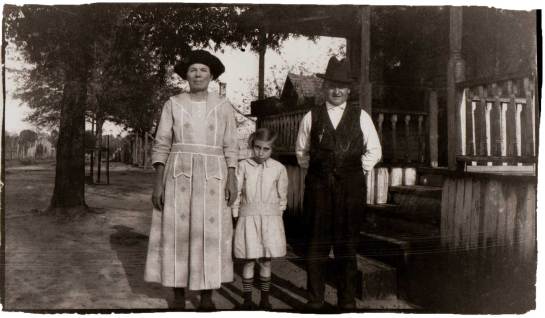
Delma Lee Smith Kirkland (center) with her parents in Esto in the 1920s.

ESTO’S MOST SENIOR CITIZEN — and one of its most beloved — died early Sunday morning, May 17, 2010. Delma Lee Kirkland was 94 and a lifelong resident of Esto.

She had been at home, in bed, for nearly a dozen years, since she had begun to drift away. She spoke only rarely at first, and then not at all. By the end she had stopped even opening her eyes. But someone was always near her side, usually one of her children or grandchildren.

News of her impending death came first on Saturday afternoon to a caretaker as she sat on the screened front porch of the family’s old white wooden house. She said it seemed as if God Himself spoke to say He was going to bring Mrs. Kirkland a blessing. So she went inside to be sure everything was alright. As she repeated what she had heard, Mrs. Kirkland, for the first time in weeks, opened her eyes and looked back, seemingly into her caretaker’s very soul. By morning, her long, lingering journey was over.

Her funeral on Wednesday morning, May 20, brought a full house of friends and flowers to Esto Baptist Church, where Mrs. Kirkland had worshipped all her life. A former son-in-law, Tommy Holman, captured her spirit in his eulogy.

“We got our phone calls early Sunday morning, one week after Mother’s Day, that Nanny had passed away,” he began. “Nanny was the wife of a farmer,” U.T. Kirkland, he said. “She knew her job and she did it well. She raised two children during wartime and she supported the endeavors of her husband until he passed away. She kept a good house and filled the table each meal with good and healthy food.”
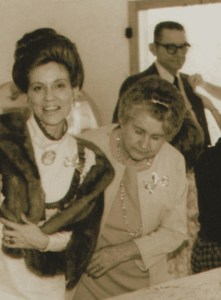
Delma Kirkland (center) with daughter Vivian Holman and husband U.T. Kirkland in 1975.

He spoke directly to those who had doubted the family’s decision to keep her at home, in bed, for so many years.

“There are many who would question why it was that Nanny was required to live so many years confined to a bed and fed through a tube,” he said. “There were many who voiced their opinion that Nanny would not want to be there in that condition. There were just as many who questioned why her family did not resign her to a nursing home.”

He had an answer. “Those who questioned did not see what Nanny was giving to her family,” he said. “Even in her nonverbal state Nanny was giving her family a reason to remain a family in these times when so many families have drifted apart.”

Some might also have questioned why it was a former son-in-law delivering the eulogy, one whose divorce had been extremely painful for the family. He had an answer for that question, too, remembering that Mrs. Kirkland had once told him, “I can’t say what’s right or wrong for other people and it’s not my place to judge.”

“That was the way Nanny lived her long life,” he said. “She worked hard, she loved devotedly, she accepted unconditionally, she cried some, but she laughed much.”

Her capacity for love was brought home powerfully just as the funeral was beginning when a group from the Association for Retarded Citizens in Chipley, where Mrs. Kirkland had worked later in her life, entered the church.

“She helped and encouraged challenged individuals toward a better life,” her ex-son-in-law said. “She was a natural at this job because it was ever her way to help and to encourage others. This job came as natural to her as her smile and her jovial laughter.”

Despite the loss of a neighbor they had known all their lives, many in the crowd that filled the church had smiles on their faces and a humorous story to share as they moved outside for the graveside farewell.

Afterward, a bounteous old-fashioned dinner on the grounds awaited inside the church’s air-conditioned fellowship hall.

“I think she would have loved her funeral,” said Annie Laura Kidd, Mrs. Kirkland’s 85-year-old first cousin and “sister of the heart,” as the obituary noted, who clutched a rose from her lifelong friend’s casket. “She always said she wanted a lot of pretty flowers.”

VIMEO | Delma Kirkland and Annie Laura Kidd remember picking violets when they were little girls.
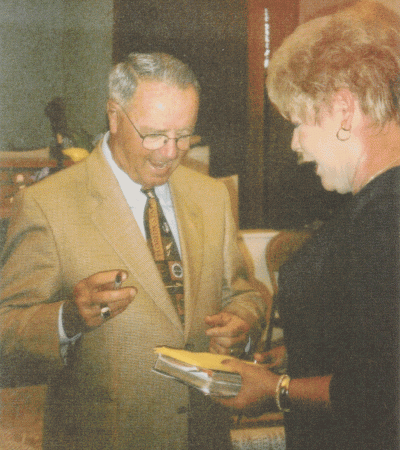
Bobby Bowden at Esto Baptist Church

EASTER WAS ALWAYS a happy time in Esto. Families gathered, and those who’d moved away came home. We hid and hunted eggs after a picnic at T’s pond. Azaleas and dogwoods blossomed.

This year we’d hoped to make it home for Easter, but it didn’t work out. I was doubly disappointed when my sister-in-law called to say we’d be having a special guest at Esto Baptist Church to deliver the Easter sermon: Florida State football coach Bobby Bowden. Holy Moses! Saint Bobby himself!

A visit to Esto by a celebrity of Bobby Bowden’s stature was big news. And it was a special celebration for our little country church.

In recent years, the church had dwindled down to just a handful of members. Even the few still active grumbled about this and that. Many locals had given up on the Esto church and joined more vibrant churches nearby. Finally those remaining asked for help. Mighty First Baptist Church in Bonifay, the county seat, agreed to take Esto’s church under its wing and try to rebuild it.

They called a new young preacher from Jacksonville. He arrived on the scene full of ideas and enthusiasm and began visiting around the town, asking people to come back to church. He invited musicians and other special guests. He organized outings for the young people and birthday parties for the seniors.

To celebrate the rebirth of the church, he invited Bobby Bowden, the legendary FSU football coach, to speak on Easter. And he kept inviting him until Bowden finally said yes — and there he was on Easter Sunday morning, having driven the two hours from Tallahassee.

Bowden told them he often spends Sunday mornings speaking in country churches. Usually his wife Ann drives, he said, but today he’d come alone. And maybe he hadn’t taken the full two hours to get to Esto, since a state trooper had pulled him over on his way. (No, he didn’t get a ticket.)

Bowden told the story of his own faith, and how it helps him shape young football players into national champions. The church was full — including some people who hadn’t seen the inside of a church in quite a few years, in a church that hadn’t been full in years.

Proving himself a good Baptist, Bowden kept his talk short, finishing about 15 minutes before noon. They like to finish a little early at his church, he said, so they can beat the Methodists to the all-you-can-eat buffet.

He stuck around for a few minutes afterward, shaking hands and signing autographs and the occasional football. My sister-in-law went up and told him one FSU graduate in California was two-times sad he hadn’t made it home for Easter this year.

He took her copy of the church bulletin and wrote: “Missed you! Bobby Bowden.”

Joe Bob Clark, John Hughes and O’Neal Thweatt grew up together in Esto and were fast friends all their lives. Standing at the graveside as John was buried in the Esto Cemetery in 1999, Joe Bob told this story:

IN 1956 I HAD A brand new red and white Mercury hardtop named Agatha. John had a brand new red and white Chevrolet hardtop named Gertrude. O’Neal had a brand new red and white Oldsmobile hardtop named Prunella.

On a lazy Sunday afternoon about 1 o’clock or so, we were all three sitting on the porch of the old brick stores in Esto — the part that is now torn down. One of us suggested we go up to Hartford to see a matinee at the Ritz. We tried to decide who would drive, but nobody wanted to drive his new car. We argued for an hour or so and still none of us would agree to drive.

After a while, one of us suggested that we hitch-hike. So that’s what we did. We left three brand new cars parked at the old store and started out walking.

At first we had pretty good luck. Before we reached the state line we caught a ride most of the way and didn’t have to walk very far to the theater.

We saw the movie and — full of popcorn, candy and Coke — started back to Esto. Our luck had run out. Of the nine or so miles from the theater to our cars, we walked probably seven or eight. Somebody finally picked us up near the state line and rode us into downtown Esto.

WE PRACTICALLY LIVED IN OUR CARS. We all worked with the federal-state inspection service. We were sent from pillar to post. There was a saying among the inspectors that you could always recognize an inspector when he hit town because he would be driving a brand new car and have one shirt hanging in the back window. This wasn’t too far from the truth. I usually had to borrow money to leave home and borrow to get back home. We stayed in rooming houses and did not live high on the hog.

And we practically lived in our cars. We kept all of our personal and what little business papers we owned in the glove compartment of our vehicles. It was a ritual that when one of us got a new car, immediately the other two would want to be taken for a ride. One of the two would jump behind the wheel and the other would claim “shotgun.” That meant the new owner would have to get in the back seat and was at the mercy of the other two.

The first thing the shotgun rider would say was, “Let me put your files in order for you.” Then he would proceed to open the glove compartment — they were big in the ’50s — put in both hands and completely destroy any semblance of order, scattering everything over the floor and the front seat. This happened without fail. You could try to dodge it, but it was going to happen sooner or later. We all thought this was hilarious — unless it was your new car.

judgeatroyal

E.W. Carswell at work in his home office, with a copy of Holmesteading nearby.

EVEN AFTER HIS DEATH, E.W. Carswell is still helping make Holmes County a better place.

Carswell, a writer and historian born in 1916 on the southern fringes of Esto near Sand Hammock, died in 2001. For much of his working life he was a reporter for the Pensacola News-Journal responsible for covering the heart of the Florida Panhandle, including his native Holmes County.

In retirement, he wrote books, including This is the Place, the story of Esto, and Holmesteading, the history of Holmes County. Holmesteading was published in 1986 to wide acclaim as a scholarly work that captured both the facts and the flavor of the county’s past.

It was so successful that it sold out soon after publication. The only place many people could get copies was in the Holmes County Public Library.

And that became a problem.

“People would check them out, but they wouldn’t bring them back,” said library director Susan Harris. “Finally we were down to a single copy,” which was kept on reserve.

Requests for the book kept coming, so Harris raised the idea of reprinting the book. The project was spearheaded by Joe Clark, head of the library board and another native of Esto.  In 2003 Holmesteading was republished and again made available — not only for checkout, but also for purchase.

Proceeds were earmarked to support the library, and more than $6,000 has been raised.

Some of the money was used to help relocate the portable library from the old Poplar Springs School, which is now being renovated as an annex to house the library’s children’s programs.

As fate would have it, the annex is named for another Esto native, A.J. Dixon, whose family’s donation is funding the renovation of the building.

“When people started inquiring about Mr. Dixon, the first thing I did was go to Holmesteading,” said assistant library director Betty Treadwell.

She found the answer on page 109 of Carswell’s book, where he wrote:

“It was from the Esto post office in 1906 that Holmes County’s first RFD (rural free delivery) mail route was established. Andrew J. Dixon was the postman for the route, traveling by horseback at first and later by bicycle, motorcycle, buggy, and ultimately by automobile. The route was later transferred to Bonifay, from where Dixon continued to serve until he retired in 1936.”

“That book is full of wonderful information,” said librarian Treadwell. “People love to see the names of their ancestors in print.”

That his book is being used to support the library would no doubt please Carswell. He notes in his foreword that when the county was created in 1848 — in a political deal made soon after Florida became a state to keep the balance between counties in east and west Florida — it contained fewer than 250 families.

“Most of them were frontier farmers,” Carswell wrote. “About one-third were illiterate. A vast majority were poor, even by the standards of that era.”

He added: “Despite the absence of great material wealth, the county’s history has been richly romantic and colorful. To better understand the appealing qualities of the place we call home, newcomers and oldtimers alike must know more of its history to better relate to its past.”

Copies of Holmesteading are available once again to be checked out at the library. If you want one to keep, or to give as a gift, the book may be purchased for $30 at the library or at the Bank of Bonifay, which helped underwrite the cost of republication.

Florida Public Radio talks to author E.W. Carswell about Holmesteading, his history of Holmes County.

MORE ABOUT E.W. CARSWELL

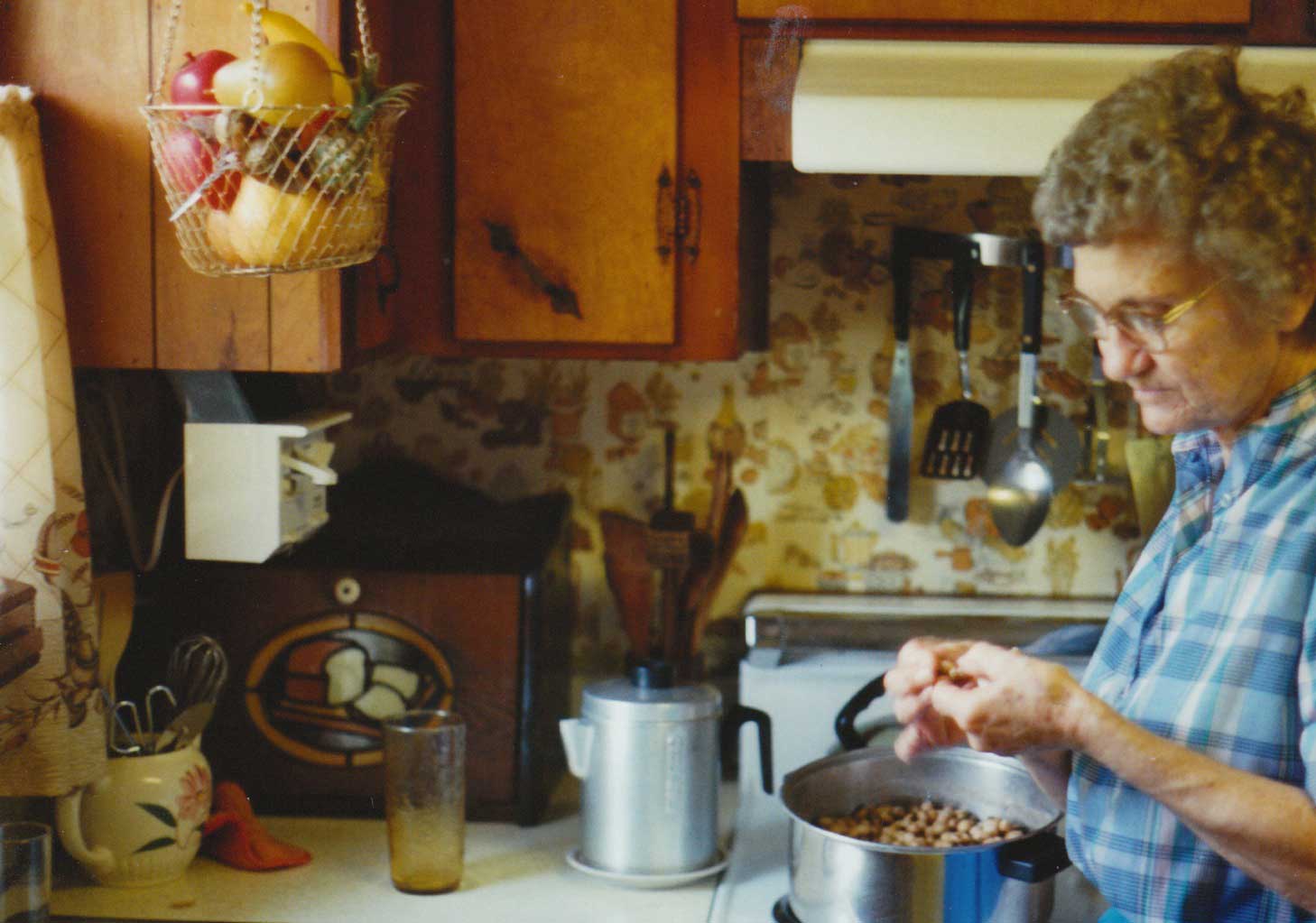
Annie Laura Kidd samples a pot of boiled peanuts in her kitchen.

ANNIE LAURA KIDD celebrated her 80th birthday the other day. She was just about the only one in the tiny Florida Panhandle town of Esto who was surprised.

Annie had thought her daughter was taking her out for a birthday lunch. She was unsuspecting when they stopped by the Esto Baptist Church and found dozens of friends and relatives waiting to honor her.

“I was completely surprised,” said Annie, who is generally up-to-the-minute on the local news.

She was born in Esto on August 25, 1923, one of six children of Harvey Williams. Her mother, Ethel Mae Williams, died young. She was raised mostly by her grandparents, Dr. D.F. Smith and his wife Becky. She grew up in Esto, then lived elsewhere for many years before she returned in 1969.

Among those in town for the surprise celebration were two brothers: Joe Williams, 89, of Columbus, Ga., and Alfred Williams, 83, and his wife Ruth of Milton, Fla.

“I walked into the church fellowship hall and saw Ruth sitting there and thought, ‘What in the world is Ruth doing here?’ ” she recalled. “Then I realized everybody was singing ‘Happy Birthday’ to me.”

The party was organized by her daughters, Liz Kidd of Dothan, Ala., and Sara Tew of St. Louis, Mo. Sara’s return to Esto was also a surprise to her mother. The sisters had decorated the church with dozens of photographs of their mother and her extended family.

She also has two sons, Kenny and Gary Jacobs, who were unable to attend. Her husband, James T. Kidd, died in 1992.

After Liz Kidd thanked the friends and neighbors who had gathered to honor her mother – and kept the secret – everyone helped themselves to an old-fashioned dinner on the grounds. Among the platters and bowls of country cooking were Annie’s favorites, lima beans and collard greens, along with corn, peas, butterbeans, cornbread dressing, chicken and dumplings, sliced ham and fried chicken. Lunch was followed by birthday cake, coconut cake and 12-layer lemon cheese cake.

Afterward, many of the guests gathered around the church piano and sang and played favorite hymns, beginning with “On the Jericho Road” and ending with “When We All Get to Heaven.”

“I loved it – especially seeing so many friends,” said Annie. “I reckon I’ll stick around and aggravate my young’uns a while longer.”

JOE BOB CLARK is one of Esto’s most successful sons, having moved all the way down to Bonifay, the county seat, and become a prosperous insurance and real estate agent.

Even as a kid I was aware that Joe Bob was an important man. People from Esto who had a problem went to Joe to get it solved. Several times when I was in school in Bonifay he helped and encouraged me — especially the day I turned 16 and thought I just had to have my driver’s license that day. When I was a senior in high school, few things seemed bigger than getting invited to the weekly lunch of the Kiwanis Club, to which all of the businessmen belonged. A boy from Esto could feel way out of his league at the Kiwanis lunch, but Joe was always there, welcoming me in, introducing me around. We kept in touch through the years.

In retirement, Joe has come full circle. He still lives on a hilltop just north of Bonifay, but he returns often to Esto, just 12 miles up the road. He also has taken on the role of caretaker of our neighbors who have gone on to the great beyond. He makes it his personal mission to keep the grass cut and the graves tidy in the Esto cemetery.

My mother is buried in that cemetery. And my grandmother and Uncle John, too. So is nearly everyone else I grew up loving in our little town.

But not my father. Cottontop, as they called him, lived hard and died young, when I had just turned 4. He was buried up the road at Lee’s Chapel, where many people from Esto had been buried before we had a cemetery of our own. The cemetery at Lee’s Chapel didn’t get the care that Joe lavished on Esto’s dead, though, and my father’s grave was in bad shape. I’d found through the years that the best way to deal with the absence of my father was not to think about it too much, and that was how I dealt with his grave, too.

One day I raised the subject with Joe Bob. What did he think about moving my father’s grave to Esto?

“Well, I sure wouldn’t want my people buried up there,” he said. And then he went out and found a local funeral home that would dig up my father’s grave and rebury his casket in Esto.

In the end, I couldn’t do it. I found the prospect unearthed too many memories I’d learned to forget. It’s enough for me to have Joe Bob in the Esto cemetery, cutting the grass, taking care of people in Esto, just as he’s always done.

lakeworth

STILL I REMEMBER the images: the grass alongside the road blurring by outside the car window; waking alone in the motel room; the whiskey bottle silhouetted against the night.

I was 2. My father had picked me up at Big Mama’s after lunch, as usual, to take me for ice cream. But he didn’t stop. I was immediately excited because I knew something unusual was happening. We always stopped at Bunk Johnson’s gas station at the crossroads to get ice cream. But this time we kept going south on Highway 79, past Moody and Sybil Taylor’s farm

Read More

E. W. Carswell: He writes about home — his home and mine.

E. W. Carswell: He writes about home — his home and mine.

THE ADVERTISER arrived in today’s mail.

Twenty-five years out of Esto and 3,000 miles away in California, I’m still always happy to get the weekly newspaper from home.

Absence makes the heart grow fonder. Aging breeds nostalgia. And now I better understand the complaints from people who had moved away that I used to hear when I worked at the Holmes County Advertiser as a teenager. “I never know anybody you write about anymore.” “I have to figure out who their mamas are to place them – or their grandmamas.” “The only names I know are in the obituaries.”

Then on the editorial page of this week’s issue I get to E. W. Carswell’s column. This week it’s titled “The Smells of Summer.”

It takes me immediately back home. And it reminds me it’s the little things I miss the most.

He writes: “The smell of summer is a reminder of the good things summer has made possible ­– mellowing pears, magnolia blossoms, fresh turpentine, overripe muscadines, fresh-sliced tomatoes, new-crop Southern peas or speckled butterbeans being cooked with slices of ham.”

“Summer is the smell of the old chinaberry tree after its waxy fruit had started dropping to the ground. It is the smell of fresh-sliced watermelon or cantaloupe.

“Unforgettable is the smell of peanut hay, curing in the sunshine. And freshly dug peanuts being boiled outdoors in a wood-fueled pot.”

I had read this column before. In fact, Judge and I included it in Commotion in the Magnolia Tree, the first collection of his columns we published in 1981. Maybe I even read it when it was first published in his regular column on the editorial page of The Pensacola Journal back in the ’70s. I might have read it again since the Advertiser started reprinting some of his columns a few years ago.

But it didn’t matter.

Like the smells of summer he was describing, Judge Carswell’s writing has a timeless quality about it. It has the feeling of home – his home, and my home too.

This week I recognize something familiar in the Advertiser. I recognize the smells of home.