A plaque on the Esto Town Hall commemorates the town's rebirth in 1963.

A plaque on the Esto Town Hall commemorates the town’s rebirth in 1963.

AFTER DECADES of little civic activity in Esto, the town experienced a rebirth in the 1960s. The Town of Esto was reincorporated by legislative enactment in 1963, subject to approval of the voters in a referendum. That was finally achieved on July 17, 1963, with 70 for and 17 against.

The new charter called for the president of the Town Council to serve as mayor. Walter Dixon, son of one of Esto’s original incorporators in 1902, got the job.

Esto’s new charter contained no law enforcement or ad valorem taxing authority, features that to some had made the town’s earlier charter obnoxious. The community had already obtained Florida’s first water system funded by the U.S. Farmers Home Administration; Esto Water Works was organized on April 3, 1963. A town hall and a fruit and vegetable marketing facility was built, along with a development of low-cost housing. Most of the streets were paved and lighted. The town’s corporate area was much larger than it was originally, extending from the Alabama-Florida state line south to Highway 2.

A community recreation center was constructed several years later and dedicated on October 15, 1977. A few years later, on October 25, 1986, the recreation center and the park surrounding it were named the John W. Clark Memorial Park after the prominent Esto resident who was instrumental in the town’s revival.

By GEORGE NAGEL
The Birmingham News

C. R. “COTTONTOP” REYNOLDS, who operates a store in Esto, has happily worked out a personal solution for Alabama’s high tobacco tax, Florida’s high gasoline tax, bone-dry Geneva County’s ban on beer and liquors — not to forget Alabama’s sales tax.

But like a lot of good things, there’s a catch to it as far as other Alabama merchants are concerned. It will only work where establishments are similarly situated. You see, Reynolds’ store happens to be located squarely on the Alabama-Florida state line. Half of the store is in Alabama and half in Florida.

The official state line marker stood just outside C. R. Reynolds' store.

Under his arrangement, customers entering through a door on the Alabama side take a seat and drink beer or liquor from a counter carefully located three inches over on the Florida side.

As Reynolds keeps his stock on the Florida side, he doesn’t have to worry about or pay sales tax. Standard brands of cigarettes sell two packages for 25 cents and tobaccos of all kinds in this store are cheaper than they are in another one across the highway in Alabama.

Customers dropping by to dance put their money in a rock-ola in Florida and dance on a floor in Alabama.

But for one item Reynolds prefers Alabama. That’s the matter of gasoline. With his pump located on the north side of the line, he can sell gasoline one cent cheaper than he could if he moved it across into Florida.

The reason Reynolds is so sure he can take advantage of his unique location is because the official state-line marker is located just outside his building and if it came to a matter of proving anything he could resort to a yardstick.

The only difficulty about the whole setup, Reynolds says, is that you can never feel that your store arrangement is permanent. You can never tell when they’ll change a state law is one of the states making it more profitable to move into the other one.

“But we don’t worry much,” he added. “It’s just a matter of shifting things around in the store to fit the situation.”

‘et us go to Esto,
You, and you, and me:
And the population will grow
To six instead of three.

‘et us go to Esto,
And build a bungalow;
And then there will be two there —
How could you want mo’?

‘et us go to Esto,
Just hop aboard a tram.
It’s the first stop you will make
After leaving Alabam’.

Now when we get to Esto,
I guess we’ll have to stay,
‘ause no trains or busses leave there
At any time of day.

By E. W. CARSWELL

TWO MEN representing the Louisville & Nashville Railroad are credited with picking Esto, in 1901, as the name of a siding for the railroad then under construction across northeastern Holmes County, Florida. The men, whose names were not recorded or remembered locally, were traveling in a luxurious buggy that was pulled by an exceptionally fine horse. Wearing bowler hats and detachable shirt collars, the men appeared to residents of the community to be railroad officials in pursuit of their duties. Will Carroll, whose home was in the area, said in 1946 that he had been among those who met with the two officials.
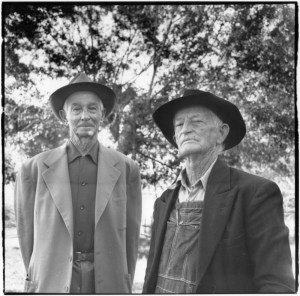
W.L. (Will) Carroll, left, and his brother-in-law Charles E. Ard recalling the day Esto was named.

W.L. (Will) Carroll, left, and his brother-in-law Charles E. Ard recalling the day Esto was named by visiting officials from the L&N Railroad.

They called the residents of the community together, told them of their plans for the siding and a railway station and asked them what they’d like to name the place. Several suggestions were made, none of which escaped strong opposition. The railroad officials, despairing of getting agreement on a locally chosen name, finally suggested Esto.

They explained that it was of Spanish derivation, meaning approximately “this is it,” or “this is the place.” The name proved acceptable to the community, and the name was also adopted for a post office that was established on November 16, 1901. The two railroad officials, who continued southeastward from Esto, are credited with naming nearby Noma in the same manner, according to Carroll.

Construction of a railroad through Esto came about 16 years after completion of the trans-West Florida railroad line, which in 1882 linked the southern portion of Holmes County with Pensacola, Tallahassee and other points east and west. The Louisville & Nashville Railroad built the second railroad through the county. It connected Georgiana, Alabama, with Graceville, Florida, a distance of about 100 miles. The line reached its termination point at Graceville on July 16, 1902, bringing new activity and an influx of new settlers not only to Esto, but also to Noma and such other communities as Wynnlum and Eleanor.

The sawmill and turpentine industries around Esto and Noma developed quickly after the railways were completed. Huge sawmills and numerous turpentine distilleries were built nearby. Williams Naval Stores Company, B.A. Balkcom Turpentine Company and Morris Naval Stores Company were in Esto, with the Alabama-Florida Lumber Company nearby in Noma and Wynn Lumber Company slightly further away in Wynnlum. Within a few years, the communities were shipping points for lumber, cross-ties, barrel staves, shingles, piling, utility poles, naval stores, cotton, cattle and wool. Prospects for a north-south railroad that would cross the L&N lines to connect the gulf coast with the states to the north added for a few years to the promise of the area as a shipping and distribution center.

IT WAS NEARLY A YEAR after the Esto post office was established that residents of the community got around to forming a municipality. Thirty-two local citizens met on October 7, 1902, at Dr. D.F. Smith’s drug store to form the municipal corporation. The 32 men voted unanimously for incorporation; women at the time of incorporation were not voters. Esto became the second municipality in the county. Westville, then the county seat, had taken steps to incorporate four days earlier.

Like most small towns founded in the Alabama-Florida border region in that era, Esto owed its initial prosperity to the area’s timber resoures. When those resources were exhausted, agriculture became the mainstay of the economy. With the coming of the Depression of the 1920s and ’30s, Esto citizens allowed their town charter to lapse.

— From Esto: This is the Place