E. W. Carswell: He writes about home — his home and mine.
THE ADVERTISER arrived in today’s mail.
Twenty-five years out of Esto and 3,000 miles away in California, I’m still always happy to get the weekly newspaper from home.
Absence makes the heart grow fonder. Aging breeds nostalgia. And now I better understand the complaints from people who had moved away that I used to hear when I worked at the Holmes County Advertiser as a teenager. “I never know anybody you write about anymore.” “I have to figure out who their mamas are to place them – or their grandmamas.” “The only names I know are in the obituaries.”
Then on the editorial page of this week’s issue I get to E. W. Carswell’s column. This week it’s titled “The Smells of Summer.”
It takes me immediately back home. And it reminds me it’s the little things I miss the most.
He writes: “The smell of summer is a reminder of the good things summer has made possible – mellowing pears, magnolia blossoms, fresh turpentine, overripe muscadines, fresh-sliced tomatoes, new-crop Southern peas or speckled butterbeans being cooked with slices of ham.”
“Summer is the smell of the old chinaberry tree after its waxy fruit had started dropping to the ground. It is the smell of fresh-sliced watermelon or cantaloupe.
“Unforgettable is the smell of peanut hay, curing in the sunshine. And freshly dug peanuts being boiled outdoors in a wood-fueled pot.”
I had read this column before. In fact, Judge and I included it in Commotion in the Magnolia Tree, the first collection of his columns we published in 1981. Maybe I even read it when it was first published in his regular column on the editorial page of The Pensacola Journal back in the ’70s. I might have read it again since the Advertiser started reprinting some of his columns a few years ago.
But it didn’t matter.
Like the smells of summer he was describing, Judge Carswell’s writing has a timeless quality about it. It has the feeling of home – his home, and my home too.
This week I recognize something familiar in the Advertiser. I recognize the smells of home.
THE CEMETERY IN THE TINY NORTH FLORIDA TOWN of Esto sits in the bright sunlight, bare before the world. The grass is closely cropped. There are no trees — no squirrels or birds to drop anything disorderly. The ground is neat and even. The gravestones are mostly hulking rectangular chunks. A number of them have names and birth dates, but no death dates. The people of Esto, it seems, believe in planning ahead.
In Esto, the dead are a part of everyday life. Just about anywhere you go, you pass the cemetery. On the way to the store, to the town hall, to church, Estonians can see the gravestones of loved ones, as well as their own.
So it is not surprising that the last wish of the town’s oldest resident — 103-year-old Ada Dupree, who had lived in Esto since the year it was named — was simply to be buried in the town cemetery. True, Ada was part African-American and part Seminole, and the cemetery was all-white. But, with the exception of Ada and her familiy, so was Esto.
ESTO, Fla. — This Florida Panhandle hamlet is reviving the legend of Two-Toed Tom, a notorious bull alligator who some folks say fell in love with a sawmill whistle after being chased from Alabama, the Associated Press reports.
Esto’s 210 residents are planning to hold what they hope will become an annual celebration of food, entertainment and story swapping about the giant swamp lizard, said Marrielle Blount, a town council member who is chairman of the Two-Toed Tom Festival.
“He’s a colorful character,” said E. W. “Judge” Carswell, a retired newspaper reporter and former chairman of the Florida Folklife Council. “I think he’s a lot more colorful than the Loch Ness monster.”
Interest in “Old Two-Toe” or “Old Tom,” as he also is known, was stirred up by Carswell’s publication of a book on Holmes County history titled Holmesteading.
The author, who grew up in Esto but now lives in nearby Chipley, where he once served as mayor and municipal judge, devoted a chapter to the Two-Toed Tom legend. In it he declared that for some 60 years nothing had been heard from the Alabama refugee who used to bellow in response to the steam-powered mill whistle.
“People called me and said, ‘You done away with old Two-Toe. He’s not gone. He’s still around,'” Carswell laughed.
That point may be open to debate, but there’s no question the legend lives.
“I’ve been hearing about this story ever since I was 10 years old,” said Ralph Dupree, a town councilman born in 1912. “He was a bad fella. He killed sheep and goats in Alabama. He like to have done away with a woman’s baby in a cotton patch.”
Dupree claims he saw Two-Toe many times after the gator took up residence in Sand Hammock Lake between Esto and its sister town, Noma, both just south of the Alabama line. He insisted he could tell it was Two-Toe because he saw the partly amputated paw.
The gator, who supposedly lost three toes from his left front paw to a steep trap, had been a legend in Alabama long before he crossed the state line. The story, at least up to that point, received a measure of immortality in Carl Carmer’s book Stars Fell on Alabama.
According to Carmer’s account, the huge red-eyed gator — the worst kind — terrorized South Alabama before being chased into Florida by a posse of lynch-mad men.
Floridians take a kinder view of Two Toe, some insisting he wasn’t actually from Alabama but simply had defected.
The gator first attracted attention south of the border with his bellowing response to the Alabama-Florida Lumber Co’s whistle at its Noma mill. The bellowing was most frequent in the spring when gators’ thoughts are said to turn to romance, Carswell said.
“I figure he was mad at that whistle or in love with it, I don’t know which,” he said.
In his book, Carswell wrote that some shots at Two-Toe “shattered off the gator’s thick hide much as dried peas would after being tossed onto a tin roof.” Dupree recalled he used to watch the big gator chase and eat snakes, frogs and turtles.
“Sand Hammock swamp was in my grandfather’s pasture,” former Esto resident Charley Wamble wrote to a town official. “I have seen Two-Toed Tom’s tracks and seen other alligators in that swamp. Granddad was always missing hogs and young cows.”
Carswell acknowledges the legend probably is a composite, with Two-Toe being blamed for the misdeeds of any and all gators in the area.
“This is the legend of Two-Toed Tom they are celebrating, you know,” said Carswell, putting the emphasis on “legend.”
Ralph Dupree (left) was a porter on the L&N Railroad and a member of the Esto Town Council.
RONALD REAGAN’S 1986 visit to nearby Dothan, Alabama, has been relegated to the footnotes of presidential history, but Ralph Dupree’s Esto neighbors are still asking how he managed to get seated at the table with the President. Some of them seem astounded that Dupree mustered enough influence to get inside the Civic Center, where the dinner was held, and even more astonished that he got such a choice seat — after it had become well known that all admission tickets to the event had been sold.
“It wasn’t influence,” Dupree explained. Then 75 and Esto’s first black town councilman, Dupree said he simply put into practice something he learned in the eighth grade at nearby Noma more than 60 years ago. He said he got his inspiration from a story about “The Boy Who Recommended Himself.”
Dupree said he wanted to meet the President after learning that he was coming to a civic dinner in Dothan, some 30 miles from Esto. “So I went to Dothan and presented my $25 and asked for a ticket to the dinner. But I was informed — not once, but twice — that there was no room at the inn, that all the tickets had been sold.”
Dupree, a longtime acquaintance of Dothan Mayor Larry Register, asked to see the mayor. Dupree said he told Register about wanting to meet the President. It was then, Dupree said, that he told Register that in coming to him he was following the example of “The Boy Who Recommended Himself.”
Dupree said the mayor smiled and directed a member of his staff to “find Ralph a ticket” and to provide him with seating arrangements. Dupree said he didn’t know he was to be seated directly across from the President until Reagan himself arrived.
“President Reagan bragged on Dothan and the people of the Wiregrass area,” Dupree recalled. “Dothan is mentioned in the Bible,” Dupree said the President observed, noting the verse in Genesis where it says, “Let us go to Dothan.”
Dupree said the President seemed relieved after a woman seated nearby advised him to eat his fried chicken by using his fingers, instead of a knife and fork. He said the President then grabbed a drumstick and went to work as if he had done it before.
Dupree said he had intended to keep his napkin as a souvenir, but that “someone borrowed it when I stood up at the end of the President’s speech.”
VIMEO | E. W. Carswell talks about Holmesteading, his history of Holmes County, in an interview with Florida Public Radio.
By AL BURT
The Miami Herald
ELBA WILSON CARSWELL, a dignified gentleman who dresses and speaks with coat-and-tie formality, tries not to forget that he began as a dirt farmer. He grew up on a farm that was close to Esto and he never got over it.
Except for the fact that he was forced to wear kneepants until age 16 — one way that oldtimers yoked the young and callow to inferior status — he felt himself from the very beginning to have been among the blessed ones.
The Carswell home place actually was halfway between Canebrake and Utopia — as he renamed Esto and Noma in his columns and books — but for him the spiritual location was Utopia.
A hundred years or so ago, the area had been part of Alabama, but a border correction returned it and the Carswell farm to Holmes County, Florida. He expressed gratitude that the shift had saved him from “those awful Alabama winters.”
To Carswell, the flavor and feel of life in Florida’s Panhandle were satisfyingly sweet. He and the land seemed star-crossed, perfectly blended. He never doubted its essential goodness, and tended to view contrary evidence as aberrant.
He settled in Chipley, only a half hour from Utopia, and accepted as his mission the celebration of Panhandle folk culture.
“We are rooted better than most of Florida and we change more slowly. We like it that way,” he said. As a public servant, historian, teacher, farmer, journalist, businessman and naturalist, his focus never wavered.
To travel here from South Florida, you must cover 550 miles in distance and about 50 years in attitudes. It is a journey that spans the state in many ways. Each end of Florida tends to feel a bit sorry for the other. Each looks at the other as through binoculars, and considers the view exotic. There is less understanding and appreciation than there should be, but it is not Carswell’s fault.
His work constructs a subtle case for respecting local differences. For example, there is his story about the time, near the end of the 19th century, when a well-meaning newcomer from Indiana migrated to the Panhandle. Because he found the area had only piney woods rooter hogs, coarse kin of the rangy razorback, the Indianan decided to introduce the more plump, high-toned Berkshire and Poland China breeds. He held a hog show to make his point.
But to his dismay, local judges were not impressed. All the prizes went to the piney woods rooters. It was a question of standards. They explained to him, as to a child, that a hog was no good in the Panhandle of that day unless it could run faster than the thieving Carpetbaggers and Scalawags. A Carpetbagger was a Yankee who moved South to exploit local naivete, and a Scalawag was an opportunistic local who aped the Carpetbaggers.
E. W. Carswell
“Used to be they’d come in here from Ohio or someplace but now they go to South Florida first, stay awhile, get crowded out or priced out, and then they move up here looking for elbow room,” said Carswell.
He recalls a young college-trained minister who accepted a post at a church happily steeped in minor sin and bitterly resistant to meddling ministers, especially outsiders. Observers gave the new man little chance. But a year later, he remained, apparently without jeopardy. One astonished observer inquired how. “We didn’t really want any preacher at all,” an oldtime member revealed. “And he’s about as close to being no preacher as we could get.”
In his books — he has written nine, five of them collections of newspaper columns — Carswell mourns the passing of his heritage. His tales of home remedies, determined mules, lighterd (resin-filled pine wood), lye soap, moonshine, the curing of warts, dog days, chitlins are a quiet romanticism of comfortable days past. Weather, religion, food and the land then so dominated the encapsuled life on a farm that the smothering limitations of it went unrecognized.
Peripheral vision of other cultural and moral influences, and the distressing self-awareness they brought, came later and forever shattered what had been a wonderful cocoon.
Carswell creates nostalgia for that time, preserves the remnants of those days, gathers them up as nourishing identity that permits the Panhandle an appreciation of what went into the forming of its blood and bone and beliefs.
Carswell has become a Panhandle institution. He endures, year after year, trying to renew the familiar while time erodes it.
He has been mayor and municipal judge in Chipley, and has served in almost every other significant local civic office. He has been chairman of the Florida Board of Parks and Historic Memorials, a member of the Florida Folklife Council, was awarded the Florida Bicentennial Patriot’s Medal.
The Judge, as his friends call him, recognized the value of roots long before it became faddish. His hope is that the Panhandle will respect and learn from its origins, that it will remember the planting of crops by the moon, the homes with wide front porches and working foreplaces, the firebrand preachers, the mayhaw trees and the rooter hogs.
For him, this was home, and it was near Utopia. In Florida, he is a gentleman Cracker who has made a difference.
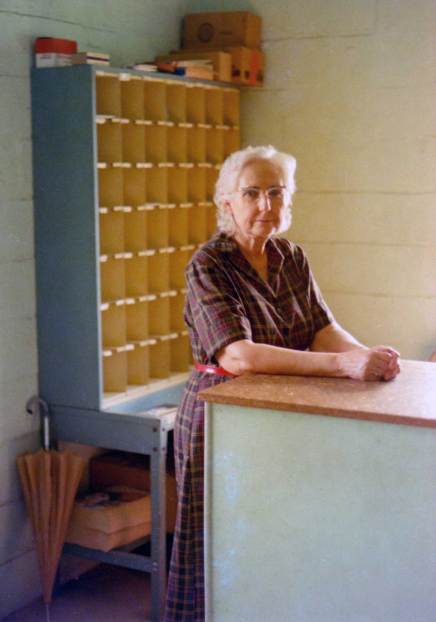
Jewel Wells was Esto's postmaster from 1965 to 1985.
By JIM REISLER
The Dothan Eagle
OF ALL THE SIGNS — and there are several — one stands out. “No soliciting or loitering,” it reads.
It’s hardly necessary because with the possible exception of “a few who like to stand around in the corner and gossip,” the crowds at the Esto Post Office, according to Postmaster Jewel Wells, are sparse.
There are a few others who frequent the building — during the summer, northerners on their way to the beaches buy stamps and deposit some letters — but generally “just normal folks,” the locals in this small crossroads village of 210.
Small wonder. As the kind of town that people pass through on their way to somewhere else, Esto — with its one store, two gas stations and cafe compacted onto six streets — is small town mid-America personified.
Similarly, the operation at the post office — a 75-year-old brick building along Highway 79 and virtually the only gathering place in the area — “runs real smoothly,” Mrs. Wells says.
In fact, nothing much ever happens in Esto. The only kind of law enforcement here is supplied by Holmes County sheriff’s deputies who occasionally make the evening rounds. There is both a railroad and a town council, but most of the people here travel for their shopping either the 12 miles south to Bonifay or the 10 miles north to Hartford.
“We’re just a small place” — officially a Bonifay substation, says Mrs. Wells. There was a time when the post office was across the street, but a switch back to its current location was made last year — a move that had been made before.
While it’s a handsome building outside, the interior differs from most any other post office you may have seen. Stark red brick walls on two sides and a bulletin board border three sides of the building now, blocking out most of the evidence — freezers, a few old Coke bottles and a wall clock — that a grocery was ever here. There is no phone.
It is in this atmosphere that Mrs. Wells, one of the few female postmasters in Florida, has operated since taking office on June 1, 1964. A former housewife, it is the only job she has ever had.
On a cold, overcast afternoon here recently, Mrs. Wells spoke of her career as the Esto postmaster. Despite long days and no heat, she “makes out like everybody likes me.”
Two other female postmasters in the state come to her mind. One — a name from many years ago — she recalls because “I remember reading about her once when she was kidnapped,” she says. Ironically, the other she knows of — Mary Alice Skipper — runs the post office down the road in Noma.
In the meantime, Mrs. Wells continues in her present capacity, walking from her house directly across the road and having “no complaints.”
It couldn’t be said any better than that.
VIMEO | Getting the mail and talking politics at the post office
U.T. Kirkland in his peach orchard on Highway 79 in Esto.
By E.W. CARSWELL
ESTO has no Peachtree Street, but it came close for a few years in the 1960s and ’70s. Commercial peach orchards sprang up in the surrounding area after horticultural scientists at the Florida agricultural experiment stations developed peach varieties that appeared to be adaptable to the North Florida climate.
To be successful, however, a marketing facility was needed. That need led to the construction — with the help of a U.S. Farmers Home Administration loan — of the Esto Fruit and Vegetable Market. The facility was equipped with warehousing, refrigeration, grading, weighing and packaging equipment. Marketed and shipped from the facility, besides peaches, were watermelons, tomatoes, peas, beans, cucumbers, squash, collards, okra and a few plums.
Almost from the beginning, however, growers were unable to find adequate seasonal labor for producing and harvesting the crops, particularly peaches, which required cultivation, fertilizing, the application of insecticides and pesticides, and hand pruning, as well as harvesting.
Major growers included John W. Clark, Frank Thweatt, Doyle and U.T. Kirkland, Jesse Mills and Willis Hardy.
Fire destroyed the Esto market after a few years, and growers reduced their production level to that required to meet regional needs. Fortunately for those who continued, Northwest Florida and South Alabama communities continued to gain population, thus creating added demand for regionally produced fruit and vegetables. Esto area growers had proved that quality production could be achieved locally, if undertaken on a scale sufficient to attract needed labor.
And the Esto peach continued to find a favored place in regional produce shelves.
ESTO — There’s little here, recreationwise or otherwise, to challenge the young people of this and the surrounding communities.
There wasn’t, at least, until the young people took matters into their own hands. It now appears that some of the community’s adult leaders will have to hustle or make way for the youthful approach.
The young people decided they needed a “voice,” a vehicle for promoting their ideas and projects. A newspaper seemed the answer. So The Esto Herald was forthwith founded.
Used for its production were a few reams of paper and a mimeograph borrowed from the Esto Baptist Church. Volume 1, Number 1, was a three-column, eight-pager. The maiden issue heralds Esto in its masthead as “The Gateway to Northwest Florida.”
The newspaper has a positive, progressive tone throughout.
But one published in Esto would have. Everybody hereabouts knows that Esto has no radical malcontents. It has a few “old soreheads.” Everybody knows that. But no modern-era radical malcontents.
A plaque on the Esto Town Hall commemorates the town’s rebirth in 1963.
AFTER DECADES of little civic activity in Esto, the town experienced a rebirth in the 1960s. The Town of Esto was reincorporated by legislative enactment in 1963, subject to approval of the voters in a referendum. That was finally achieved on July 17, 1963, with 70 for and 17 against.
The new charter called for the president of the Town Council to serve as mayor. Walter Dixon, son of one of Esto’s original incorporators in 1902, got the job.
Esto’s new charter contained no law enforcement or ad valorem taxing authority, features that to some had made the town’s earlier charter obnoxious. The community had already obtained Florida’s first water system funded by the U.S. Farmers Home Administration; Esto Water Works was organized on April 3, 1963. A town hall and a fruit and vegetable marketing facility was built, along with a development of low-cost housing. Most of the streets were paved and lighted. The town’s corporate area was much larger than it was originally, extending from the Alabama-Florida state line south to Highway 2.
A community recreation center was constructed several years later and dedicated on October 15, 1977. A few years later, on October 25, 1986, the recreation center and the park surrounding it were named the John W. Clark Memorial Park after the prominent Esto resident who was instrumental in the town’s revival.
C. R. “COTTONTOP” REYNOLDS, who operates a store in Esto, has happily worked out a personal solution for Alabama’s high tobacco tax, Florida’s high gasoline tax, bone-dry Geneva County’s ban on beer and liquors — not to forget Alabama’s sales tax.
But like a lot of good things, there’s a catch to it as far as other Alabama merchants are concerned. It will only work where establishments are similarly situated. You see, Reynolds’ store happens to be located squarely on the Alabama-Florida state line. Half of the store is in Alabama and half in Florida.
The official state line marker stood just outside C. R. Reynolds' store.
Under his arrangement, customers entering through a door on the Alabama side take a seat and drink beer or liquor from a counter carefully located three inches over on the Florida side.
As Reynolds keeps his stock on the Florida side, he doesn’t have to worry about or pay sales tax. Standard brands of cigarettes sell two packages for 25 cents and tobaccos of all kinds in this store are cheaper than they are in another one across the highway in Alabama.
Customers dropping by to dance put their money in a rock-ola in Florida and dance on a floor in Alabama.
But for one item Reynolds prefers Alabama. That’s the matter of gasoline. With his pump located on the north side of the line, he can sell gasoline one cent cheaper than he could if he moved it across into Florida.
The reason Reynolds is so sure he can take advantage of his unique location is because the official state-line marker is located just outside his building and if it came to a matter of proving anything he could resort to a yardstick.
The only difficulty about the whole setup, Reynolds says, is that you can never feel that your store arrangement is permanent. You can never tell when they’ll change a state law is one of the states making it more profitable to move into the other one.
“But we don’t worry much,” he added. “It’s just a matter of shifting things around in the store to fit the situation.”




 The Esto Herald